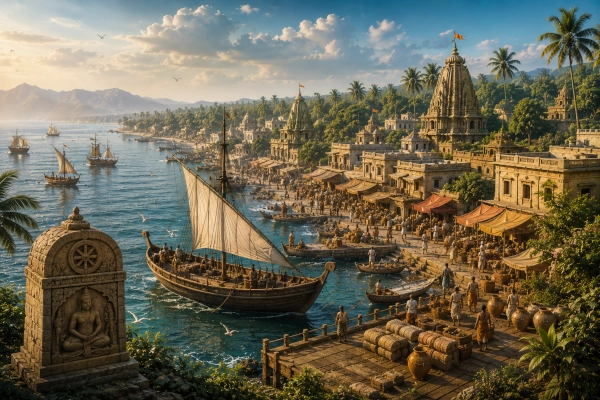
The ancient Surparaka, Shurparaka or Suparaka occupies an unusually strong position in the geographical landscape of the Mahabharata because both the ancient name and its modern location can be identified with considerable confidence. Surparaka is generally identified with Sopara, now Nala Sopara, in Maharashtra’s Palghar district, north of Mumbai. Archaeological Survey of India publications describe Sopara as the ancient emporium of Surparaka in Aparanta or Northern Konkan, while archaeological discoveries at the site confirm that it remained an important religious and commercial centre during the early historical period.
The Mahabharata mentions Surparaka several times and in different contexts. Sahadeva brought it under Yudhishthira’s authority during his southern campaign before the Rajasuya. The Vana Parva remembers it as an exceptionally sacred coastal tirtha visited by Yudhishthira and the Pandavas during their exile, while another passage associates it directly with Parashurama, the son of Jamadagni. The Shanti Parva later relates the remarkable tradition that the Ocean itself created the land of Surparaka for Parashurama.
Surparaka should therefore be understood as more than the name of an ancient port. Within the Mahabharata it represents a sacred coastal region, political territory and pilgrimage centre on India’s western seaboard, while later archaeology reveals that the same place developed into one of the important maritime centres of ancient western India.
Surparaka at a Glance
Surparaka belongs to the Northern Konkan coast of present-day Maharashtra and is most securely centred on modern Nala Sopara and the surrounding Vasai region. It lay within the wider territory known as Aparanta, with the Arabian Sea to the west and the Sahyadri or Western Ghats farther inland. Archaeological Survey of India scholarship explicitly identifies ancient Surparaka with Sopara and places it within Aparanta or northern Konkan.
Unlike Aparanta, which could denote a broader western coastal region, Surparaka had a more specific geographical centre. Ancient Sopara became sufficiently important for the name to refer both to the settlement itself and, in some later epigraphic usage, to a surrounding district. Archaeological scholarship notes the term Soparakahara, suggesting that Surparaka could function as both a city name and a wider territorial designation.
The most useful modern identification is therefore Surparaka → Nala Sopara and adjoining Northern Konkan coast → Maharashtra → India.
Where Was Ancient Surparaka?
Modern Nala Sopara lies within the Vasai-Virar urban region north of Mumbai. The ancient settlement developed within the low-lying coastal landscape of northern Konkan, where creeks, tidal channels, rivers and the Arabian Sea created natural opportunities for maritime activity. The modern city has expanded dramatically, and the shoreline has changed over centuries, so today’s dense urban landscape gives little immediate impression of the great ancient port that once occupied the area.
The identification itself, however, is unusually strong. Archaeological Survey of India publications describe Sopara at approximately 19°25′ N, 72°47′ E as the ancient emporium of Surparaka in northern Konkan. A Government of India urban-development document for Vasai-Virar likewise records Sopara’s ancient name as Shurparaka.
This makes Surparaka one of the Mahabharata locations where textual geography and archaeological geography reinforce one another particularly well.
Surparaka Is Directly Named in the Mahabharata
The Mahabharata does not merely refer vaguely to a western coastal country that scholars later identified with Sopara. The name Surparaka or Suparaka occurs directly in the epic.
The Sabha Parva records Surparaka during Sahadeva’s conquest of southern and western regions before Yudhishthira’s Rajasuya. The Vana Parva later describes the Pandavas reaching Suparaka during their pilgrimage, while another pilgrimage list specifically identifies it as a sacred place associated with Jamadagni’s son. The Shanti Parva adds the tradition explaining how the land itself was created for Parashurama.
Few western coastal sites possess this combination of repeated epic references and a strong modern geographical identification.
Sahadeva Conquers Surparaka Before the Rajasuya
One of the most important references occurs during the preparations for Yudhishthira’s Rajasuya Yajna. To establish his brother’s imperial authority, Sahadeva undertook an extensive campaign through southern and western India.
After subduing several rulers and bringing King Akriti of Saurashtra under Yudhishthira’s authority, Sahadeva continued farther south. The Sabha Parva states that he then reduced Surparaka and Talakata to submission before proceeding into the Dandaka region and toward other coastal peoples.
This passage demonstrates that Surparaka was more than a religious shrine. It possessed sufficient political identity to appear among the regions that Sahadeva brought under Pandava sovereignty.
The epic does not identify the ruler defeated at Surparaka, nor does it provide details of a battle. Nevertheless, its position within Sahadeva’s campaign establishes Surparaka as part of the political geography surrounding Yudhishthira’s Rajasuya.
Surparaka Between Saurashtra and Dandaka
The sequence of Sahadeva’s campaign also provides useful geographical context.
Sahadeva is described as moving from Saurashtra before bringing Surparaka and Talakata under his control and subsequently entering the Dandaka country. This places Surparaka naturally along the western coastal corridor between Gujarat and regions farther south in the Deccan.
That sequence fits the identification with northern Konkan. Saurashtra lies to the north-west across Gujarat, while the wider Dandaka and Deccan landscapes extend south and east beyond the Konkan coast.
The narrative therefore makes geographical sense when Surparaka is placed around modern Nala Sopara.
Yudhishthira Reaches Surparaka During Exile
Surparaka appears again in the Vana Parva, this time not as a conquered territory but as a major sacred destination.
During the Pandavas’ exile, Yudhishthira and his brothers undertook a long tirtha-yatra through many parts of Bharatavarsha. The Mahabharata describes them visiting sacred places along the coast, bathing, offering libations and making gifts before arriving at Suparaka, which the translation describes as among the holiest places encountered on their journey.
The passage is especially valuable because it explicitly places the journey within a coastal landscape. The Pandavas move among sacred places beside the sea before reaching Surparaka, reinforcing its identification as part of India’s western maritime world.
Yudhishthira’s presence also gives the place a direct narrative connection with the Pandavas rather than merely an appearance in a geographical catalogue.
A Sacred Landscape Filled with Shrines
The Vana Parva’s description of Surparaka is unusually rich. After reaching the region, Yudhishthira encounters a celebrated forest where gods and virtuous kings were believed to have performed austerities and sacrifices. He sees the famous altar associated with Richika’s son, a reference connected with the Bhargava tradition surrounding Parashurama, and the surrounding landscape contains shrines dedicated to numerous deities.
Yudhishthira observes religious vows, gives away wealth and bathes at the sacred places before eventually returning to Surparaka and continuing toward Prabhasa in western Gujarat.
The sequence places Surparaka within a broader chain of western Indian pilgrimage centres connecting the Konkan with Saurashtra and the sacred coast around Prabhasa.
The Tirtha of Parashurama
Another Vana Parva passage gives Surparaka its most important sacred association. The text instructs pilgrims to proceed to Surparaka, where Jamadagni’s son had formerly dwelt, and says that bathing at this tirtha of Rama produced great religious merit.
The Rama in this context is Bhargava Rama or Parashurama, son of Jamadagni and Renuka. He occupies an unusual place in the Mahabharata as both a great ascetic and one of the most formidable warriors of an earlier age.
Parashurama is connected with several major Mahabharata figures. Bhishma encounters him in the story of Amba, while Karna receives weapons instruction from him before being cursed after concealing his identity. His association with Surparaka therefore connects this coastal region with one of the epic’s most important figures from the generation before the Kurukshetra heroes.
The Ocean Creates Surparaka for Parashurama
The most dramatic account of Surparaka appears in the Shanti Parva.
Bhishma recounts that after Parashurama had repeatedly destroyed the Kshatriyas, he performed a sacrifice and gave the conquered earth to Kashyapa. Because the land had now been donated, Kashyapa told Parashurama that he should no longer continue living within it and instructed him to withdraw toward the ocean.
The Mahabharata then states that the Ocean created a region called Surparaka for Jamadagni’s son.
This is one of the earliest forms of the celebrated western Indian tradition in which Parashurama obtains land from the sea. Later legends dramatically expand the story and associate Parashurama with the creation of large sections of the Konkan and Malabar coasts, but the Mahabharata itself specifically names Surparaka.
Surparaka and the Parashurama-Kshetra Tradition
The later idea of Parashurama Kshetra grew far beyond the immediate Surparaka landscape. Over time, different traditions connected Parashurama with much of India’s western coast, extending from Maharashtra through Goa, Karnataka and Kerala.
For Mahabharata geography, however, the distinction matters. The epic’s Shanti Parva does not provide a modern cartographic description of the entire western coast being reclaimed from the sea. It specifically states that the Ocean created Surparaka for Parashurama.
Surparaka can therefore be regarded as one of the earliest textual centres from which the much broader Parashurama-and-the-western-coast tradition developed.
Surparaka and Aparanta
Surparaka and Aparanta are closely related but should not be presented as identical geographical terms.
Aparanta was the wider western or north-Konkan region, while Surparaka was one of its most important centres. Archaeological Survey of India scholarship describes Sopara as the ancient Surparaka in Aparanta, explicitly identifying Aparanta with northern Konkan.
This distinction is useful when reconstructing the Mahabharata map. Aparanta should cover a broader stretch of northern Konkan, whereas Surparaka should receive a more concentrated marker around Nala Sopara and the Vasai coastal zone.
In later sources, the name Surparaka could also describe a surrounding district, but the archaeological and textual heart of the identification remains Sopara.
Was Surparaka a City or a Region?
The Mahabharata itself allows both possibilities to some degree.
The Shanti Parva calls Surparaka a desha or region created for Parashurama. The Vana Parva treats it as a sacred destination containing multiple tirthas, forests, sacrificial places and shrines. The Sabha Parva lists it among territories brought under Sahadeva’s authority.
Later inscriptional evidence similarly suggests that Surparaka could refer to both an important settlement and a surrounding administrative territory. Archaeological research notes the term Soparakahara, indicating a district associated with the city.
It is therefore safest to understand ancient Surparaka as a major coastal settlement that gave its name to a surrounding regional territory, rather than attempting to force the ancient evidence into a modern distinction between city and district.
Was Surparaka the Capital of Aparanta?
Later historical scholarship frequently describes Sopara as the capital or principal centre of Aparanta, especially during the early historical period. Maharashtra’s historical traditions and epigraphic studies strongly associate the city with the political and commercial life of northern Konkan.
The Mahabharata itself does not explicitly state, however, that “Surparaka was the capital of Aparanta.” Such terminology belongs more securely to later historical reconstruction.
For the epic period, the most accurate description is therefore “Surparaka — major sacred and political centre of the western coast, later securely associated with Aparanta/Northern Konkan.”
No Secure Mahabharata Ruler of Surparaka
The Mahabharata records Sahadeva bringing Surparaka under his authority, but it does not identify the local king who opposed or submitted to him.
This means that a named “King of Surparaka” should not be inserted into a Mahabharata geographical profile without stronger textual evidence. Later Buddhist, Jain and regional traditions mention various rulers connected with Sopara, but these belong to different historical or legendary contexts.
Surparaka’s Mahabharata significance comes primarily from Sahadeva’s conquest, Yudhishthira’s pilgrimage and Parashurama’s sacred association, rather than from a famous royal dynasty.
Nala Sopara Provides the Strongest Modern Identification
The identification of ancient Surparaka with Sopara/Nala Sopara is supported by far more than similarity of names.
Archaeological Survey of India scholarship explicitly states that modern Sopara represents the ancient emporium of Surparaka in Aparanta. Epigraphia Indica likewise identifies the site as ancient Surparaka while discussing inscriptions discovered there.
The site also preserves substantial archaeological evidence demonstrating its importance during later centuries. This does not prove every Mahabharata event historically, but it makes the geographical identification exceptionally strong.
For the Dharmakshethra Mahabharata map series, Nala Sopara should therefore be treated as the principal modern anchor for Surparaka.
One of Western India’s Great Ancient Ports
Surparaka eventually became one of the important ports of India’s western coast.
Archaeological studies describe Sopara as an ancient emporium and an important commercial centre. Research on the site identifies its role in networks linking the coastal region with the Deccan hinterland and with long-distance maritime routes across the Arabian Sea.
Its position made this development natural. Northern Konkan lies close to major passes through the Western Ghats, giving merchants access to the interior while the Arabian Sea opened routes toward Gujarat and the wider Indian Ocean.
The sacred Surparaka of the Mahabharata consequently occupied the same geographical setting that later became a major commercial gateway.
The Ashokan Edicts of Sopara
Among the strongest archaeological indications of Sopara’s later importance are fragments of Emperor Ashoka’s Major Rock Edicts.
In 1882, scholar Bhagwanlal Indraji discovered a fragment of Rock Edict VIII near Sopara. Another fragment containing part of Rock Edict IX was discovered in the same general area in 1956. Epigraphia Indica identifies the location directly as Sopara, ancient Surparaka in Aparanta.
India’s 2025 UNESCO tentative nomination for Ashokan edict sites also includes Sopara among the locations preserving Major Rock Edict evidence.
These inscriptions belong to the Mauryan period and therefore cannot be used as evidence for dating the Mahabharata narrative. What they establish is that the place identified with epic Surparaka was already an important centre by the third century BCE.
The Buddhist Stupa at Nala Sopara
Sopara also developed into an important Buddhist centre.
The Archaeological Survey of India has documented and conserved the Buddhist stupa at Nala Sopara, locally known as Burud Rajacha Kot. The ASI describes Sopara or Shurparaka as one of India’s oldest ports and explicitly notes its appearance in the Mahabharata’s Aranyaka or Vana Parva during the Pandavas’ western pilgrimage.
The stupa was excavated by Bhagwanlal Indraji in 1882, revealing relic deposits and demonstrating the site’s importance within western India’s Buddhist network. Archaeological evidence and inscriptions from other Buddhist centres also record people and donors connected with Sopara.
Surparaka consequently developed from a sacred site remembered in Sanskrit epic tradition into a centre important to Buddhist religious history as well.
Merchants from Surparaka
Inscriptions from western Indian Buddhist caves reveal the commercial strength of the city.
Archaeological studies note donors identified as merchants, jewellers and residents from Sopara at sites including Kanheri, Karla, Nashik and Naneghat. Such inscriptions show that Surparaka participated in an economic network extending from the Konkan coast across the Western Ghats and into the Deccan.
This evidence is significant because ancient trade depended upon more than ships. Coastal ports needed merchants, caravan routes, financiers, craftspeople and inland markets.
Surparaka’s prosperity was therefore tied to its position between the Arabian Sea and the plateau routes of western India.
A Gateway Between Sea and Deccan
The geography of northern Konkan explains why Surparaka became important.
The coast is separated from the Deccan plateau by the Sahyadri or Western Ghats, but passes through the mountains allowed people and commodities to move between the interior and the Arabian Sea. Agricultural goods, textiles, forest products and other materials could travel toward coastal markets, while imported goods could move inland.
Surparaka’s maritime role therefore depended upon a much larger geographical system. The port faced the Arabian Sea, but its commercial hinterland extended eastward toward the Deccan.
This combination of maritime access and inland communication made northern Konkan strategically valuable throughout later Indian history.
Surparaka and the Arabian Sea
The sea is fundamental to the identity of Surparaka in both the Mahabharata and later history.
The Vana Parva explicitly places Yudhishthira’s journey among sacred places on the coast of the sea before he reaches Suparaka. The Shanti Parva then makes the Ocean itself an actor in the region’s sacred mythology by describing it as creating Surparaka for Parashurama.
Later archaeological history adds a commercial dimension to the same maritime geography. Sopara became a port connected with western Indian and overseas networks.
Surparaka is therefore one of the clearest Mahabharata locations in which the western ocean is not merely a boundary but an integral part of the story.
Surparaka and Prabhasa
The Vana Parva provides an especially useful connection between Surparaka and Prabhasa in Saurashtra.
After completing his religious observances around Surparaka, Yudhishthira continues along the maritime landscape until he reaches Prabhasa, the great sacred site associated with modern Prabhas Patan and Somnath in Gujarat.
This connection demonstrates that the Mahabharata imagined western India’s sacred coast as an interconnected pilgrimage landscape.
Surparaka in northern Konkan and Prabhasa in Saurashtra were separated by a considerable distance, yet both formed part of the Pandavas’ sacred geography along the western sea.
Surparaka and Dandaka
Sahadeva’s Rajasuya campaign connects Surparaka in another direction.
After bringing Surparaka and Talakata under his authority, the Pandava prince continued toward the Dandakas and other southern peoples.
The passage helps locate Surparaka near the transition between western coastal Maharashtra and the larger Deccan world. The Dandaka tradition itself covered an enormous and imprecisely defined forest region extending across parts of central and southern India.
Surparaka therefore stood near the north-western approaches to this broader southern landscape.
Surparaka Was More Specific Than Aparanta
The distinction between Surparaka and Aparanta is especially important because both are connected with northern Konkan.
Aparanta is the broader regional term. Depending on the period and source, it can mean northern Konkan specifically or western India more generally.
Surparaka is much more geographically concentrated. Its strongest identification centres on Nala Sopara, while the Mahabharata also uses the name for a surrounding sacred or territorial region.
On a reconstruction of ancient western India, Aparanta should therefore form the larger coastal zone while Surparaka appears as its most important named Mahabharata location.
Ancient Surparaka and Modern Coastal Maharashtra
The landscape surrounding ancient Surparaka has changed dramatically.
Modern Nala Sopara forms part of the densely populated Vasai-Virar metropolitan area, while Mumbai lies farther south. Urban growth, sedimentation and changing coastal geography have transformed many of the creeks and shoreline environments that would have shaped the ancient port.
The ancient site should therefore not be imagined simply by looking at today’s shoreline. Sopara’s maritime importance developed within an earlier coastal environment in which tidal channels and navigable waterways would have connected the settlement more directly with the Arabian Sea.
Archaeological remains beneath and around the modern city preserve fragments of this much older landscape.
The Name Survives in Sopara
The continuity of the place-name itself is striking.
Ancient texts and inscriptions preserve variants such as Surparaka, Shurparaka, Suparaka and Soparaka, while the settlement eventually became known simply as Sopara. Modern urban development has produced the familiar name Nala Sopara. Archaeological and historical scholarship consistently connects these forms.
Such linguistic continuity adds another layer to the geographical identification.
The Mahabharata’s Surparaka has not disappeared behind an entirely unrelated modern name. Its ancient identity survives recognisably within the name Sopara itself.
From Mahabharata Tirtha to Mauryan Port
Surparaka provides an excellent example of how Dharmakshethra’s Mahabharata geography can be connected with later historical evidence without confusing the two periods.
The epic remembers Surparaka as a sacred coastal land visited by Yudhishthira, conquered by Sahadeva and associated with Parashurama. Later archaeological and inscriptional evidence reveals an important port, Ashokan edicts, a Buddhist stupa and merchant communities connected with some of western India’s major religious centres.
The later evidence does not prove the Mahabharata stories as historical events. Instead, it demonstrates that the geographical location preserved by the epic corresponds to a real ancient centre whose importance continued through subsequent centuries.
That distinction strengthens rather than weakens the identification.
Why Surparaka Matters in Mahabharata Geography
Surparaka is particularly valuable because it appears in the Mahabharata in political, sacred and legendary contexts simultaneously.
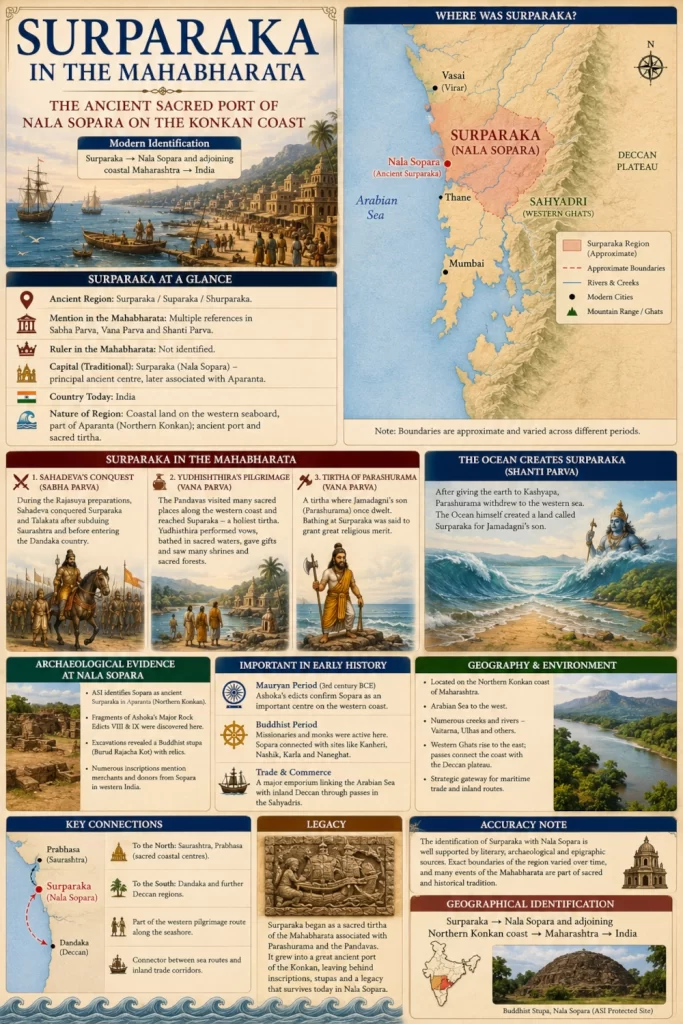
Sahadeva’s conquest shows its place in the political world preceding Yudhishthira’s Rajasuya. Yudhishthira’s pilgrimage demonstrates its importance as a tirtha. The Parashurama tradition connects it with one of the great warrior-sages of the epic, while the Shanti Parva’s story of the ocean creating Surparaka gives the region a distinctive sacred origin.
Few Mahabharata locations along India’s western coast possess so many independent points of contact with the text.
The Legacy of Surparaka
Today, little about the dense urban landscape of Nala Sopara immediately suggests the ancient sacred port described in literary and archaeological sources. Yet beneath the modern city lies one of western India’s most important ancient geographical identities.
The Mahabharata remembers Surparaka as a coastal territory subdued by Sahadeva, as a sacred place visited by Yudhishthira and as the land connected forever with Parashurama. The epic even preserves the remarkable tradition that the Ocean itself created Surparaka for Jamadagni’s son.
Centuries later, the same location became an important maritime and Buddhist centre. Ashokan edicts were erected there, merchants from Sopara appear in inscriptions across western India, and a Buddhist stupa preserves evidence of the city’s religious importance. Archaeological Survey of India publications identify the site directly with ancient Surparaka.
Among the geographical locations of the Mahabharata, Surparaka therefore offers an unusually compelling combination of textual continuity, surviving place-name, archaeological evidence and geographical logic.
Its most accurate modern identification is Surparaka → Nala Sopara and the adjoining northern Konkan coast → Maharashtra → India.
Seen through the Mahabharata, however, Surparaka was far more than an ancient port. It was a sacred land beside the western ocean, a tirtha of Parashurama, a destination of Yudhishthira’s pilgrimage and a coastal territory brought into Yudhishthira’s imperial sphere by Sahadeva. That combination makes Surparaka one of the strongest anchors for reconstructing the Mahabharata’s western coastal geography.
You may also like
-
Samatata — The Low-Lying Deltaic Realm of Southeastern Bengal
-
Tamralipta — The Maritime Gateway of the Lower Ganga
-
Suhma — The River-and-Forest Country of Southwestern Bengal
-
Gauda — The Western Bengal Country of the Bhagirathi and the Rise of Karnasuvarna
-
Pundra — The Northern Bengal Kingdom of the Karatoya and the Ancient City of Pundranagara
