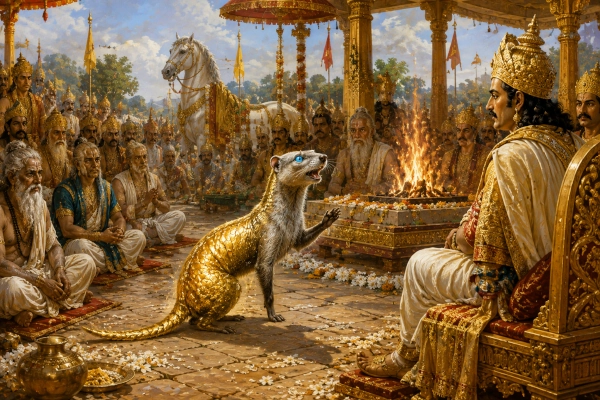
After the devastation of the Kurukshetra War, Yudhishthira eventually performed the Ashvamedha Yajna, the great horse sacrifice associated with royal sovereignty. The ceremony was conducted on an enormous scale, with kings, sages, Brahmanas, relatives, guests and the poor receiving food, honours and generous gifts. It appeared to be one of the greatest religious and charitable acts of Yudhishthira’s reign, yet the Mahabharata introduces an extraordinary visitor at the very moment when the sacrifice seems to have reached its glorious conclusion.
A strange mongoose with blue eyes and half its body shining like gold entered the sacrificial ground. To the astonishment of everyone present, the animal spoke in a human voice and declared that Yudhishthira’s magnificent Ashvamedha did not equal the merit of a small quantity of powdered barley once given away by a poor Brahmana family at Kurukshetra. The statement seemed almost impossible to accept, because the emperor had distributed enormous wealth while the family mentioned by the mongoose had possessed almost nothing. The mongoose therefore began telling the story that explained both its golden body and the deeper meaning of true sacrifice.
Yudhishthira’s Great Ashvamedha
The Kurukshetra War had given the Pandavas their kingdom, but victory brought little joy to Yudhishthira. Countless warriors had died, much of the Kuru family had been destroyed, and Yudhishthira remained troubled by the enormous human cost of becoming king. In the years that followed, he sought to restore order and fulfil his responsibilities as ruler while also attempting to overcome the grief and guilt left by the war.
Under the guidance of Vyasa, Krishna and other elders, Yudhishthira undertook the Ashvamedha. Arjuna followed the sacrificial horse as it travelled through different kingdoms, meeting rulers who either acknowledged Yudhishthira’s sovereignty or challenged the Pandava warrior. Once the horse returned, the concluding ceremonies were performed with elaborate rituals, abundant food and the distribution of extraordinary wealth.
Those attending praised Yudhishthira’s generosity and the magnificence of the sacrifice. It was precisely at this moment, when royal splendour and religious achievement appeared unquestionable, that the golden mongoose arrived and challenged the assumption that the largest sacrifice must necessarily be the greatest.
The Mongoose Makes a Startling Declaration
The appearance of the mongoose immediately attracted attention because one half of its body possessed an extraordinary golden colour while the other half remained ordinary. It walked among the participants and announced that all the wealth and ritual grandeur of the Ashvamedha could not equal the merit created by a humble family that had once offered a small quantity of barley to a hungry guest.
The assembled sages naturally wanted to know how such a comparison could possibly be justified. Yudhishthira had spent vast resources feeding guests and giving away wealth, while the sacrifice had involved great preparation and the participation of distinguished priests. The mongoose answered by telling them about a poor Brahmana who had lived with his wife, son and daughter-in-law in Kurukshetra.
The Poor Family of Kurukshetra
The Brahmana and his family lived according to an extremely austere way of life. They survived through the practice known as Unccha, gathering individual grains that remained scattered in fields after farmers had completed the harvest. They accumulated no large stores of food and possessed little material security, depending instead upon what their daily effort allowed them to find.
Their already difficult existence became desperate when a severe famine struck the region. Food disappeared from the fields, vegetation dried up and even the scattered grains on which the family depended became almost impossible to obtain. The Brahmana, his wife, his son and his daughter-in-law endured prolonged hunger, yet they continued observing their disciplined way of life.
After considerable effort, the Brahmana finally managed to obtain a small quantity of barley. For a family suffering from extreme hunger, the grain was enormously valuable because it represented their first real opportunity in some time to eat and regain a little strength.
The Family Prepares Its Meal
The family ground the barley into saktu, or powdered barley, and divided it into four portions. Each member received an equal share, and although the amount was small, the food meant a great deal to people who had already endured prolonged hunger.
They prepared to eat after completing their religious duties. Every portion had been obtained through honest effort, and every member of the family urgently needed nourishment. At that moment, however, an unexpected guest arrived at their home and asked for hospitality.
The ancient ideal of welcoming an atithi, an unexpected guest, carried great importance. Despite their own desperate condition, the family received the stranger respectfully. The Brahmana then placed his own portion of barley before the guest rather than eating it himself.
The Brahmana Gives Away His Share
The guest consumed the Brahmana’s portion, but his hunger remained unsatisfied. The Brahmana had already surrendered the only food allocated to him, and there was nothing else in the household except the portions belonging to his wife, son and daughter-in-law.
Seeing the situation, the Brahmana’s wife offered her share. She was herself weak from hunger, and her husband initially resisted because he believed it was his duty to protect and nourish her. The woman nevertheless insisted that a guest who had entered their home should not leave hungry while food remained with them.
The Brahmana eventually accepted her request and gave the second portion to the guest. The stranger ate it, but astonishingly he was still hungry.
The Son Gives Away His Meal
The son then came forward and offered his own portion. His father hesitated again because a parent naturally wished to preserve the life and strength of his child, particularly during a famine. The son, however, argued that helping his father fulfil the duty of hospitality was itself part of his responsibility.
His portion was therefore given to the guest as well. The stranger consumed the third share, yet his hunger remained unsatisfied, leaving only the small quantity of food belonging to the daughter-in-law.
The entire family now understood what giving away the final portion would mean. None of them would have anything left to eat, despite having already suffered greatly from hunger.
The Daughter-in-Law Gives the Last Portion
The daughter-in-law approached her father-in-law and voluntarily offered her share of the barley. The Brahmana was deeply reluctant because she was the youngest member of the household, already weakened by hunger and deserving of the family’s protection.
She nevertheless insisted that she too wished to participate in the act of hospitality. The Brahmana finally accepted her decision and offered the final portion to the stranger. With this last gift, the family had surrendered everything they had obtained.
Measured by quantity, their offering was tiny. There were no jewels, cattle, palaces or mountains of grain. Yet every grain they gave away had enormous value because it was food they desperately needed for themselves.
The Guest Reveals Himself as Dharma
After receiving the final portion, the mysterious visitor revealed his true identity. He was Dharma, the divine embodiment of righteousness, who had come in disguise to test the family.
Dharma praised them for overcoming one of the strongest instincts of the human body: hunger. Each member of the household had needed the food, yet each voluntarily surrendered it so that another person could eat. Their generosity had not arisen from abundance but from genuine deprivation.
Their gift had also been acquired honestly through their own labour. They had not accumulated wealth through wrongdoing and then offered a small part of it in charity. The very food necessary for their survival had been obtained through hardship and then freely surrendered without knowing that their guest was divine.
Because of the extraordinary purity of their sacrifice, Dharma blessed the family. Their humble act became greater in spiritual merit than many outwardly magnificent ceremonies.
How the Mongoose Became Half Golden
The mongoose explained that it had later come to the place where the family’s offering had occurred. When its body touched the ground and the remnants associated with the sacrifice, one half of the animal miraculously turned into gold.
The mongoose realised that the transformation reflected the extraordinary merit of the family’s act. It then began travelling to other religious sacrifices, hoping to find another ceremony of equal purity that would cause the remaining half of its body to become golden.
It visited many great sacrificial grounds, but nothing happened. The ordinary half of its body remained unchanged because none of the ceremonies it encountered produced the same effect.
When the mongoose heard of Yudhishthira’s magnificent Ashvamedha, it believed that it might finally have found a sacrifice equal to the humble offering of the starving family.
Yudhishthira’s Ashvamedha Fails the Test
The mongoose came to Yudhishthira’s sacrificial ground and exposed the remaining portion of its body to the merit of the ceremony. Despite the enormous wealth distributed by the king and the elaborate rituals performed by learned priests, the other half of the mongoose did not become golden.
The animal therefore declared that the Ashvamedha had not equalled the sacrifice of the poor family. This did not mean that Yudhishthira’s generosity was meaningless. Instead, the comparison revealed that the greatness of a charitable act cannot be calculated simply by measuring the amount of wealth being given away.
Yudhishthira had given enormously, but he remained an emperor with immense resources. The Brahmana family had offered only a little barley, yet that barley represented almost everything they possessed at a moment when they desperately needed it themselves.
The True Measure of Giving
The mongoose’s story asks an important question: should generosity be measured by the absolute size of a gift or by what that gift means to the person giving it? A king can distribute great quantities of wealth and still retain a kingdom, while someone who possesses almost nothing may make a far greater personal sacrifice by giving away a small meal.
The Brahmana family did not give from surplus. They gave while starving. Their offering therefore contained an element of self-denial that could not easily be reproduced through royal wealth.
The Mahabharata does not argue that large-scale charity has no value. Yudhishthira’s generosity benefited many people and was itself regarded as righteous. The story instead warns against assuming that visible grandeur automatically represents greater virtue.
The Difference Between Wealth and Sacrifice
Yudhishthira’s Ashvamedha required vast resources, political authority and elaborate organisation. The Brahmana family’s sacrifice required none of these things. It took place in an impoverished household during a famine, without witnesses, public praise or the expectation that anyone would remember what had happened.
Yet the family gave away something that possessed greater immediate value to them than enormous riches might possess to a king. Their offering involved real personal cost, and this willingness to surrender what they desperately needed gave their act its exceptional moral weight.
The episode therefore expands the meaning of sacrifice beyond formal ritual. True sacrifice involves giving up something that matters to the giver rather than simply disposing of what can easily be spared.
Dharma Arrives in an Ordinary Form
Another important aspect of the story is that the family did not know their guest was Dharma. Had a god appeared openly before them, surrounded by divine signs, giving him food might have been motivated by the expectation of blessing or reward.
Instead, Dharma arrived as an ordinary hungry traveller. The family believed that they were helping someone who could offer them nothing in return, which meant that their generosity emerged from duty and compassion rather than self-interest.
The Mahabharata repeatedly uses such disguised tests to reveal character. Dharma becomes meaningful precisely when a person must act without knowing that the gods are watching.
Kurukshetra and Two Very Different Sacrifices
The fact that the poor family lived in Kurukshetra adds another layer of meaning to the story. The same landscape later became the battlefield on which armies were destroyed and countless warriors sacrificed their lives during the struggle between the Pandavas and Kauravas.
Yet the mongoose remembers another kind of sacrifice from Kurukshetra. There were no chariots, celestial weapons or heroic warriors in the Brahmana’s home. There were only four hungry people and a small amount of food.
By placing these different forms of sacrifice within the same sacred landscape, the Mahabharata reminds its audience that moral greatness does not always appear through spectacular events. An unknown family performing a quiet act of compassion can possess a greatness equal to, or even greater than, the achievements of kings.
An Anonymous Family Is Compared with an Emperor
Yudhishthira stands at the centre of the Mahabharata and belongs to one of the greatest royal families of the epic age. His victories, failures, suffering and moral struggles are remembered across generations. The Brahmana family, by contrast, appears only briefly and possesses none of the king’s fame.
Nevertheless, when Yudhishthira completes one of the greatest ceremonies available to an emperor, the sacrifice of this forgotten family becomes the standard against which his achievement is measured. The contrast shows that dharma does not depend upon social position, political authority or public recognition.
An unknown person living in poverty can perform an act of generosity greater than the ceremony of a celebrated ruler. The Mahabharata therefore places moral worth beyond the boundaries of wealth and status.
The Meaning of the Half-Golden Body
The mongoose’s body becomes a powerful symbol within the story. Its golden half preserves the memory of the starving family’s extraordinary generosity, while its ordinary half challenges every subsequent sacrifice to equal that achievement.
If another ceremony possessed the same moral purity, the remaining half would become golden. Yudhishthira’s Ashvamedha fails to produce this transformation, showing that external magnificence alone cannot reproduce the depth of the family’s sacrifice.
The visual image makes the teaching immediately memorable. One half of the animal represents what genuine selflessness can accomplish, while the unchanged half demonstrates how rare such sacrifice truly is.
The Story Does Not Condemn Yudhishthira
The mongoose’s declaration should not be understood as an accusation that Yudhishthira had acted wrongly. The king had performed the Ashvamedha according to the traditions of his time and had distributed wealth generously among those who attended.
The purpose of the mongoose is instead to prevent magnificence from becoming pride. Yudhishthira is reminded that even an emperor celebrated for righteousness cannot assume that his grandest public ceremony surpasses every quiet act of goodness performed by ordinary people.
The Mahabharata therefore introduces humility at the very height of royal glory. Yudhishthira’s achievement remains significant, but it does not become the ultimate measure of dharma.
Wealth Cannot Purchase Righteousness
The episode offers one of the Mahabharata’s clearest warnings against believing that spiritual merit can simply be purchased through wealth. Money can certainly be used to relieve suffering, feed people and support worthy causes, but the amount spent does not by itself determine the moral quality of an action.
The intention behind a gift matters, as does the manner in which the wealth was obtained and the sacrifice made by the giver. A small gift offered sincerely by someone who possesses little can carry a different moral weight from a much larger donation that requires no personal sacrifice.
The Brahmana family’s barley was honestly acquired, urgently needed and freely surrendered. These qualities made an apparently insignificant meal greater than a royal display of wealth.
Generosity Without Recognition
The family also expected no praise for what they did. There was no crowd watching them and no priest announcing their generosity. They did not know that future generations would hear their story, nor did they know that their guest was Dharma.
Their sacrifice took place quietly inside a poor household. The only reason anyone later learned of it was because the mongoose preserved its memory.
This anonymity strengthens the moral message because the family gave without reputation becoming part of the reward. Their compassion existed independently of recognition.
The Ashvamedha Ends with a Lesson in Humility
The placement of the mongoose episode at the conclusion of Yudhishthira’s Ashvamedha is deliberate. The Ashvamedha represents royal authority, wealth and ceremonial grandeur, and Yudhishthira had reached a moment when everyone around him was praising his generosity.
The mongoose suddenly introduces another measure of greatness. It tells the emperor that somewhere in Kurukshetra, an unknown starving family once gave away a handful of food that possessed greater merit than all the wealth surrounding the royal sacrifice.
The Mahabharata therefore refuses to allow grandeur to have the final word. It ends the ceremony by reminding Yudhishthira and everyone present that true dharma can exist just as powerfully in the poorest household as in the palace of an emperor.
The Final Lesson of the Golden Mongoose
The story of the golden mongoose is ultimately about the difference between the size of a gift and the depth of a sacrifice. Yudhishthira gave away enormous wealth during his Ashvamedha, but the poor Brahmana family gave away the only food they had while suffering from severe hunger.
The family’s offering was tiny when measured materially, yet enormous when measured according to what they surrendered. They acted without knowing that Dharma stood before them and without expecting recognition or reward. Their generosity came entirely from their willingness to place the need of another person above their own immediate suffering.
That is why half of the mongoose became golden. It travelled from one magnificent sacrifice to another searching for an act capable of reproducing the merit of that simple meal, but even Yudhishthira’s Ashvamedha could not complete the transformation.
The Mahabharata therefore leaves behind a timeless lesson through one of its most unusual characters. True generosity is not measured by how impressive the gift appears to the world, but by the sincerity, compassion and sacrifice behind it. Yudhishthira gave away the wealth of an emperor before thousands of witnesses, while a starving family quietly gave away its final meal to a stranger. In the eyes of Dharma, the humble handful of barley was the greater sacrifice.
You may also like
-
Yudhishthira and the Faithful Dog: The Final Test of Dharma on the Road to Heaven
-
Indian Indology and Sanskrit Programmes Build Growing Academic Presence in Poland
-
IAF and IIT Bombay Join Hands for Master’s-Level Education of India’s Flight Test Crew
-
Sanjaya’s Embassy to the Pandavas: The Messenger Who Had to Speak for a Policy He Did Not Fully Support
-
Krishna and the Hunter Jara: The Final Moment of Krishna’s Earthly Life
