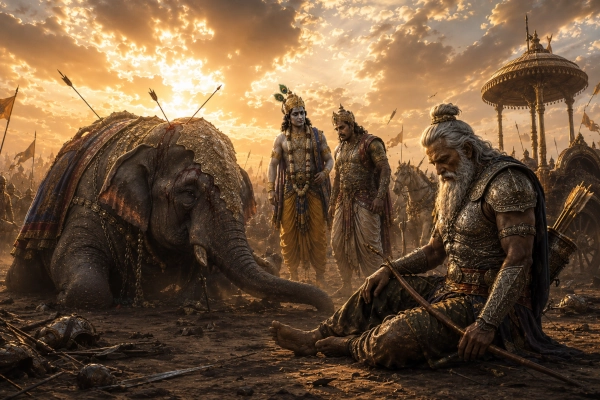
Among the many morally difficult episodes of the Mahabharata, few are as famous as the deception that led to the death of Dronacharya, the great teacher of the Kauravas and Pandavas. At the centre of the episode stood an elephant that happened to bear the same name as Drona’s beloved son—Ashwatthama.
By the time the war at Kurukshetra reached this stage, Drona had become almost impossible to stop. His mastery of weapons, knowledge of celestial astras and experience in warfare allowed him to cut through the Pandava forces with devastating effect. Krishna understood that defeating him through ordinary combat would be extraordinarily difficult.
Drona, however, possessed one weakness stronger than any weapon.
It was his love for his son.
Dronacharya Becomes Unstoppable
After the fall of Bhishma, Drona became commander of the Kaurava army. Once he took command, the fighting became increasingly destructive.
Drona was no ordinary warrior. He had trained many of the greatest fighters on both sides of the battlefield, including Arjuna, Bhima, Yudhishthira, Duryodhana and Ashwatthama. He understood their strengths, their habits and the techniques they were likely to use against him.
When Drona fought with his full power, ordinary soldiers could hardly approach him.
Arrows poured from his bow so rapidly that they seemed to cover the sky. Chariots shattered before him, elephants fell, cavalry formations broke apart and large sections of the Pandava army were driven backwards.
The Pandavas soon realised that as long as Drona remained fully armed and determined to fight, defeating him might be impossible.
Krishna began searching for another way.
Drona’s Greatest Attachment
For all his discipline as a warrior and teacher, Drona possessed a deep emotional attachment to his son Ashwatthama.
Ashwatthama had been born after years of hardship in Drona’s household. Ancient accounts describe Drona as having lived in poverty before entering the court of Hastinapura. His love for his only son therefore ran extremely deep.
Krishna understood that Drona might continue fighting even against overwhelming military pressure, but the news of Ashwatthama’s death could destroy his will to fight.
A plan began to form.
The problem was obvious.
Ashwatthama was still alive.
An Elephant With the Same Name
Among the forces fighting at Kurukshetra was an elephant named Ashwatthama.
The coincidence of names created the opportunity Krishna needed.
According to the Mahabharata narrative, Bhima went into battle against the elephant. Wielding his tremendous strength and weapons, he attacked the animal and killed it.
The elephant Ashwatthama fell upon the battlefield.
Bhima then began loudly proclaiming:
“Ashwatthama has been killed!”
Technically, the statement was true.
But Drona naturally understood the name to refer to his son.
Drona Refuses to Believe Bhima
Drona heard the cries that Ashwatthama had died.
For a moment, the words struck him with terrible force. Yet he knew the nature of war and understood that enemies might deliberately spread false information to weaken him.
He did not immediately believe Bhima.
Drona knew that Bhima could use deception in battle if necessary. The great teacher therefore sought confirmation from someone whose word he believed could never be false.
That man was Yudhishthira.
Yudhishthira had built his entire reputation around truthfulness. Even his enemies trusted his word. Tradition describes his commitment to truth as so extraordinary that his chariot travelled slightly above the earth.
If Yudhishthira confirmed Ashwatthama’s death, Drona believed, then the news had to be true.
Drona turned toward him and asked whether his son had really been killed.
The entire plan now depended upon Yudhishthira.
Yudhishthira Faces an Impossible Choice
For Yudhishthira, the moment created an enormous moral crisis.
He knew that Ashwatthama, Drona’s son, was alive.
He also knew that the elephant named Ashwatthama had genuinely been killed.
Krishna urged him to use this distinction.
If Yudhishthira refused, Drona could continue destroying thousands of Pandava soldiers. If he directly lied, however, Yudhishthira would violate one of the principles upon which he had built his entire life.
The choice was not simply between truth and falsehood.
It was between maintaining absolute truthfulness and preventing further slaughter.
Yudhishthira finally agreed to speak.
“Ashwatthama Is Dead”
Yudhishthira declared that Ashwatthama had been killed.
He then added words indicating that he meant the elephant rather than Drona’s son.
The Mahabharata tradition preserves the famous expression in various forms, often rendered as:
“Ashwatthama is dead—whether man or elephant.”
Krishna and the Pandava forces ensured that the qualifying words were obscured by the sudden sound of drums, conches and battlefield noise.
Drona clearly heard only the first part.
Ashwatthama was dead.
And because Yudhishthira had spoken the words, he believed them.
The Warrior Inside Drona Collapses
Drona’s strength did not disappear because an enemy had wounded him.
His will disappeared.
The thought that his beloved son had died broke something inside the great warrior. The reason for continuing the battle suddenly seemed meaningless.
Around him, Kurukshetra continued to roar with arrows, chariots, elephants and men. Yet Drona’s mind had turned away from war.
He lowered his weapons.
The commander who moments earlier had seemed almost unstoppable now became detached from everything happening around him.
Drona sat upon his chariot and entered a state of meditation, withdrawing his mind from the battlefield.
It was the moment the Pandavas had been waiting for.
Dhrishtadyumna Approaches Drona
Drona had another enemy on the battlefield whose destiny had always been connected with his death.
Dhrishtadyumna, son of King Drupada, had been born from a sacrificial fire specifically for the purpose of killing Drona.
The history between Drona and Drupada stretched back many years.
The two had once been childhood companions, but their friendship collapsed after Drupada rejected Drona when he came seeking assistance. Drona later humiliated Drupada through his students, creating an enmity that eventually resulted in Dhrishtadyumna’s birth.
Now the prophecy surrounding him approached fulfilment.
Seeing Drona unarmed and absorbed in meditation, Dhrishtadyumna moved toward him.
Some warriors protested. Arjuna, who continued to respect Drona as his teacher despite fighting against him, reportedly urged that Drona should not be killed in such a condition.
Dhrishtadyumna did not stop.
He struck down the great teacher and killed him.
Thus Dronacharya, one of the mightiest warriors of the Mahabharata, fell not because someone defeated him in a straightforward contest of weapons, but because grief caused him to abandon them.
Ashwatthama Was Still Alive
The bitterest part of the episode was that Drona’s son was still fighting elsewhere on the battlefield.
The real Ashwatthama had not died.
When he later learned how his father had been deceived and killed, his grief transformed into furious anger.
That anger would have terrible consequences.
Ashwatthama unleashed the Narayanastra against the Pandava army and, after the formal fighting ended, carried out the infamous night attack on the Pandava camp in which Dhrishtadyumna, Shikhandi and the sons of Draupadi were killed.
The deception that brought down Drona therefore did not end the violence associated with his family.
It created another cycle of vengeance.
The Price Yudhishthira Paid
The Mahabharata does not present Yudhishthira’s statement as morally simple.
Until this moment, tradition says that Yudhishthira’s chariot travelled slightly above the ground because of his perfect commitment to truth.
After he spoke the ambiguous words concerning Ashwatthama, his chariot descended and touched the earth.
The symbolism is powerful.
Yudhishthira had not spoken a completely false sentence. An elephant named Ashwatthama truly had died.
Yet he had deliberately spoken the truth in a way designed to create a false belief in Drona’s mind.
The Mahabharata therefore raises a much deeper question than whether the words themselves were technically accurate.
Can a truth intentionally used to deceive still be considered truth?
Krishna and the Dharma of War
Krishna’s role in the episode is equally important.
Throughout the Kurukshetra War, Krishna repeatedly confronted situations in which strict adherence to ordinary rules appeared likely to result in the destruction of the Pandavas.
He did not treat warfare as a contest taking place in a morally perfect world.
Drona, Bhishma, Karna and Duryodhana were all warriors of extraordinary ability. Each required an unconventional method to defeat.
In Drona’s case, Krishna argued that allowing thousands of soldiers to die merely to preserve one man’s perfect record of truthfulness would itself create a moral problem.
The choice therefore became one between competing forms of dharma.
Protect absolute truth.
Or stop a warrior who was continuing to destroy an army.
The Mahabharata gives no comfortable answer.
Instead, it shows the burden produced when every available choice carries a moral cost.
Bhima and the Elephant Named Ashwatthama
Bhima’s role is sometimes overshadowed by Yudhishthira’s famous declaration, but without him the plan could not have worked.
He deliberately sought out and killed the elephant named Ashwatthama.
In the chaos of Kurukshetra, the death of a single elephant might normally have passed unnoticed among thousands of casualties.
Instead, the animal became central to one of the decisive turning points of the entire war.
Its name became the foundation of a carefully constructed deception.
The mighty Drona could withstand arrows, swords, maces and celestial weapons.
He could not withstand the belief that his son was dead.
A Story Without a Simple Hero or Villain
The episode of Ashwatthama the elephant captures the moral complexity that makes the Mahabharata different from a simple tale of good warriors defeating evil ones.
Bhima kills the elephant knowing how its name will be used.
Krishna designs the strategy because he believes Drona cannot otherwise be stopped.
Yudhishthira compromises his devotion to absolute truth to save his army.
Drona abandons his weapons after believing his son has died.
Dhrishtadyumna kills an unarmed teacher whom fate had destined him to destroy.
And the real Ashwatthama survives, only to unleash terrible vengeance later.
Each action creates consequences.
No victory is completely clean.
The Deeper Lesson of Ashwatthama’s Elephant
The death of the elephant named Ashwatthama became one of the Mahabharata’s most enduring examples of the conflict between literal truth and moral truth.
Yudhishthira did not simply tell an ordinary lie. He constructed a statement that remained factually defensible while intentionally allowing Drona to misunderstand it.
That distinction has kept the episode alive in Indian philosophical discussion for centuries.
The story asks whether morality lies only in the words a person speaks or also in the intention behind them.
It asks whether an individual may compromise one principle to prevent a greater catastrophe.
And it asks what happens to dharma when war creates circumstances in which every available choice involves wrongdoing.
The Mahabharata rarely provides easy answers to such questions.
Instead, it shows that even the most righteous characters can emerge from war carrying wounds that no weapon created.
The elephant named Ashwatthama appears for only a brief moment in the enormous story of Kurukshetra.
Yet its death changed the course of the battle, brought down one of the greatest warriors of the age and permanently altered the moral legacy of Yudhishthira.
In the Mahabharata, even a single sentence can become a battlefield.
You may also like
-
Indian Physicist Ashoke Sen Becomes First Indian to Receive Prestigious Oskar Klein Medal
-
Indian Army’s Northern Command Opens 75-Day Defence Technology Internship Programme for Young Innovators
-
Ayush Patent Filings Rise Eightfold as India Records 4,077 Applications and 711 Grants in 12 Years
-
DRDO Announces Paid Research Internships at Gwalior for Science and Engineering Students
-
PM-SETU: Government Approves ₹1,194.92 Crore to Modernise 25 ITIs Across Maharashtra, Odisha and Jammu & Kashmir
