India’s transition to electric mobility and renewable energy will require enormous quantities of batteries. Yet much of the global battery industry remains dependent on minerals such as lithium, cobalt, nickel and graphite, whose mining, processing and refining are concentrated in a relatively small number of countries.
A Roorkee-based Indian deep-tech company is attempting to build a different battery supply chain.
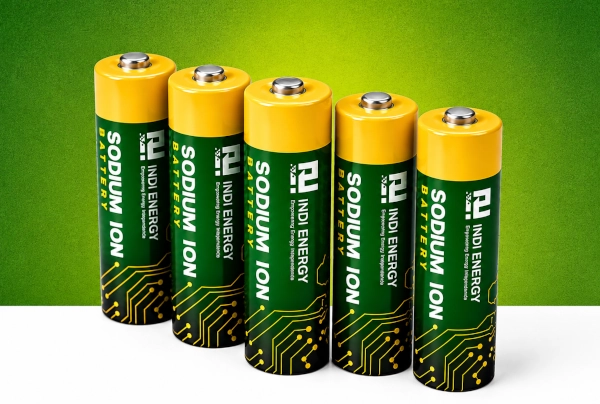
Indi Energy, the brand of Indigenous Energy Storage Technologies Private Limited, is developing sodium-ion batteries in India while converting agricultural and biological waste into a high-value battery material called BioBlack™ hard carbon.
Instead of limiting itself to assembling imported cells, the company is working across several levels of battery technology. Its development programme covers hard-carbon anodes, sodium-ion cathode materials, electrolytes, cylindrical cells, battery packs and complete energy-storage products. Indi Energy describes its goal as creating an indigenous sodium-ion technology platform built around materials that can increasingly be sourced within India.
That combination of advanced material science and agricultural waste utilisation makes Indi Energy an unusual example of Make in India: crop residue that might otherwise have little economic value can potentially become a critical material inside a next-generation rechargeable battery.
Born From India’s Energy-Storage Research Ecosystem
Indi Energy traces its roots to Roorkee in Uttarakhand and has strong links with IIT Roorkee.
Startup India identifies Indigenous Energy Storage Technologies Private Limited as a Roorkee-based energy-storage startup founded in 2019. Its leadership today includes co-founder and CEO Akash Soni, along with researchers Dr Yogesh Kumar Sharma, Dr Asit Sahoo and Dr Nagesh Kumar.
The team brings expertise across chemical engineering, physics, lithium-ion batteries, sodium-ion batteries, solid-state batteries and supercapacitors. Dr Sharma is also associated with IIT Roorkee as an associate professor.
The company was incubated through the TIDES Business Incubator at IIT Roorkee, according to a Government of India science and technology report.
From the beginning, Indi Energy focused on an important question: could India develop rechargeable batteries using raw materials that are considerably more abundant domestically than many of the minerals used in conventional lithium-ion cells?
Sodium-ion chemistry offered one possible route.
Sodium Instead of Lithium
Sodium-ion and lithium-ion batteries work according to broadly similar electrochemical principles.
During charging and discharging, ions move between the cathode and anode through an electrolyte while electrons travel through the external electrical circuit.
Lithium-ion batteries use lithium ions as the charge carriers. Sodium-ion batteries instead use sodium ions.
The attraction is largely based on resource availability.
Sodium is extremely abundant and widely distributed. It does not face the same geological concentration and supply-chain constraints associated with lithium.
However, simply replacing lithium with sodium is not straightforward.
A sodium ion is larger than a lithium ion. Materials that store lithium efficiently therefore do not necessarily perform equally well with sodium.
The anode becomes one of the key engineering challenges.
Graphite Creates a Problem for Sodium-Ion Batteries
Graphite dominates the anode side of conventional lithium-ion batteries because lithium ions can move efficiently into its layered structure.
Sodium behaves differently.
Its larger ionic size makes conventional graphite poorly suited to many practical sodium-ion chemistries. Researchers therefore need an alternative carbon structure that provides enough microscopic spaces, defects and pathways for sodium ions to enter and leave repeatedly.
One of the leading solutions is hard carbon.
Hard carbon has a disordered internal structure containing irregular carbon layers and microscopic pores. This architecture can provide sites capable of storing sodium ions.
The Government of India’s Technology Development Board notes that hard carbon’s disordered microstructure and porosity make it particularly suitable for sodium-ion batteries and can support stable cycling and useful energy-storage capacity.
For Indi Energy, solving the hard-carbon problem created another opportunity.
India already possesses enormous quantities of carbon-rich biological material.
BioBlack: Turning Agricultural Residue Into Battery Material
Indi Energy developed a proprietary hard-carbon material called BioBlack™ using agricultural and biological waste as feedstock.
Government descriptions of the company’s earlier development work specifically mention materials such as rice straw and cattle manure among locally available sources investigated for its sodium-ion technology.
Through controlled processing, suitable biomass can be converted into a carbonaceous structure engineered for electrochemical use.
This is considerably more sophisticated than simply burning agricultural waste to produce charcoal.
Battery-grade hard carbon requires precise control over properties such as porosity, particle size, surface area, purity and the spacing between disordered carbon layers. These characteristics influence how quickly sodium ions move through the material, how much sodium can be stored and how efficiently the electrode behaves over repeated cycles.
Indi Energy’s current specification for BioBlack lists a reversible capacity of around 330 ±5 mAh per gram up to 1.0 V, a plateau capacity of around 250 ±5 mAh/g up to 0.2 V, average interlayer spacing of approximately 0.38 nanometres, a median particle size near 25 micrometres, and specific surface area below 5 m²/g.
Those numbers are important because they show that agricultural residue is being transformed into an engineered electrochemical material rather than simply being reused as a low-value fuel.
From Farm Waste to Advanced Manufacturing
India produces vast quantities of agricultural residue every year.
Some of it already enters animal feed, biomass plants, paper production, composting and other industries. Other residues can become difficult to utilise economically, particularly when collection and transportation costs are high.
Converting suitable waste streams into battery materials introduces a potentially much higher-value application.
The chain could eventually look like this:
Agricultural residue → biomass processing → engineered hard carbon → battery anode → sodium-ion cell → energy-storage system.
This represents a striking form of industrial value addition.
Instead of importing a specialised electrode material, an Indian factory could potentially manufacture part of the battery from domestically sourced biological feedstock.
The Government of India has specifically highlighted this waste-to-value model. The Technology Development Board says biomass-derived hard carbon can utilise locally available resources while reducing dependence on imported raw materials.
Indi Energy Is Developing More Than the Anode
BioBlack is perhaps the company’s most distinctive technology, but Indi Energy is attempting to develop a broader sodium-ion stack.
Its technology portfolio includes development of a sodium-ion cathode material and a proprietary liquid sodium-ion electrolyte in addition to the hard-carbon anode.
The electrolyte is crucial.
It carries sodium ions between the positive and negative electrodes while electrically separating them. Its formulation influences operating voltage, charging characteristics, temperature performance, cycle life and safety.
Indi Energy says its proprietary electrolyte has been designed to operate with its BioBlack anode and indigenously developed sodium-ion cathode.
Developing these materials in parallel allows engineers to optimise them as a system rather than treating the individual components independently.
That is an important distinction from importing finished cells and merely assembling them into Indian battery packs.
From Battery Materials to an Indian Sodium-Ion Cell
Indi Energy has now moved beyond laboratory-scale electrode materials.
Its present product portfolio includes a cylindrical Sodium 26700 Cell, which the company describes as an indigenously developed sodium-ion cell.
The current specification lists:
- Nominal voltage: 3.0 V
- Nominal capacity: 3.2 Ah
- Cell energy: 9.6 Wh
- Operating voltage: 2.0–3.95 V
- Gravimetric energy density: 100–140 Wh/kg
- Claimed cycle life: more than 3,000 cycles
- Discharge temperature: -40°C to +60°C
- Charging temperature: -10°C to +55°C
Indi Energy also says the cylindrical format allows the technology to be incorporated into battery architectures similar to those already used for conventional cylindrical cells.
The 100–140 Wh/kg energy-density range illustrates both the strength and the present limitation of sodium-ion technology.
It is already highly relevant for many stationary applications, but the best lithium-ion cells can achieve considerably higher gravimetric energy density. Sodium-ion therefore does not need to defeat lithium-ion in every application to become commercially important.
It needs to excel where cost, supply security, safety, temperature tolerance and cycle life are more important than achieving the lowest possible battery weight.
An Indian Alternative to Lead-Acid Batteries
One of the most immediate markets may not be premium electric cars at all.
It could be the enormous installed base of lead-acid batteries.
India uses lead-acid batteries extensively in home inverters, automobiles, telecom infrastructure, commercial backup systems and numerous industrial applications.
Lead-acid technology is mature and inexpensive, but the batteries are heavy and have relatively modest energy density.
Sodium-ion batteries could occupy an attractive middle ground between lead-acid and high-energy lithium-ion chemistries.
Indi Energy is already targeting this market with sodium-ion starter batteries, inverter systems and solar applications. Its current product range includes sodium-ion starter batteries for two-wheelers, a 24 V 50 Ah residential inverter system, a 24 V 100 Ah solar inverter system, and a 12 V 30 Ah battery for solar street lighting.
This illustrates an important feature of the emerging sodium-ion industry: the technology does not have to begin with long-range electric cars.
Stationary and lower-speed applications can provide a large commercial market while cell chemistry continues improving.
Solar and Wind Power Create an Enormous Storage Opportunity
India is rapidly expanding solar and wind generation.
Unlike coal, gas or nuclear generation, renewable output depends heavily on environmental conditions. Solar production falls rapidly after sunset, while wind generation varies according to weather.
A power system with a high proportion of renewables therefore needs large amounts of storage.
For grid batteries, weight is often much less important than it is inside an electric car.
A stationary battery installation does not need to carry itself down a highway.
Cost per stored unit of electricity, cycle life, safety, raw-material availability and operating temperature can therefore become much more important than maximum energy density.
The Technology Development Board specifically identifies grid-scale energy storage, UPS and inverter systems, solar street lighting and low-speed electric mobility as promising application areas for sodium-ion batteries.
This could create a natural market for domestically produced sodium-ion cells.
A Battery Supply Chain Less Exposed to Imported Critical Minerals
India’s battery ambitions face a structural challenge.
Even when battery packs are assembled domestically, many high-value materials can remain dependent on international supply chains.
Lithium, nickel, cobalt, graphite and various processed battery chemicals pass through globally concentrated mining and refining systems.
Sodium-ion chemistry can reduce some of those vulnerabilities.
Sodium is widely available. Certain sodium-ion cathode chemistries can avoid cobalt and nickel. Hard carbon can potentially be manufactured from domestic biomass rather than relying entirely on imported battery-grade graphite.
The Technology Development Board explicitly noted in April 2026 that sodium and carbon resources are more geographically distributed than lithium and could therefore reduce exposure to global supply risks.
This is where Indi Energy’s approach aligns especially closely with India’s push for Atmanirbhar Bharat.
Domestic cell assembly is valuable.
Domestic control over the materials inside the cell is considerably more strategic.
Government Support Is Now Moving BioBlack Toward Commercial Scale
A major development came on April 2, 2026, when the Government of India’s Technology Development Board under the Department of Science and Technology announced financial assistance to Indigenous Energy Storage Technologies Private Limited.
The support is specifically for the commercialisation of hard carbon derived from bio-waste and agricultural waste for sodium-ion batteries.
According to the government, the project will establish commercial-scale production capability for indigenous hard-carbon anode materials and accelerate their deployment in sodium-ion batteries.
This is significant because battery technologies often face a difficult transition between laboratory success and industrial production.
Producing a few grams or kilograms of material under controlled laboratory conditions is very different from manufacturing tonnes of material while maintaining consistent particle size, purity, electrochemical properties and cost.
The TDB-supported scale-up is therefore an important step in determining whether BioBlack can become an industrial battery material rather than remaining primarily a research achievement.
Recognition Through the National Startup Awards
Indi Energy has also received recognition through the Government of India’s startup ecosystem.
Indigenous Energy Storage Technologies Private Limited was recognised under the Energy–Storage category of the National Startup Awards 2022.
Startup India highlighted the company’s work on sodium-ion batteries made using locally available bio-waste and abundant raw materials.
The recognition is notable because it came while sodium-ion technology was still at an earlier stage of global commercial development.
Since then, interest in sodium-ion batteries has accelerated internationally as battery manufacturers search for alternatives that reduce dependence on lithium and other constrained raw materials.
Sodium-Ion Will Not Simply Replace Lithium-Ion
The emergence of sodium-ion technology does not mean lithium-ion batteries will disappear.
Lithium-ion chemistry has benefited from decades of engineering improvement, enormous manufacturing investment and a global supply chain built around consumer electronics and electric vehicles.
It continues to offer excellent energy density, making it particularly attractive where size and weight are critical.
Sodium-ion has its own trade-offs.
Because sodium ions are larger and heavier than lithium ions, achieving extremely high gravimetric energy density can be more difficult. Manufacturing must also scale dramatically before sodium-ion cells can consistently achieve their theoretical cost advantages.
New cell chemistries require extensive testing for cycle life, ageing, abuse tolerance and performance under actual operating conditions.
Claims regarding exceptional safety or complete immunity from thermal incidents should likewise be judged against independent cell and pack-level testing as commercial deployment increases.
The strongest case for sodium-ion is therefore not that it makes every other battery obsolete.
Its strength lies in diversifying the battery ecosystem.
Different Batteries for Different Jobs
India will likely require several battery chemistries simultaneously.
High-performance lithium-ion batteries can serve long-range electric vehicles, consumer electronics and applications where energy density is crucial.
Sodium-ion batteries could increasingly serve grid storage, solar systems, telecom backup, home inverters, two- and three-wheelers, low-speed mobility and other applications where affordability and resource availability carry greater weight.
Lead-acid batteries may continue in cost-sensitive markets while newer chemistries gradually displace them where lifecycle economics justify the transition.
Future energy storage may therefore resemble India’s electricity-generation system itself: a portfolio of technologies rather than dependence on a single solution.
Indi Energy is positioning sodium-ion as one of those technologies.
Agricultural Waste Could Become Part of India’s Battery Economy
The most intriguing part of Indi Energy’s model is the connection it creates between two economic sectors that appear completely unrelated.
At one end lies Indian agriculture.
At the other lies advanced electrochemical energy storage.
Between them sits materials science.
If hard-carbon manufacturing from agricultural residue scales successfully, some crop and biological waste streams could acquire an additional industrial market.
This does not mean every tonne of farm residue can or should become battery carbon. Feedstock composition, collection economics, competing agricultural uses and manufacturing yields will determine which waste streams make practical sense.
But the underlying concept is powerful.
A low-value biological residue can become a precision-engineered material inside an advanced rechargeable battery.
That is the type of value addition India increasingly needs.
From Battery Assembly to Battery Science
India has spent years building domestic battery-pack manufacturing capacity.
The next stage is more difficult.
It requires mastering electrode materials, electrolytes, separators, cell designs, manufacturing processes and eventually the specialised equipment needed to produce those components at massive scale.
Indi Energy represents this deeper layer of the battery industry.
Its work begins before the battery cell reaches an assembly line.
It starts with the carbon structure inside the anode.
The company is attempting to control the chain from biomass-derived hard carbon to cathodes, electrolyte, cells and complete energy-storage systems.
That approach gives India the opportunity to develop intellectual property and manufacturing knowledge at several levels of the battery value chain.
From Rice Straw to Stored Electricity
The story of Indi Energy captures an important direction in India’s emerging deep-tech economy.
The country possesses a huge agricultural base, a growing scientific workforce, rapidly expanding renewable-energy capacity and one of the world’s largest future markets for batteries.
Connecting those advantages could create entirely new industries.
Indi Energy’s BioBlack technology effectively attempts to transform agricultural and biological residues into a strategic energy-storage material. Its sodium-ion programme then combines that hard carbon with domestically developed cathode and electrolyte technology before integrating the materials into cells and finished battery systems.
The Government of India’s decision in 2026 to support commercial-scale production of the company’s biomass-derived hard carbon marks another step toward taking that technology from laboratory development into manufacturing.
Much will depend on whether Indi Energy can manufacture its materials and cells consistently, achieve competitive costs at scale and demonstrate long-term performance across thousands of real-world battery installations.
But the direction is significant.
India does not necessarily have to reproduce the existing global lithium-ion supply chain exactly as it developed elsewhere.
It can also invest in alternative chemistries built around resources the country possesses in abundance.
In Indi Energy’s case, that means combining sodium, agricultural residue, Indian materials science and domestic cell engineering to create a new battery ecosystem.
When successfully scaled, the journey from farm waste to BioBlack, from BioBlack to sodium-ion cells, and from those cells to renewable-energy storage could become one of the more distinctive examples of Make in India—turning a material once treated as waste into part of the infrastructure powering India’s energy transition.
You may also like
-
ICAR Scientists Develop Indigenous Protective Gloves for Cotton Farmers, Sign Commercial Manufacturing Agreement
-
India Moves Towards Five-Year Assured Orders for Defence Startups Under New Procurement Reforms
-
BHEL–Coal India Joint Venture Begins Construction of ₹25,016 Crore Indigenous Coal Gasification Project in Odisha
-
Zen Technologies Introduces Indigenous Hyper-Strike Falcon AI-Guided Counter-Drone Interceptor
-
L&T and Germany’s SCHOTTEL Expand Partnership for Controllable Pitch Propeller Systems in Indian Shipbuilding
