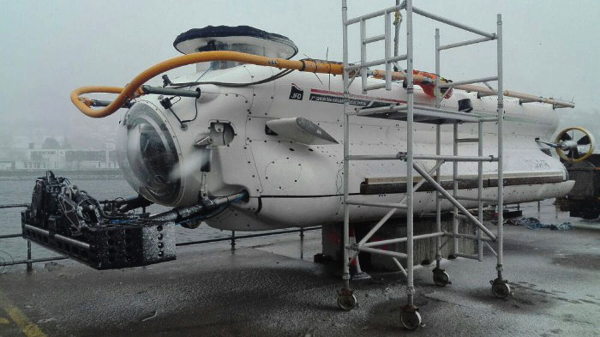
The Indian Navy has strengthened its submarine rescue infrastructure on the eastern seaboard with the inauguration of a new Launch and Recovery System Test Plinth at the Submarine Rescue Unit (East) in Visakhapatnam.
Vice Admiral Sanjay Bhalla, Flag Officer Commanding-in-Chief of the Eastern Naval Command, inaugurated the facility on August 19, 2026. The specialised installation will support shore-based testing and maintenance of the Launch and Recovery System, or LARS, used with the Navy’s Deep Submergence Rescue Vehicle (DSRV).
The new capability is particularly important because the launch and recovery mechanism is one of the most critical elements of a submarine rescue system. During an emergency, it must safely lower the rescue vehicle into the sea and recover it after the DSRV completes its mission.
Shore-Based Testing Improves Rescue Readiness
The new test plinth gives the Submarine Rescue Unit an in-house facility where personnel can inspect, test and maintain the LARS without depending entirely on deployment at sea.
This allows the Navy to conduct routine functional checks under controlled conditions and identify technical issues before the equipment is required for an operational mission.
Submarine rescue operations leave little room for equipment failure. Once a submarine becomes disabled underwater, rescuers must locate it, assess the condition of the vessel and establish contact before deploying a rescue vehicle.
Maintaining the DSRV and its supporting equipment at a high level of readiness is therefore essential.
The Visakhapatnam facility will allow technicians and operators to validate one of the most important parts of that rescue chain more regularly. It should also reduce the requirement to mobilise ships and other resources merely to conduct certain LARS trials.
What Is the DSRV?
A Deep Submergence Rescue Vehicle is a specialised manned submersible designed to rescue sailors trapped inside a disabled submarine resting below the surface.
After reaching the distressed submarine, the DSRV manoeuvres above its rescue hatch and establishes a watertight connection. Personnel can then move from the disabled submarine into the rescue vehicle before being transported safely to the surface.
The Indian Navy inducted two advanced DSRV systems during 2018-19, providing dedicated submarine rescue capabilities for both the western and eastern seaboards.
According to the Ministry of Defence, the systems can conduct rescue operations at depths of up to 650 metres. They can also be rapidly transported to a mobilisation port when required, giving India the ability to respond to submarine emergencies well beyond its immediate coastline.
The DSRV itself operates with a crew of three and can rescue up to 14 personnel during a single sortie. During trials in 2018, an Indian Navy DSRV successfully conducted underwater mating with a submarine and demonstrated personnel transfer procedures.
LARS Is a Critical Part of the Rescue System
The DSRV cannot operate independently. It forms part of a broader submarine rescue package that includes detection equipment, remotely operated vehicles, decompression facilities and the Launch and Recovery System.
LARS performs the demanding task of safely deploying the rescue vehicle from its support platform into the sea and recovering it following a mission.
Those operations can take place under difficult maritime conditions. The equipment must therefore handle the weight of the rescue vehicle while compensating for ship movement, waves and other environmental factors.
Regular maintenance and testing of the LARS is consequently just as important as maintaining the rescue vehicle itself.
The new Visakhapatnam test plinth allows the Eastern Naval Command to perform these checks ashore and sustain the system in a rescue-ready condition.
Visakhapatnam Is Emerging as a Major Submarine Rescue Hub
The facility also strengthens Visakhapatnam’s growing role in India’s underwater rescue architecture.
The city is home to the headquarters of the Eastern Naval Command and hosts the Submarine Rescue Unit (East). India has progressively developed supporting infrastructure there for its eastern DSRV capability.
A major addition came with the commissioning of INS Nistar at Visakhapatnam on July 18, 2025.
Built by Hindustan Shipyard Limited, Nistar is India’s first indigenously designed and constructed Diving Support Vessel. The ship can undertake deep-sea saturation diving and submarine rescue operations and acts as a dedicated mother ship for the DSRV.
Nistar carries side-scan sonar, remotely operated vehicles and extensive deep-sea diving equipment. Its design allows the Navy to deploy specialised rescue systems while providing medical and decompression support to personnel recovered from a distressed submarine.
The ship subsequently demonstrated India’s growing submarine rescue reach during Exercise Pacific Reach 2025 in Singapore and the South China Sea.
During the exercise, the Indian DSRV successfully mated with foreign submarines, demonstrating the interoperability of India’s rescue system with vessels operated by partner navies.
India Has Built a Fly-Away Submarine Rescue Capability
One of the most useful features of India’s DSRV architecture is its mobility.
The Navy describes its rescue systems as capable of deployment in a fly-away configuration. Key components can be transported by heavy-lift aircraft to a suitable port and installed aboard a vessel capable of supporting the rescue operation.
This means the system does not have to remain permanently attached to a single ship.
Such flexibility is particularly important for a country operating across the vast Indian Ocean, where a submarine emergency could occur hundreds or even thousands of kilometres from the nearest naval base.
India has already demonstrated this ability internationally. In 2021, the Navy mobilised its Visakhapatnam-based DSRV capability to assist Indonesia after the disappearance of submarine KRI Nanggala-402.
Strengthening the Complete Submarine Rescue Chain
The new LARS Test Plinth may appear modest compared with a warship or submarine, but submarine rescue depends heavily on specialised support infrastructure.
A DSRV can only fulfil its mission if its sensors, launch machinery, communications, decompression facilities and support platforms function reliably as an integrated system.
The Navy has steadily strengthened each part of this chain. It now operates DSRVs on both coasts, has commissioned INS Nistar as a dedicated diving and rescue support platform and has demonstrated its submarine rescue capability during multinational exercises.
The new shore-based LARS testing facility adds another layer to that architecture by allowing the Eastern Naval Command to maintain and validate critical launch-and-recovery equipment without relying solely on sea deployments.
As the Indian Navy expands its conventional and nuclear-powered submarine forces, maintaining an equally capable rescue network will remain essential. The facility at Visakhapatnam strengthens that safety infrastructure and improves India’s ability to respond rapidly when submariners face an emergency beneath the sea.
You may also like
-
Indian Army Special Forces Depart for Indonesia for Exercise Garuda Shakti 2026
-
India to Train 600 Nigerian Army Soldiers in Specialised Jungle and Mountain Warfare
-
ICAR Scientists Develop Indigenous Protective Gloves for Cotton Farmers, Sign Commercial Manufacturing Agreement
-
India Moves Towards Five-Year Assured Orders for Defence Startups Under New Procurement Reforms
-
BHEL–Coal India Joint Venture Begins Construction of ₹25,016 Crore Indigenous Coal Gasification Project in Odisha
