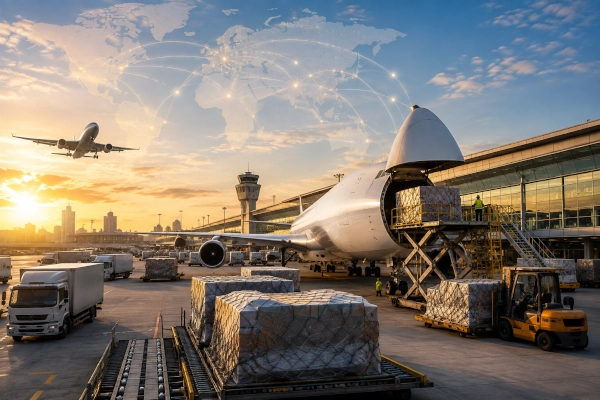
India is moving to transform its airports from predominantly origin-and-destination facilities into major international cargo hubs, combining a long-term plan to raise air freight volumes to around 10 million tonnes by 2030 with reforms designed to make transshipment through Indian airports faster and more competitive.
The latest step came on 19 August 2026, when Civil Aviation Minister Kinjarapu Ram Mohan Naidu launched the scaled-up phase of India’s air-cargo transshipment programme at the Transshipment Excellence Centre at Delhi’s Indira Gandhi International Airport. The expansion follows a successful trial that dramatically reduced transit time while improving aircraft cargo utilisation.
India Targets Nearly Three-Fold Growth in Air Cargo
India has set an ambitious goal of raising annual air-cargo throughput to about 10 million metric tonnes by 2030. The government has previously described present volumes at around 3.5 million tonnes, meaning the target represents an increase of almost three times the current scale. Prime Minister Narendra Modi formally highlighted the 10-million-tonne target while addressing the International Air Transport Association’s annual meeting in June 2025.
Official Ministry of Civil Aviation data provide additional context. India’s air-cargo throughput increased from 2.53 million metric tonnes in FY2014-15 to 3.72 million tonnes in FY2024-25. Cargo operations are now conducted at 74 airports, while new warehousing and cargo infrastructure are being developed at major airports and upgraded at several regional locations.
Reaching 10 million tonnes, however, requires more than additional warehouses and aircraft capacity. India must also attract cargo that currently passes through major foreign hubs and make it easier for freight originating in smaller Indian cities to connect with international flights.
That is where the transshipment programme becomes important.
Chennai-Delhi-Frankfurt Trial Demonstrates the Model
The government began a proof-of-concept for domestic-to-international cargo transshipment on 20 June 2026.
Under the trial, cargo originating in Chennai travelled through Delhi before connecting with an international Air India service to Frankfurt. Air India operated the movement end-to-end through Delhi Airport’s Transshipment Excellence Centre.
During the trial, around 280 metric tonnes of cargo moved through the system. More importantly, aircraft cargo-capacity utilisation increased from around 75% to nearly 100%, according to the Ministry of Civil Aviation.
The results demonstrated how a hub-and-spoke system can consolidate freight from different Indian cities before loading it onto long-haul international flights.
Rather than requiring every city to sustain its own direct international cargo connection, domestic flights can feed freight into large hubs such as Delhi. International aircraft departing from the hub can then operate with higher cargo utilisation.
Bengaluru, Ahmedabad, Mumbai and Hyderabad Added
Following the success of the initial trial, the government expanded the network on August 19.
Four additional domestic cargo origins have now been brought into the framework:
- Bengaluru
- Ahmedabad
- Mumbai
- Hyderabad
At the international end, London and Copenhagen have been added alongside the existing Frankfurt connection.
The expanded network is expected to have an immediate effect on Air India’s cargo volumes along these routes. The Ministry estimates that monthly cargo carriage could increase from 1,763 metric tonnes to 3,183 metric tonnes, representing an increase of nearly 80%.
This is an important demonstration of the potential available through better utilisation of India’s existing aviation network rather than relying exclusively on new freighter aircraft.
Removing Re-Screening Cuts Transit Time Dramatically
One of the biggest obstacles to efficient air transshipment in India had been the requirement to re-screen cargo at the connecting airport even when it had already passed through approved security screening at its airport of origin.
That process added time, handling and congestion.
The Bureau of Civil Aviation Security revised the framework through Addendum-II to AVSEC Circular No. 6/2024 on 21 July 2025. Secured transshipment cargo can now move through dedicated Transfer Cargo Security Hold Areas without undergoing repeated screening, subject to prescribed safeguards.
The effect during the Delhi trial was substantial.
According to the Civil Aviation Ministry, average end-to-end transit time on the Chennai-Delhi-Frankfurt movement fell from approximately 60 hours to about 20 hours.
That difference is particularly significant for products where speed determines commercial viability.
Pharmaceuticals, Electronics and Perishables Could Benefit
Air freight accounts for only a small proportion of India’s total freight by volume, but it carries a disproportionate share of goods where value, speed or temperature control is critical.
Pharmaceuticals, vaccines, electronics, precision components, engineering products, jewellery, high-value agricultural produce, seafood, flowers and rapidly moving e-commerce consignments can all depend heavily on air logistics.
India’s growing electronics and advanced-manufacturing industries could therefore become important drivers of future air-cargo growth.
Agricultural exports could also benefit. Faster connections between regional production centres and international airports can reduce the amount of time perishable products spend waiting inside logistics networks.
Delhi Airport already operates extensive cold-chain infrastructure for pharmaceutical and temperature-sensitive shipments and handles more than one million tonnes of cargo annually, connecting with over 150 destinations through its wider cargo network.
Delhi Being Developed as a Major Cargo Hub
Delhi occupies a particularly important place in the government’s aviation-hub strategy because of its domestic connectivity and large international network.
The Transshipment Excellence Centre was specifically designed to move connecting cargo without forcing it through conventional import or export terminal processes.
Delhi Cargo describes the facility as India’s first dedicated airside transshipment centre and says cargo can be reconnected within around 20 minutes under suitable operating conditions.
The government’s wider hub-and-spoke strategy is not restricted to freight. India has also been developing passenger transfer hubs and introducing the Easy Connect model, initially from cities such as Varanasi and later Amritsar, allowing passengers from regional cities to connect seamlessly through major airports.
Air cargo is now being developed according to a similar principle.
From Domestic-to-International to Global Transshipment
The current expansion represents only one stage of the programme.
Ram Mohan Naidu said the immediate priority is domestic-to-international transshipment, where cargo originating at an Indian airport connects through another Indian hub before travelling overseas.
The government eventually intends to expand the framework to:
International-to-International transshipment, in which cargo arriving from another country connects through India before travelling to a third country; and
International-to-Domestic transshipment, where overseas cargo arriving at an Indian hub is transferred efficiently to domestic destinations.
International-to-international traffic could be particularly significant because it would allow India to compete for cargo that does not necessarily originate or terminate in the country.
India’s geographical position between Southeast Asia, West Asia, Europe and Africa creates a natural opportunity for such hub operations.
Customs Reforms Support the Cargo Strategy
Security reform is being accompanied by changes in customs procedures.
The Central Board of Indirect Taxes and Customs has already waived transshipment permit fees, simplified procedures covering temporary movement of Unit Load Devices and enabled online filing of transshipment applications through ICEGATE.
An All-India National Transhipment Bond has also been operating to eliminate the need for airlines to submit separate bonds at multiple customs stations.
These reforms address an important reality of global logistics: cargo hubs compete not only on infrastructure but also on processing time.
A modern terminal provides limited advantage if freight remains delayed by repeated screening, documentation or customs procedures.
New Airports Add Future Cargo Capacity
India is simultaneously expanding the physical infrastructure available for freight.
The Ministry of Civil Aviation says cargo warehousing capacity is being augmented through major facilities at Noida International Airport at Jewar and Navi Mumbai International Airport, alongside upgrades at airports including Dibrugarh, Dimapur, Dehradun, Jodhpur, Srinagar and Vijayawada.
Navi Mumbai International Airport, for example, has been designed with cargo as a major component. Its first-phase capacity includes roughly 0.5 million tonnes of annual cargo handling, supported by automated systems and specialised facilities for pharmaceuticals and perishables.
This gives India the possibility of developing multiple cargo gateways rather than concentrating international freight almost entirely at a handful of existing metropolitan airports.
The 10-Million-Tonne Target Now Depends on Execution
India’s plan to raise annual air cargo from roughly 3.5-3.7 million tonnes to 10 million tonnes by 2030 is ambitious. Infrastructure construction alone will not deliver that increase.
Aircraft capacity, dedicated freighters, airport terminals, cold-chain facilities, digital customs systems, regional connectivity and rapid transshipment processes will all have to expand together.
The August 19 expansion at Delhi therefore represents more than the addition of a few new cargo routes.
The Chennai-Delhi-Frankfurt trial showed that removing one major procedural bottleneck could cut transit time from around 60 hours to 20 hours, while increasing aircraft utilisation from 75% to almost full capacity. The next phase brings Bengaluru, Ahmedabad, Mumbai and Hyderabad into the network and adds London and Copenhagen to its international reach.
If the model can be replicated across India’s major airports and eventually extended to international-to-international cargo, Indian airports could begin capturing freight that today moves through established Asian and Middle Eastern hubs.
India’s air-cargo expansion is therefore evolving from a simple volume target into a broader strategy: connect regional production centres to global markets, make Indian airports efficient transfer hubs, and position the country as an increasingly important node in international supply chains.
References
Press Information Bureau – Civil Aviation Minister Ram Mohan Naidu Flags Off Transshipment Cargo Operations at Delhi’s IGI Airport
https://pib.gov.in/PressReleaseIframePage.aspx?PRID=2301373
News on AIR – India Emerges as Leading Force in Global Space-Aviation Convergence; Air Cargo Target of 10 Million Tonnes by 2030
https://newsonair.gov.in/india-emerges-as-leading-force-in-global-space-aviation-convergence-says-pm-modi/
Ministry of Civil Aviation – Annual Report 2025-26
https://www.civilaviation.gov.in/sites/default/files/2026-04/annual-report-english-2025-moca.pdf
PIB – CBIC Introduces Trade Facilitation Measures for Transhipment and Air Cargo
https://www.pib.gov.in/PressReleaseIframePage.aspx?PRID=2124318
Delhi Airport Cargo – Cargo and Transshipment Infrastructure
https://www.gmrgroup.com/airports-and-aero-services/airport-services/cargo-logistics/delhi-cargo
You may also like
-
Koraput Kalajeera Rice of Odisha: The GI-Tagged Aromatic Heritage of India’s Ancient Rice-Growing Region
-
ICAR Scientists Develop Indigenous Protective Gloves for Cotton Farmers, Sign Commercial Manufacturing Agreement
-
BHEL–Coal India Joint Venture Begins Construction of ₹25,016 Crore Indigenous Coal Gasification Project in Odisha
-
PM Modi to Inaugurate RBI’s Tier IV Data Centre and Cybersecurity Training Institute in Bhubaneswar
-
India Creates 11 Crore Digital Farmer IDs Five Months Ahead of Target, Strengthening AgriStack Infrastructure
