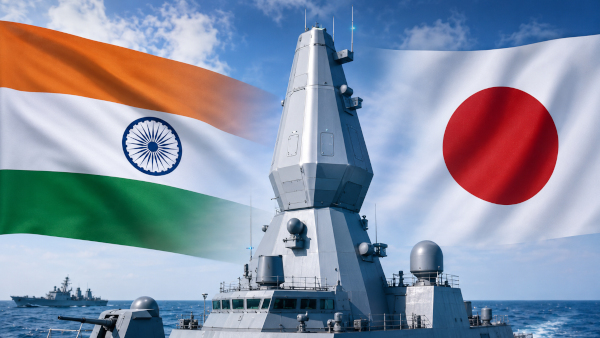
India and Japan have taken a significant step towards deeper strategic and defence cooperation, signing a new Memorandum of Arrangement on Maritime Security Cooperation while agreeing to expand collaboration in naval operations, defence manufacturing, advanced technologies, intelligence exchanges and joint military exercises.
The decisions were announced following talks between Defence Minister Rajnath Singh and Japanese Defence Minister Shinjiro Koizumi in New Delhi on August 20, 2026. The meeting came amid growing strategic uncertainty across the Indo-Pacific and reflected the steadily expanding security dimension of the Japan-India Special Strategic and Global Partnership.
Both ministers reaffirmed their commitment to a free and open Indo-Pacific and stressed the importance of maintaining freedom and safety of navigation and overflight. They also opposed attempts to alter the regional status quo through force or coercion.
New Maritime Security Framework
The most important outcome of the meeting was the signing of the Memorandum of Arrangement on Maritime Security Cooperation between India’s Ministry of Defence and Japan’s Ministry of Defense.
The agreement establishes a framework for closer cooperation between the Indian Navy and the Japan Maritime Self-Defense Force, particularly in Maritime Domain Awareness. The two sides will expand information sharing and strengthen cooperation in Search and Rescue operations as well as Humanitarian Assistance and Disaster Relief missions.
India and Japan also intend to coordinate more closely in protecting strategically important Sea Lines of Communication, which carry a large share of the energy supplies and commercial trade flowing through the Indo-Pacific.
The cooperation will include visits by naval ships and military units, joint exercises, exchanges involving personnel and subject-matter experts, and wider logistical support. Both sides also plan to increase access to ports, maintenance facilities and repair infrastructure.
The arrangement signals an effort to move bilateral maritime cooperation beyond periodic exercises towards a more sustained operational partnership.
India and Japan Explore Naval Shipbuilding Partnership
Defence industrial cooperation emerged as another major pillar of the talks.
The two ministers agreed to explore the possibility of joint development in naval shipbuilding and ship design, combining Japanese technological expertise with India’s growing shipbuilding and manufacturing capabilities.
Japan will also examine opportunities to utilise Indian production capacity under the Make in India framework. The move could eventually allow Indian shipyards and defence manufacturers to become part of a broader Japan-linked defence industrial ecosystem.
Both countries agreed to deepen discussions on shipbuilding and related technologies while examining reciprocal arrangements for naval ship repairs.
The ministers also agreed to work towards concluding a formal ship repair arrangement in the near future. Such a mechanism could allow Japanese vessels to make greater use of Indian maintenance and repair facilities while potentially opening additional opportunities for Indian naval infrastructure and shipyards.
Mine Countermeasures Identified as Priority Area
India and Japan also agreed to maximise cooperation in mine countermeasure capabilities, an increasingly important aspect of maritime security.
Naval mines can threaten commercial shipping, harbour access and military operations across strategic sea lanes. Cooperation in mine detection, clearance systems, unmanned platforms and associated technologies could therefore develop into an important operational and technological component of the bilateral relationship.
The decision complements broader discussions on unmanned systems and advanced naval technology.
Veer Guardian 26 to Bring Japanese Fighters to India for First Time
Military exercises between the two countries will also expand significantly.
The ministers welcomed the continuing growth of the bilateral Army exercise Dharma Guardian and the naval exercise JAIMEX.
Particular attention was given to Veer Guardian 26, the planned India-Japan Air Force exercise scheduled for later in 2026.
Under the exercise, Japan Air Self-Defense Force fighter aircraft will visit India for the first time to participate in a bilateral air exercise, marking another important milestone in air power cooperation between the two countries.
India and Japan intend to increase the complexity of future military exercises and incorporate more advanced operational scenarios. The two sides specifically agreed to pursue greater integration of unmanned systems and examine opportunities for conducting joint exercises at short notice.
Such drills could improve the ability of Indian and Japanese forces to operate together in rapidly developing security situations.
Special Forces Cooperation to Expand
The two defence ministers also agreed to promote exchanges between their respective Special Operations Forces.
Japan expressed its intention to cooperate with India’s proposed integrated theatre commands once the new command structures are established.
This could eventually provide another institutional channel for operational coordination between the two militaries, particularly in areas requiring joint planning across multiple services.
UNICORN Project Moves Towards Implementation
Defence technology cooperation received further momentum with both sides reaffirming support for the UNICORN integrated communications antenna system project.
The shipborne UNICORN system represents the first defence equipment transfer project between India and Japan, making it an important symbolic and practical milestone in their defence relationship.
Both ministers agreed to work towards its early implementation.
The project could serve as a foundation for additional defence equipment and technology partnerships as Japan gradually broadens its framework governing defence exports and technology transfers.
Rajnath Singh welcomed Japan’s recent review of its defence equipment and technology transfer framework and expressed hope that it would contribute to deeper defence industrial cooperation between the two countries.
DRDO and Japan’s ATLA to Deepen Advanced Technology Research
India and Japan also agreed to strengthen cooperation between India’s Defence Research and Development Organisation (DRDO) and Japan’s Acquisition, Technology and Logistics Agency (ATLA).
The two organisations will explore greater research and development cooperation in state-of-the-art defence technologies.
While the joint statement did not identify specific new technology programmes, closer cooperation between DRDO and ATLA could provide a platform for future projects involving advanced electronics, sensors, communications, maritime technologies, unmanned systems and other emerging military capabilities.
Both governments also confirmed plans to convene a Defence Industry Forum, creating an additional platform for defence companies and government agencies from both countries to explore industrial partnerships.
Trilateral Cooperation with Indonesia Expands
India and Japan are also widening their defence cooperation to include other Indo-Pacific partners.
The ministers welcomed the first trilateral naval PASSEX involving India, Japan and Indonesia, conducted in February 2026.
The three-country engagement reflects growing interest in smaller operational groupings that can complement wider regional security frameworks.
India and Japan agreed to expand cooperation with third countries through military exercises, senior-level exchanges and other initiatives aimed at contributing to stability across the Indo-Pacific.
Indo-Pacific Logistics Network to Support Disaster Response
Another area of cooperation involves the Indo-Pacific Logistics Network, or IPLN.
The initiative seeks to improve the ability of participating countries to move personnel and essential supplies during natural disasters and humanitarian emergencies.
India and Japan agreed to further promote cooperation through the network. The second IPLN tabletop exercise is scheduled to take place at the Japanese Ministry of Defense in September 2026.
The initiative adds a humanitarian and disaster-response dimension to the broader strategic partnership.
Fourth India-Japan 2+2 Dialogue Planned in Tokyo
The two ministers also agreed to accelerate preparations for the Fourth Japan-India Foreign and Defence Ministerial Meeting, commonly known as the 2+2 dialogue, which is expected to be held in Tokyo later in 2026.
The mechanism brings together the foreign and defence ministers of both countries and has become one of the most important institutional platforms for coordinating bilateral strategic and security policy.
India and Japan additionally agreed to hold consultations whenever necessary to ensure their security and contribute to peace and stability in the region.
New Working Group to Coordinate Defence Cooperation
To ensure faster implementation of the expanding defence agenda, India and Japan will establish a new Director-General/Joint Secretary-level Working Group.
The group will coordinate cooperation across several domains, including operations, intelligence, defence equipment, technology and defence industry.
Rather than allowing individual projects to progress separately, the new mechanism is intended to bring them under a more integrated framework, identify areas of overlap and accelerate implementation.
Its creation underlines how the India-Japan defence relationship is moving towards deeper institutional coordination.
Koizumi Visits Western Naval Command
Ahead of the bilateral meeting, Japanese Defence Minister Shinjiro Koizumi paid tribute to India’s fallen soldiers by laying a wreath at the National War Memorial in New Delhi.
He was also accorded a ceremonial Tri-Service Guard of Honour.
During his visit to India, Koizumi travelled to Mumbai and visited the Western Naval Command as well as INS Chennai, giving the Japanese delegation direct exposure to one of the Indian Navy’s principal operational commands.
India-Japan Defence Ties Enter a More Operational Phase
The August 20 meeting indicates that India-Japan defence relations are gradually evolving from regular strategic dialogue and military exercises towards a broader operational and industrial partnership.
Maritime Domain Awareness, naval logistics, ship repairs, mine countermeasures, shipbuilding, advanced military exercises, Special Forces exchanges and defence technology cooperation are now being developed simultaneously.
The proposed use of India’s manufacturing capabilities by Japan under Make in India could become particularly significant if discussions progress into concrete shipbuilding, repair or defence equipment programmes.
At the same time, the planned arrival of Japanese fighter aircraft in India for Veer Guardian 26, the UNICORN communications system project and closer DRDO-ATLA cooperation demonstrate that the relationship is expanding across the maritime, air and technological domains.
With a new maritime security framework and an institutional working group to coordinate implementation, New Delhi and Tokyo are laying the groundwork for a more structured defence partnership designed to address the increasingly complex security environment of the Indo-Pacific.
Source: Joint Press Statement issued by the Ministry of Defence, Government of India, through the Press Information Bureau on 20 August 2026.
You may also like
-
India Moves Towards Five-Year Assured Orders for Defence Startups Under New Procurement Reforms
-
India and Italy Hold First Maritime Security Dialogue in Rome, Strengthen Strategic Maritime Cooperation
-
India and Azerbaijan Agree to Strengthen Security, Trade, Energy and Economic Cooperation
-
Zen Technologies Introduces Indigenous Hyper-Strike Falcon AI-Guided Counter-Drone Interceptor
-
L&T and Germany’s SCHOTTEL Expand Partnership for Controllable Pitch Propeller Systems in Indian Shipbuilding
