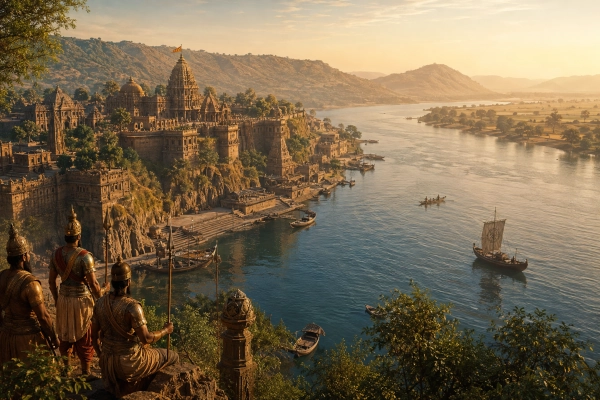
The Mahabharata preserves the memory of Anupa as a recognised kingdom of ancient Bharat. Its ruler appears among the kings gathered in Yudhishthira’s magnificent assembly at Indraprastha, while warriors called the Anupakas later appear in the armies of the Kurukshetra War. Closely associated with this geographical world is Mahishmati, the celebrated city on the Narmada where Sahadeva encountered King Nila during his southern campaign before Yudhishthira’s Rajasuya.
Later Sanskrit geographical tradition makes the relationship still clearer. Kalidasa’s Raghuvamsha remembers Mahishmati on the Reva, the ancient name of the Narmada, as the capital of the Anupa country. Historical geography has therefore generally placed the principal Anupa region in the Narmada valley of present-day Madhya Pradesh, with Maheshwar and the surrounding Narmada corridor forming one of the strongest candidates for its ancient political heart.
Anupa is particularly important because the Mahabharata does not present this landscape merely as a name in a geographical catalogue. Mahishmati becomes the setting for one of the most remarkable episodes of Sahadeva’s Digvijaya, involving King Nila, the protection of Agni and the political submission of the city to Yudhishthira’s Rajasuya authority.
Anupa at a Glance
| Feature | Description |
|---|---|
| Ancient Name | Anupa / Anupaka |
| Principal Geographical Zone | Narmada valley of central India |
| Principal Ancient City | Mahishmati |
| Modern Core for Mapping | Maheshwar and the adjoining Narmada corridor of Madhya Pradesh |
| Principal River | Narmada, ancient Reva |
| Mahabharata Ruler | Anupa Raja is named among the kings at Yudhishthira’s court |
| Mahishmati Ruler | King Nila |
| Rajasuya Association | Sahadeva campaigns through the Narmada country and brings Nila of Mahishmati under Yudhishthira’s authority |
| Divine Association | Agni protects Mahishmati in the story of King Nila |
| Kurukshetra Association | Anupakas appear among contingents in the Pandava battle formation |
| Later Literary Identification | Raghuvamsha associates Mahishmati on the Reva with Anupa |
| Major Modern Identification | Maheshwar, although Mandhata/Omkareshwar is another important candidate for ancient Mahishmati |
| Archaeological Landscape | Maheshwar–Navdatoli |
| Modern State | Madhya Pradesh |
| Country Today | India |
The Land of Anupa
The Sanskrit geographical term Anupa carries a strong association with water. Lexicographical traditions define anūpa or ānūpa in terms such as watery, moist or marshy land. Such a name fits naturally with a fertile riverine territory dominated by the Narmada and its adjoining floodplains.
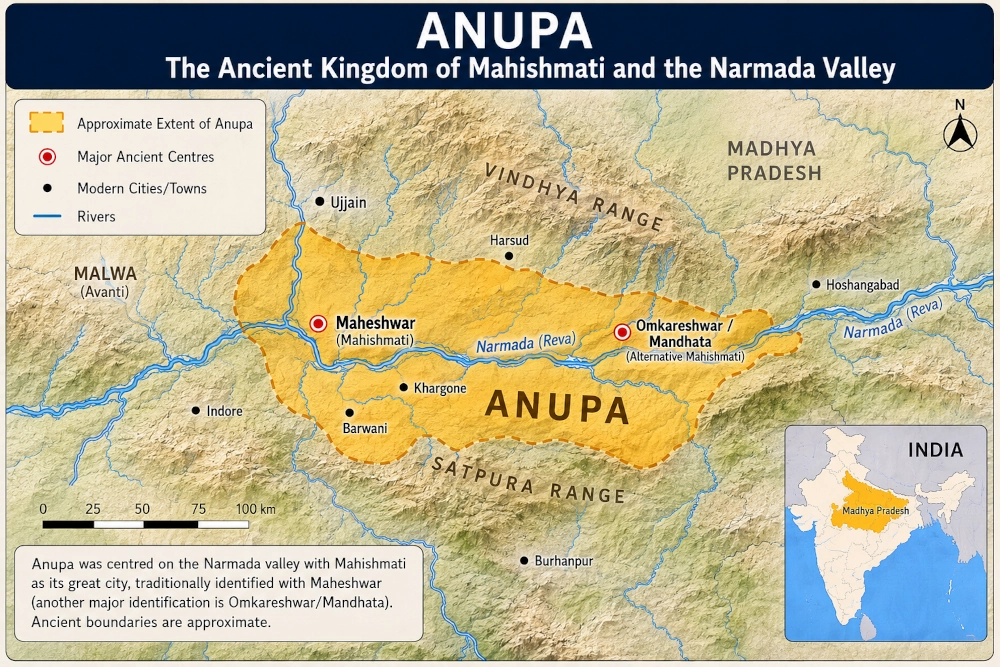
In historical geography, Anupa came to be associated particularly with the country around ancient Mahishmati in central India. The Narmada created a long natural corridor between the interior of Madhya Pradesh and western India, while the Vindhyas rose to the north and the Satpura system extended to the south. The river therefore acted not simply as a geographical feature but as one of the great east-west arteries of ancient India.
For the purposes of reconstructing the Mahabharata landscape, the strongest core can be shown approximately as:
Maheshwar – Narmada corridor – adjoining Khargone region – eastward toward the Omkareshwar/Mandhata zone
Ancient territorial boundaries should not be drawn as though they corresponded to modern districts. Anupa was a regional and political identity whose extent could have changed considerably under different rulers.
There is also an important geographical qualification. Maheshwar is sometimes loosely placed within an “upper Narmada” cultural region in modern reconstructions, but geographically it lies considerably west of the river’s true upper course. For a historical map, the central-western Narmada valley around Maheshwar is therefore the safer description.
Mahishmati: The Great City of the Narmada
The most celebrated city associated with the Anupa landscape is Mahishmati.
Ancient literary traditions consistently place Mahishmati on or beside the Narmada. The city occupied an important position between northern and southern India, and later sources place it on routes connecting Ujjayini in Malwa with settlements farther south toward the Deccan.
The identification of Mahishmati, however, is not entirely settled.
Several scholars, including H. D. Sankalia and P. N. Bose, identified ancient Mahishmati with modern Maheshwar, which stands prominently on the northern bank of the Narmada in present-day Madhya Pradesh. Another influential interpretation places Mahishmati farther east at Mandhata, modern Omkareshwar, also on the Narmada. Ancient textual and inscriptional evidence has been used to support both possibilities.
For our Mahabharata geolocation series, Maheshwar should remain the principal marker, while Omkareshwar/Mandhata should be shown as an alternative scholarly identification rather than ignored.
This distinction is useful because our maps are reconstructions of ancient geographical memory, not declarations of precisely surveyed ancient boundaries.
The Mahabharata Names an Anupa King at Yudhishthira’s Court
Anupa enters the Mahabharata’s political world very early in the Sabha Parva.
After Maya completed Yudhishthira’s extraordinary assembly hall at Indraprastha, sages, warriors and rulers from many regions gathered there. The epic gives an extensive list of kings present in the Sabha.
Among them appears an Anuparaja — a king of Anupa.
He is listed alongside rulers and princes belonging to several important regions of Bharat, including Vaideha, Karusha, Kalinga, Magadha and the Vrishni world.
This small reference carries considerable geographical value.
The Mahabharata treats Anupa as a recognised political entity with its own ruler. It was therefore not simply a descriptive expression for wet or riverine land in this context. Anupa formed part of the network of kingdoms whose rulers interacted with the emerging Pandava court at Indraprastha.
The presence of the Anupa king in Yudhishthira’s Sabha also shows that the kingdom participated in the wider political order of the epic.
Sahadeva Marches Toward the Narmada
Anupa’s geographical world becomes much more vivid during preparations for Yudhishthira’s Rajasuya Yajna.
The four Pandava brothers undertook campaigns in different directions to establish Yudhishthira’s imperial authority and secure tribute from surrounding rulers. Sahadeva received responsibility for the southern direction.
His march provides one of the Mahabharata’s most valuable geographical sequences for central and southern India.
The Sabha Parva describes Sahadeva moving through Surasena and Matsya territories before advancing farther south. Eventually he reached the countries situated on the banks of the Narmada. There he fought Vinda and Anuvinda of Avanti before continuing through a succession of kingdoms and forest regions.
The Narmada therefore appears explicitly as a major geographical threshold in Sahadeva’s campaign.
This is important when reconstructing Anupa. The epic clearly recognises the Narmada corridor as an organised political landscape populated by kingdoms, rulers, roads and military routes.
Sahadeva Arrives at Mahishmati
One of the dramatic high points of Sahadeva’s entire southern Digvijaya occurs when he reaches Mahishmati.
The Sabha Parva states that Sahadeva marched to the celebrated city and encountered its ruler, King Nila. A fierce battle followed. Unlike many of the other campaigns described during the Digvijaya, however, the struggle at Mahishmati immediately assumed a supernatural dimension.
King Nila possessed an extraordinary protector.
That protector was Agni, the deity of fire.
As Sahadeva’s army attempted to fight Nila’s forces, flames overwhelmed his warriors, chariots and elephants. The Pandava prince realised that he faced something beyond conventional military resistance.
Mahishmati was under divine protection.
Why Agni Protected King Nila
The Mahabharata explains Agni’s protection of Mahishmati through an older story connected with King Nila’s daughter.
According to the Sabha Parva narrative, Nila’s daughter regularly attended the sacred fire maintained by her father. Agni became enamoured of her and eventually approached her while assuming the appearance of a Brahmana.
King Nila initially reacted against the stranger, but when Agni revealed his divine nature, the king recognised the deity and honoured him. Nila ultimately gave his daughter to Agni. Pleased with the king, Agni offered him a boon.
Nila requested protection for his kingdom in battle.
Agni granted it.
From that time, according to the epic tradition, rulers attempting to conquer Mahishmati risked encountering the power of fire itself. The story gives Mahishmati an unusual position among the kingdoms visited during the Rajasuya campaigns.
Many rulers in the Mahabharata possessed great armies, elephants, chariots or powerful allies. Mahishmati possessed something different: the protection of Agni.
Sahadeva Appeals to Agni
Sahadeva did not answer the supernatural danger with another weapon.
Seeing his troops surrounded by flames, he purified himself, touched water and addressed Agni in prayer. He acknowledged the deity’s central position in Vedic sacrifice and explained that his campaign itself served the Rajasuya being prepared by Yudhishthira.
This changed the confrontation.
Agni assured Sahadeva that he understood the purpose of the campaign. He explained that his protection of Mahishmati remained connected with the descendants of King Nila, but he would not prevent Yudhishthira’s sacrificial objective from being fulfilled.
King Nila then received Sahadeva and paid the required tribute.
The resolution is characteristic of the Rajasuya Digvijaya. Sahadeva did not destroy Mahishmati or annex it permanently. He established Yudhishthira’s paramount authority, received tribute and continued southward.
Mahishmati Enters Yudhishthira’s Rajasuya Sphere
Sahadeva’s encounter with Nila places the Narmada kingdom firmly inside the political geography surrounding Yudhishthira’s Rajasuya.
The campaign was fundamentally about recognition of sovereignty.
Kingdoms could continue to retain their rulers while acknowledging Yudhishthira’s imperial status and contributing tribute toward the sacrifice. This is exactly what appears to have happened at Mahishmati.
The sequence can therefore be represented as:
Sahadeva reaches the Narmada → advances to Mahishmati → confronts King Nila → Agni intervenes → Sahadeva propitiates Agni → Nila accepts Yudhishthira’s authority and pays tribute.
Mahishmati consequently became one of the important central Indian kingdoms incorporated into the Rajasuya political order.
Anupa and Mahishmati: Are They Exactly the Same?
Here the literary evidence requires some care.
The Mahabharata explicitly mentions an Anupa Raja at Yudhishthira’s assembly. It also explicitly describes Mahishmati, King Nila and Sahadeva’s campaign in the Narmada region. Yet the passages cited above do not themselves directly state that “Mahishmati was the capital of Anupa.”
That explicit connection becomes clearer in later Sanskrit geographical tradition.
Kalidasa’s Raghuvamsha associates Mahishmati on the Reva or Narmada with the Anupa country, and historical geographers have consequently treated the Mahishmati region as the principal centre of ancient Anupa.
The responsible reconstruction is therefore:
Mahabharata: Anupa is a recognised kingdom; Mahishmati is a major Narmada city ruled by Nila.
Later Sanskrit geographical tradition: Mahishmati is identified as the capital of Anupa.
Modern reconstruction: The Anupa-Mahishmati landscape is centred in the Narmada valley around Maheshwar, with Mandhata/Omkareshwar remaining an alternative candidate for Mahishmati.
This distinction preserves both the epic evidence and later geographical tradition without forcing them into a certainty that the surviving passages do not provide.
The Anupakas at Kurukshetra
Anupa was not forgotten when the Mahabharata’s political rivalries finally became war.
During the Kurukshetra conflict, the Bhishma Parva describes the deployment of the Pandava forces into the Krauncha, or heron-shaped, battle formation. Among the peoples assigned positions within this array were the Anupakas, along with contingents associated with Dasharna, Prayaga, the Daserakas and the Kiratas.
This indicates that warriors bearing the Anupa regional identity participated in the great military coalition assembled by the Pandavas.
The reference is particularly valuable when read together with the Anupa ruler’s earlier presence at Yudhishthira’s court.
The epic therefore preserves Anupa at more than one political stage: first within Yudhishthira’s royal world and later within the military geography of Kurukshetra.
Anupa Between Avanti and the Deccan
The geographical position of Anupa helps explain its significance.
North of the Narmada lay the Malwa plateau and the great political world of Avanti, associated especially with Ujjayini. Southward lay routes through the Satpura country toward Vidarbha, the western Deccan and farther peninsular regions.
The Mahabharata itself reflects this transitional geography in Sahadeva’s march. He encounters the rulers of Avanti around the Narmada region and subsequently continues toward Mahishmati and then farther south.
A kingdom controlling an important crossing or settlement on the Narmada could therefore participate simultaneously in the politics of central India, western India and the northern approaches to the Deccan.
Mahishmati’s importance was rooted in geography as much as in royal power.
The Narmada as the Lifeline of Anupa
For Anupa, the Narmada was what the Yamuna was to Vatsa and what the Ganga was to several eastern kingdoms.
It structured the landscape.
The river rises at Amarkantak in the Maikala region and crosses central India westward before reaching the Arabian Sea. Along the way it creates one of India’s most distinctive river corridors.
In the Maheshwar region, the broad Narmada valley offered access to fertile land, water, settlements and movement along the river corridor. The Vindhyan and Satpura landscapes surrounding it created natural geographical boundaries while also providing routes through central India.
The very name Anupa, with its association with a water-rich landscape, becomes particularly appropriate in such a setting.
Maheshwar and the Search for Ancient Mahishmati
Modern Maheshwar is one of the strongest candidates for ancient Mahishmati.
The settlement stands dramatically above the Narmada and has long been associated in historical scholarship with the ancient city mentioned in Sanskrit literature. Archaeologist H. D. Sankalia was among the scholars who supported the Maheshwar identification.
The identification cannot be described as universally settled, however.
Other scholars have argued for Mandhata, the island associated today with Omkareshwar, roughly east of Maheshwar. A Paramara inscription dated to 1225 CE records a king staying at Mahishmati and was found in the Mandhata area, adding weight to that alternative identification.
Consequently, our map should communicate the evidence rather than conceal the debate.
Maheshwar should be shown as the principal traditional and scholarly identification used for this series.
Omkareshwar/Mandhata should appear as an alternative proposed location.
The wider Narmada corridor connecting the two represents the safest geographical core of the Anupa-Mahishmati landscape.
Archaeology at Maheshwar and Navdatoli
The Maheshwar region is also significant archaeologically.
Across the Narmada from Maheshwar lies Navdatoli, one of central India’s important prehistoric and Chalcolithic settlement sites. Archaeological investigations at Maheshwar and Navdatoli were conducted by H. D. Sankalia, B. Subbarao and S. B. Deo, with the major excavation report published by Deccan College and Maharaja Sayajirao University in 1958.
This archaeological evidence should not be treated as direct proof that every Mahabharata narrative concerning Mahishmati occurred at modern Maheshwar.
What it does establish is something more fundamental: the Narmada landscape around Maheshwar possessed a very long history of human settlement.
Literary geography and archaeology therefore converge on the broader importance of this river corridor, even where the precise identification of individual epic places remains debated.
Anupa in Later Historical Geography
Anupa did not disappear from India’s geographical vocabulary after the epic traditions.
The region is mentioned in later inscriptions and historical traditions. The Nasik inscription associated with Gautamiputra Satakarni includes Anupa among territories connected with his rule, while the Junagadh inscription of Rudradaman also names Anupa within a wider territorial description.
This continuing use of the name is important.
It shows that Anupa was not exclusively an epic geographical memory. The name survived into historically documented political geography.
Over time, rulers and political boundaries changed, but the Narmada region continued to function as an identifiable territorial zone.
Anupa on the Modern Map
For our ancient kingdoms series, Anupa can be represented approximately as:
Anupa → Mahishmati → Maheshwar and adjoining Narmada valley → Madhya Pradesh, India
The principal mapping zone should include:
Maheshwar – Narmada River – Navdatoli – surrounding Khargone region – Omkareshwar/Mandhata as an alternative Mahishmati identification
Modern Identification
| Ancient Geography | Modern Geographical Reference |
|---|---|
| Anupa | Narmada valley of central-western Madhya Pradesh |
| Principal political centre | Mahishmati |
| Main modern identification | Maheshwar |
| Alternative Mahishmati identification | Mandhata/Omkareshwar |
| Principal River | Narmada / Reva |
| Archaeological landscape | Maheshwar–Navdatoli |
| Nearby northern political region | Malwa / ancient Avanti |
| Modern State | Madhya Pradesh |
| Country | India |
A map should avoid enclosing Anupa within a sharp modern-style frontier. Instead, the most responsible presentation would show a shaded Narmada valley zone centred on Maheshwar, with Mahishmati prominently marked and Omkareshwar identified as the principal alternative location.
Anupa’s Place in the Mahabharata
Anupa may not receive the narrative attention given to Kuru, Panchala, Magadha or Matsya, but its appearances in the Mahabharata are geographically significant.
The epic knows an Anupa Raja, a ruler important enough to appear among the kings attending Yudhishthira’s Sabha at Indraprastha.
It knows the Narmada as a political corridor crossed during Sahadeva’s southern Digvijaya.
It knows Mahishmati, ruled by King Nila, as a powerful city whose defence was connected with Agni. Sahadeva’s attempt to subdue it becomes one of the most unusual episodes of all four Pandava conquest campaigns.
It also remembers Anupaka warriors participating in the military world of Kurukshetra.
Later Sanskrit tradition then places Mahishmati directly within Anupa and associates the kingdom with the Reva-Narmada landscape.
Taken together, these references allow a coherent geographical reconstruction.
Ancient Anupa occupied the river country of central India.
Its lifeline was the Narmada.
Its great city was Mahishmati.
Its strongest modern geographical association lies around Maheshwar.
Its political connections reached northward toward Avanti and southward toward the Deccan.
And through King Nila, Sahadeva and the protection of Agni, its Narmada landscape became part of one of the most memorable episodes in the Mahabharata’s great survey of ancient Bharat.
Today, the Narmada still flows beneath the high riverbanks of Maheshwar. Across the river stand the archaeological remains of Navdatoli, while farther east lies the sacred island of Omkareshwar. Together they preserve the physical landscape in which scholars continue to search for Anupa and the ancient city of Mahishmati.
References
Mahabharata — Sabha Parva, Section IV
Lists the Anupa ruler, Anuparaja, among the kings assembled in Yudhishthira’s Sabha at Indraprastha.
Mahabharata — Sabha Parva, Digvijaya Parva, Section XXXI
Describes Sahadeva’s southern campaign, his movement through the countries of the Narmada, his arrival at Mahishmati, his battle with King Nila and the intervention of Agni.
Mahabharata — Bhishma Parva, Section L
Names the Anupakas among contingents in the Pandava Krauncha battle formation.
Kalidasa — Raghuvamsha
Later Sanskrit literary tradition associates Mahishmati on the Reva/Narmada with the Anupa country.
H. D. Sankalia, B. Subbarao and S. B. Deo — The Excavations at Maheshwar and Navdatoli, 1952–53
Major archaeological publication documenting excavations in the Maheshwar–Navdatoli landscape.
Historical geography of Anupa
Later inscriptional references include Anupa among territories appearing in Satavahana and Western Kshatrapa political geography.
Note on Identification: The association of ancient Mahishmati with modern Maheshwar is strong and has been supported by important scholars, but it is not universally accepted. Mandhata/Omkareshwar remains a significant alternative identification. The safest geographical reconstruction therefore centres Anupa on the Narmada corridor around Maheshwar while acknowledging the wider Mahishmati identification debate.
You may also like
-
Sindhu: The Indus Kingdom of Jayadratha in the Mahabharata
-
Kuninda or Kulinda: The Himalayan Realm of the Mahabharata in Uttarakhand and Himachal Pradesh
-
Durga versus Mahishasura: Weapons, Battlefield Tactics and the Triumph of Shakti
-
Kuluta: The Kullu Valley Kingdom of the Mahabharata
-
Trigarta: The Kangra–Jalandhar Kingdom of the Mahabharata
