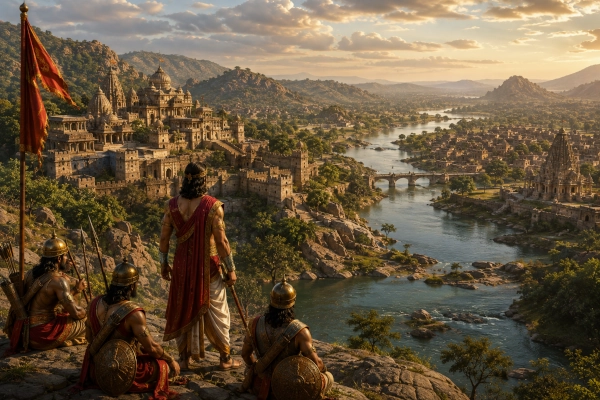
The ancient Chedi kingdom, also written as Cedi or Cheti, was one of the important political powers of central India described in the Mahabharata. Its territory is generally associated with the historic Bundelkhand region, which today is divided between Madhya Pradesh and Uttar Pradesh.
Chedi occupied a strategic position south of the Yamuna and within the river systems and uplands of central India. The kingdom appears repeatedly in the Mahabharata. Its rulers interacted with the Kurus, Pandavas, Yadavas, Magadhas, Kasis and other major powers of ancient Bharat. Ancient geographical traditions broadly place Chedi in Bundelkhand, although its exact political boundaries would have changed over time.
Its best-known ruler in the Mahabharata is King Shishupala, the powerful but bitter rival of Krishna. After Shishupala’s death during Yudhishthira’s Rajasuya, his son Dhrishtaketu became one of the Pandavas’ important allies and led Chedi forces in the Kurukshetra War.
Chedi therefore presents an unusual political transformation within the epic. Under Shishupala, the kingdom stood in opposition to Krishna. Under the next generation, it became firmly associated with the Pandava coalition.
Chedi at a Glance
| Feature | Identification |
|---|---|
| Ancient Kingdom | Chedi / Cedi |
| Capital | Suktimati / Suktimati-nagara |
| Approximate Modern Region | Bundelkhand |
| Modern States | Madhya Pradesh and Uttar Pradesh |
| Country Today | India |
| Important Early King | Uparichara Vasu |
| Famous Mahabharata King | Shishupala |
| Later King | Dhrishtaketu |
| Major Political Association | Magadha alliance under Shishupala; Pandava alliance under Dhrishtaketu |
| Major Mahabharata Event | Shishupala slain by Krishna at Yudhishthira’s Rajasuya |
| Kurukshetra Alignment | Pandava side under Dhrishtaketu |
| Ancient Historical Status | One of the sixteen Mahajanapadas |
Where Was Ancient Chedi?
The most widely accepted broad identification places Chedi in Bundelkhand, south of the Yamuna River. The region now extends across northern Madhya Pradesh and southern Uttar Pradesh. Ancient descriptions associate Chedi particularly with the country around the Ken and neighbouring river systems.
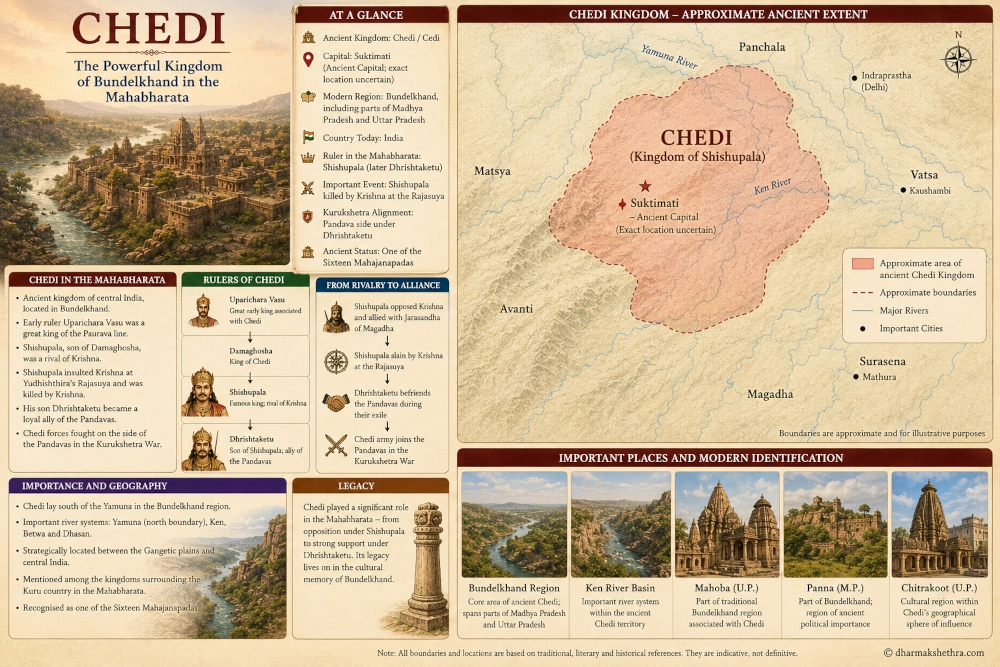
Bundelkhand today covers a large cultural region. On the Uttar Pradesh side it includes areas around Banda, Mahoba, Hamirpur, Jhansi, Lalitpur and Chitrakoot. In Madhya Pradesh, the wider region includes Chhatarpur, Panna, Tikamgarh, Niwari, Datia, Sagar and Damoh, among other districts.
The ancient kingdom should not be presented as exactly matching all these modern districts. Modern administrative boundaries cannot simply be projected backwards onto the Mahabharata period.
For a geographical reconstruction, Chedi is best shown as an approximate zone across Bundelkhand, centred south of the Yamuna and spanning territory that now lies in both Madhya Pradesh and Uttar Pradesh.
This also placed Chedi between several important regions of ancient Bharat. Vatsa lay towards the north-east around Kaushambi. Panchala and Kuru territory lay farther north. Matsya was situated towards Rajasthan, while Avanti and other central Indian kingdoms lay to the south and west.
Chedi therefore stood along an important geographical transition between the Gangetic plain and central India.
Suktimati: Capital of the Chedis
The Mahabharata identifies Suktimati as the capital of Chedi.
The Vana Parva provides particularly important evidence. When King Dhrishtaketu departed from the Pandavas, the text describes him returning to his beautiful city of Suktimati.
Suktimati also appears in traditions concerning the earlier Chedi ruler Uparichara Vasu. The city and a river bearing the same name form part of the narrative associated with his reign.
Unlike Viratanagara in Matsya or Kaushambi in Vatsa, however, Suktimati has not been securely identified with a single modern archaeological site.
Different scholars have proposed locations in the wider Bundelkhand and adjoining central Indian region. Some older reconstructions placed it around the Banda area, while other proposals have looked farther south-east. None has achieved universal acceptance.
A responsible historical map should therefore mark:
Suktimati — Ancient capital of Chedi; exact modern location uncertain.
The uncertainty does not weaken the broader identification of Chedi with Bundelkhand. It simply means that the precise location of its capital remains open to historical and archaeological study.
Uparichara Vasu: The Earlier King of Chedi
Long before Shishupala appears in the epic, the Mahabharata connects Chedi with the famous king Uparichara Vasu.
The Adi Parva describes Uparichara as a king of the Paurava line who conquered the prosperous kingdom of Chedi. The narrative associates him closely with Indra and presents him as an important ruler of the region.
Uparichara Vasu occupies a particularly significant place in the wider genealogical structure of the Mahabharata.
His story is linked to the birth of Satyavati, who would later marry King Shantanu of Hastinapura. Satyavati became the mother of Chitrangada and Vichitravirya and was also the mother of Vyasa through the sage Parashara.
Through this genealogy, the Chedi ruler Uparichara Vasu becomes indirectly connected with the very dynasty at the centre of the Mahabharata.
This relationship demonstrates how deeply interconnected the kingdoms of ancient Bharat are within the epic. Chedi was not an isolated central Indian kingdom. Its royal traditions became woven into the ancestry of the Kuru house itself.
Chedi as an Important Kingdom of Ancient Bharat
The Mahabharata repeatedly lists Chedi among the major kingdoms surrounding the Kuru political world.
When the Pandavas considered where they might spend their thirteenth year of exile in disguise, Chedi was among the kingdoms named as prosperous and suitable. The list included Panchala, Chedi, Matsya, Surasena, Dasarna, Avanti and other important states.
This passing reference is geographically important.
It shows that Chedi was regarded as a substantial and recognisable political territory within the larger network of northern and central Indian kingdoms.
The kingdom also survived in later historical memory. Buddhist traditions included Chedi among the sixteen Mahajanapadas, confirming that the name remained attached to an important political region in early historic India.
The Mahabharata’s Chedi and the later historical Mahajanapada should not automatically be assumed to possess identical boundaries. Nevertheless, their association with the same central Indian region is significant.
Shishupala: The Famous King of Chedi
The ruler most closely associated with Chedi in popular Mahabharata tradition is Shishupala.
He was the son of King Damaghosha and belonged to the Chedi royal house. Through his mother, Shishupala was related to Krishna. Their family relationship, however, did not produce political friendship. Instead, Shishupala became one of Krishna’s fiercest opponents.
Shishupala was not portrayed as an insignificant local ruler. He appears as a king capable of participating in the wider rivalries of the Mahabharata world.
He was closely associated with Jarasandha of Magadha, one of the most powerful rulers of the period described in the epic. This placed Chedi within a larger political grouping opposed to Krishna and the Yadavas.
The relationship between Chedi, Magadha and the Yadava world therefore became an important part of Shishupala’s political identity.
Shishupala and Krishna
The conflict between Shishupala and Krishna had both personal and political dimensions.
Shishupala repeatedly opposed Krishna and criticised his status among the rulers of Bharat. The rivalry reached its climax during Yudhishthira’s Rajasuya sacrifice at Indraprastha.
The Rajasuya was more than a religious ceremony. It proclaimed Yudhishthira’s growing imperial authority and brought kings and warriors from across Bharat to his court.
A major question arose over who should receive the first and highest honour among the assembled guests.
Bhishma declared that Krishna deserved that distinction.
Shishupala strongly objected.
The Rajasuya and the Death of Shishupala
Shishupala’s protest developed into one of the most famous confrontations of the Sabha Parva.
He challenged the decision to honour Krishna above the other kings and launched a sustained attack upon Krishna’s character and status.
Krishna initially tolerated the insults.
The Mahabharata connects this restraint with a promise made earlier to Shishupala’s mother. Krishna had agreed to forgive a large number of his cousin’s offences.
At the Rajasuya, however, Shishupala eventually crossed the limit Krishna had promised to tolerate.
Krishna then killed the king of Chedi.
The episode ended the life of Chedi’s most famous king, but it did not bring the kingdom itself to an end.
Instead, Chedi soon underwent a dramatic political realignment.
Dhrishtaketu Becomes King of Chedi
After Shishupala’s death, his son Dhrishtaketu emerged as ruler of Chedi.
This created one of the more interesting generational changes in the Mahabharata.
Shishupala had been a determined opponent of Krishna. Yet Dhrishtaketu became a close supporter of the Pandavas, whose strongest political ally was Krishna himself.
The Vana Parva confirms Dhrishtaketu’s relationship with the Pandavas. After Yudhishthira lost his kingdom and went into exile, Dhrishtaketu travelled to meet the Pandava brothers in the forest along with other allied rulers.
This was politically significant.
Visiting the Pandavas while they were dispossessed demonstrated that Chedi’s new king was prepared to maintain his alliance even when Yudhishthira no longer possessed a throne.
Chedi had therefore moved from Shishupala’s hostility towards Krishna to active support for the Pandava cause.
Suktimati Under Dhrishtaketu
The Mahabharata provides one of its clearest references to Chedi’s capital during Dhrishtaketu’s reign.
After meeting the Pandavas in exile, Dhrishtaketu departed for Suktimati, explicitly described as his city.
This makes Dhrishtaketu particularly important for reconstructing Chedi geography.
Suktimati was not merely a legendary settlement connected with an ancient ancestor. It remained the royal centre of the Chedi kingdom during the generation immediately preceding the Kurukshetra War.
The capital therefore belongs firmly within the political geography of the Mahabharata narrative.
Chedi Joins the Pandava Coalition
As negotiations between the Pandavas and Kauravas failed, rulers across Bharat were forced to choose sides.
Dhrishtaketu committed Chedi to the Pandavas.
The Mahabharata describes the powerful chief of the Chedis arriving with an akshauhini of troops to support the sons of Pandu. Chedi and Karusha forces were among the kingdoms firmly aligned with Yudhishthira.
Chedi was therefore not represented at Kurukshetra by a token royal contingent.
It contributed a substantial military force.
Dhrishtaketu was regarded as an important chariot warrior and held command responsibilities within the Pandava army. Traditional summaries of the Mahabharata describe him as leading troops associated with the Chedis, Kasis and Karushas.
This placed the king of Chedi among the important regional commanders of the war.
Dhrishtaketu at Kurukshetra
Dhrishtaketu fought throughout the great conflict on the Pandava side.
The fighting eventually brought him against Dronacharya, who had assumed command of the Kaurava forces after the fall of Bhishma.
Dhrishtaketu was killed by Drona during the war. Members of the Chedi royal family also fought and died in the conflict.
The fate of Chedi reflects the enormous human and political cost of Kurukshetra.
The kingdom entered the conflict as an important ally with its own royal house and army. Like many other kingdoms involved in the war, it suffered severe losses among its ruling warriors.
Yet Chedi’s decision to support Yudhishthira demonstrates how extensively the Pandava alliance reached into central India.
Chedi’s Changing Alliances
The political history of Chedi within the Mahabharata is particularly interesting because the kingdom cannot be described simply as belonging permanently to one camp.
Under Shishupala, Chedi belonged to a political world closely connected with Jarasandha and opposed to Krishna.
After Shishupala’s death, Dhrishtaketu aligned Chedi with the Pandavas.
This change reveals an important feature of the Mahabharata’s political landscape. Alliances were often based on rulers and dynastic relationships rather than fixed territorial blocs.
A kingdom could therefore change its diplomatic position when a new ruler took the throne.
Chedi provides one of the clearest examples.
Chedi, Magadha and the Politics of Central India
The relationship between Shishupala and Jarasandha is also important for understanding the strategic significance of Chedi.
Magadha occupied the eastern Gangetic region, while Chedi lay farther west in central India. An alliance between the two could connect political power across a wide section of the subcontinent.
Chedi’s geographical position in Bundelkhand placed it near routes linking the Gangetic plain with central and western India.
This would have made the region politically valuable regardless of the precise boundaries of the ancient kingdom.
The rivers and uplands of Bundelkhand also formed natural corridors between the Yamuna valley and the interior of Madhya Pradesh.
Chedi therefore belonged to a landscape that connected several of the Mahabharata’s major political zones.
Rivers and the Geography of Chedi
Bundelkhand is defined by river valleys, rocky uplands and the northern edge of the Vindhyan landscape.
The Yamuna forms the great river boundary to the north of much of the region. Rivers such as the Ken, Betwa and Dhasan flow northwards through Bundelkhand before joining the Yamuna system.
Ancient geographical reconstructions commonly place Chedi south of the Yamuna, with the Ken region forming an important part of its territory.
This terrain differs noticeably from the broad alluvial plains of Kuru, Panchala and Vatsa.
Rocky ridges, river gorges, seasonal forests and agricultural valleys dominate much of Bundelkhand. Such geography helped create a distinct central Indian cultural zone while still maintaining routes towards the Gangetic plain.
Chedi and Modern Bundelkhand
Modern Bundelkhand is divided between Uttar Pradesh and Madhya Pradesh, but culturally it continues to form a recognisable region.
On the Uttar Pradesh side, major districts associated with Bundelkhand include:
Jhansi, Lalitpur, Jalaun, Hamirpur, Mahoba, Banda and Chitrakoot.
Across the Madhya Pradesh side lie regions such as:
Datia, Niwari, Tikamgarh, Chhatarpur, Panna, Sagar and Damoh.
The ancient kingdom should not be mapped automatically over every one of these districts. They are best used as modern geographical reference points.
For an article map, the most historically cautious approach is to shade a broad central and northern Bundelkhand zone, spanning the present Madhya Pradesh-Uttar Pradesh border.
Where Should Suktimati Be Shown on a Map?
Suktimati presents the greatest challenge when mapping Chedi.
The Mahabharata clearly identifies it as the kingdom’s capital. What remains uncertain is its exact correspondence with a modern settlement.
Some historical scholars placed Suktimati in the vicinity of Banda in Uttar Pradesh. Other research has suggested alternatives farther into Madhya Pradesh.
For this reason, an article map should avoid presenting a modern city as unquestionably identical with Suktimati.
A better label would be:
Suktimati — Ancient Capital of Chedi
Exact modern location uncertain; traditionally placed within the Bundelkhand region.
This preserves the ancient textual evidence without presenting an unresolved archaeological question as settled fact.
Chedi as a Mahajanapada
Chedi’s importance continued beyond the epic tradition.
Later Buddhist texts list Chedi among the sixteen Mahajanapadas, the great territorial states of northern and central India during the early historic period. Its capital appears in Pali tradition as Sotthivati or Sotthivatinagara, corresponding to Sanskrit Suktimati.
This continuity is important.
The kingdom named in the Mahabharata did not simply disappear from Indian geographical memory. Chedi remained a recognised political name in later textual traditions.
The boundaries may have changed, dynasties may have changed and capitals may have risen or declined. Yet the regional identity of Chedi survived.
Ancient Chedi and Modern Geography
| Ancient Geography | Modern Reference |
|---|---|
| Chedi / Cedi | Bundelkhand |
| Suktimati | Exact modern identification uncertain |
| Northern geographical marker | Yamuna River |
| Important river zone | Ken and neighbouring Bundelkhand rivers |
| Modern Uttar Pradesh region | Banda, Mahoba, Hamirpur, Jhansi, Lalitpur and adjoining areas |
| Modern Madhya Pradesh region | Chhatarpur, Panna, Tikamgarh, Sagar, Damoh and adjoining areas |
| Modern States | Madhya Pradesh and Uttar Pradesh |
| Country | India |
For mapping purposes, the geographical identification can therefore be expressed as:
Chedi → Suktimati → Bundelkhand → Madhya Pradesh and Uttar Pradesh → India
Important Personalities Associated With Chedi
Uparichara Vasu
An ancient king associated with the establishment of Chedi’s royal tradition. The Mahabharata describes him conquering Chedi and ruling the kingdom. His family story is also connected with Satyavati and therefore with the ancestry of the Kuru dynasty.
Shishupala
The most famous Chedi king of the Mahabharata. He was Krishna’s relative and political rival. His opposition to Krishna culminated at Yudhishthira’s Rajasuya, where Krishna killed him after repeated insults.
Dhrishtaketu
Shishupala’s son and successor. Unlike his father, Dhrishtaketu supported the Pandavas. He visited them during their exile, brought Chedi forces to the Pandava coalition and fought at Kurukshetra. He was eventually slain by Drona.
Chedi’s Place in the Mahabharata
Chedi occupies a remarkable position in the epic because its story stretches across several generations.
It begins with Uparichara Vasu, whose royal lineage becomes connected with the ancestry of the Kuru house.
It later emerges as the kingdom of Shishupala, one of Krishna’s most outspoken enemies.
Chedi then witnesses the death of its king during the Rajasuya at Indraprastha.
Yet the story does not end there.
Under Dhrishtaketu, the same kingdom becomes a loyal supporter of the Pandavas. Chedi sends a major force to Kurukshetra and takes its place within Yudhishthira’s alliance.
Few kingdoms in the Mahabharata demonstrate the changing nature of ancient politics so clearly.
From the Mahabharata to Modern Bundelkhand
Today, the political kingdom of Chedi no longer exists, but its geographical memory survives within Bundelkhand.
The ancient landscape is now shared by Madhya Pradesh and Uttar Pradesh. Cities such as Jhansi, Banda, Mahoba, Chhatarpur, Panna and Tikamgarh belong to a modern region whose history extends through many later dynasties and kingdoms.
The name Bundelkhand itself belongs to a much later period, but the land beneath that name contains the geographical world traditionally associated with Chedi.
When the Mahabharata speaks of Shishupala returning to Chedi, Dhrishtaketu ruling from Suktimati or the Chedi army marching to join the Pandavas, the broad landscape behind those stories can therefore be sought in this part of central India.
The Legacy of Chedi
Chedi deserves attention not merely because Shishupala was killed by Krishna.
Its importance is much broader.
It was an established kingdom remembered across epic, Vedic and Buddhist traditions. It occupied a strategic central Indian region. It possessed its own royal capital at Suktimati. Its kings were connected with some of the most important dynasties of ancient Bharat.
Uparichara Vasu connects Chedi with the ancestry surrounding Vyasa and the Kuru dynasty.
Shishupala connects it with Krishna, Jarasandha and the political struggles preceding the Rajasuya.
Dhrishtaketu connects it directly with the Pandava coalition and the Kurukshetra War.
Seen on the modern map, Chedi belongs to the rugged and historic landscape of Bundelkhand across Madhya Pradesh and Uttar Pradesh.
The kingdom therefore forms an important bridge between the Gangetic political world of the Mahabharata and the great central Indian territories farther south.
For the geographical history of the epic, its most useful modern identification is:
Chedi — Bundelkhand, including parts of Madhya Pradesh and Uttar Pradesh, India.
Sources and Further Reading
Mahabharata — Adi Parva
The account of Uparichara Vasu identifies him with the conquest and rule of Chedi.
Mahabharata — Sabha Parva
Contains the Rajasuya narrative and the confrontation between Krishna and Shishupala.
Mahabharata — Vana Parva, Kisari Mohan Ganguli translation
Describes Dhrishtaketu, King of Chedi, visiting the exiled Pandavas and later departing for his capital Suktimati.
Mahabharata — Udyoga and Drona traditions
Describe Dhrishtaketu’s military support for the Pandavas and his participation in the Kurukshetra War.
Historical geography of the Mahajanapadas
Chedi is widely identified with the Bundelkhand region of present-day Madhya Pradesh and Uttar Pradesh. The precise archaeological identification of Suktimati remains uncertain.
You may also like
-
Yavana in the Mahabharata: Greek Connections, Pandava Campaigns and the Warriors of Kurukshetra
-
India and Sri Lanka Launch SAMHiTA Manuscript Digitisation Project to Preserve Ancient Buddhist Heritage
-
ASI Uses Ground-Penetrating Radar to Investigate Ancient Buddhist Stupa at Ujjain After Nearly 90 Years
-
Pahlava: The Parthian World Beyond India’s Northwestern Frontiers in the Mahabharata
-
Namami Gange in 2026: 368 Projects Completed, 4,339 MLD Sewage Treatment Capacity Created as Ganga Rejuvenation Advances
