India’s unmanned-aircraft industry is entering a new phase. The challenge is no longer merely to assemble drones in India, but to design the airframe, manufacture the structure, build the electronics, develop the flight-control software, create the propulsion system and integrate autonomous intelligence within the country itself.
Noida-based Raphe mPhibr is one of the Indian aerospace companies pursuing precisely this model.
Unlike manufacturers that depend heavily on imported subsystems assembled around an indigenous airframe, Raphe has built a vertically integrated research and manufacturing ecosystem covering areas such as carbon-fibre composites, metal and polymer manufacturing, printed circuit boards, flight-control systems, autonomous navigation, ground-control technology, propulsion and artificial intelligence. The company says its objective is to build systems from scratch so that it retains greater control over performance, efficiency and manufacturing.
The result is a growing family of military UAVs ranging from man-portable reconnaissance drones to high-altitude cargo aircraft, maritime-surveillance platforms and coordinated autonomous swarms.
From Drone Assembly to Aerospace Manufacturing
Vertical integration is perhaps the most important aspect of Raphe mPhibr’s Make in India story.
A modern military drone contains far more than an airframe and motors. It depends upon flight computers, power systems, communications equipment, navigation, composites, actuators, software, antennas, electronic assemblies and increasingly sophisticated artificial intelligence.
Dependence on imported components can therefore become a strategic vulnerability.
Raphe has consequently invested in manufacturing capabilities that would normally be distributed among several specialised suppliers. Its Noida infrastructure includes additive manufacturing, subtractive manufacturing, PCB assembly and composite manufacturing, while the company describes its approach as combining research-led innovation with end-to-end manufacturing.
Its technology portfolio includes lightweight carbon-fibre composites, autonomous navigation using simultaneous localisation and mapping — SLAM, advanced aerodynamic simulation, multilayer PCB manufacturing, surface-mount and system-on-chip integration, and ground-control technologies.
This creates a fundamentally different type of Indian drone manufacturer: not simply a company building UAVs, but one attempting to build much of the industrial infrastructure required to build UAVs.
An Indigenous Engine Programme
Propulsion is one of the difficult areas in which indigenous UAV development frequently encounters dependence on foreign suppliers.
Raphe says it has developed a fully indigenous two-stroke engine, employing technologies including metal additive manufacturing.
The company has also invested heavily in engine testing.
When Defence Minister Rajnath Singh inaugurated Raphe mPhibr’s advanced test facility in Noida in August 2025, the Ministry of Defence highlighted an engine test bed, metal additive-manufacturing infrastructure, furnaces capable of reaching temperatures as high as 2,800°C, and an advanced composite-polymer manufacturing centre.
These facilities matter because developing an aircraft engine requires far more than designing individual components. Materials, temperature behaviour, vibration, durability and performance under different atmospheric conditions must all be validated repeatedly.
Building those capabilities in India therefore strengthens not merely a single UAV programme but the country’s broader unmanned-aircraft engineering base.
mR20 — Taking Logistics Into the Himalayas
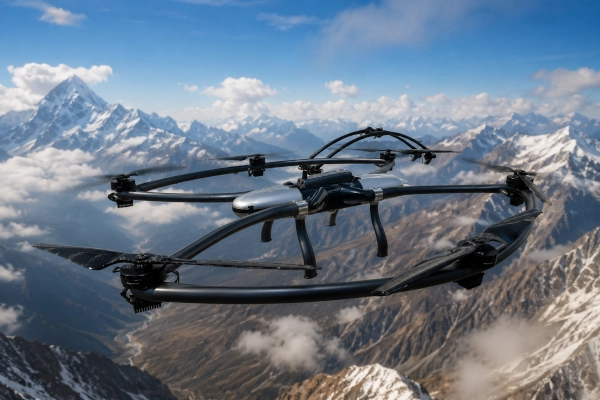
One of Raphe’s most interesting products is the mR20, developed for high-altitude logistics.
Janes describes the mR20 as a UAV designed specifically for delivering supplies in high-altitude environments, while Raphe has also presented it as its flagship logistics drone.
The requirement is particularly relevant to India.
Military positions in the Himalayas may lie at extreme altitudes and in terrain where roads can be blocked by snow, landslides or enemy observation. Moving relatively small quantities of ammunition, medicines, batteries, communications equipment or emergency supplies can consequently consume substantial manpower and helicopter resources.
A heavy-lift unmanned aircraft provides another option.
Rather than dispatching personnel across exposed terrain for every resupply mission, UAVs can potentially carry cargo between logistics nodes and forward positions.
The same technology has civilian utility. Janes notes that the mR20 can also support maritime resupply and humanitarian assistance and disaster-relief missions.
This dual-use capability is characteristic of heavy-lift unmanned aviation: a platform designed for mountain warfare can also become useful following floods, earthquakes and other disasters where conventional transport infrastructure has been disrupted.
Bharat — A Drone That Can Move With the Soldier
At the opposite end of Raphe’s UAV spectrum is Bharat, a lightweight man-portable surveillance system.
The aircraft is intended to provide rapidly deployable reconnaissance in difficult terrain, allowing troops to carry aerial surveillance with them rather than depending exclusively upon larger UAV detachments operating from distant bases.
That changes battlefield reconnaissance at the tactical level.
A patrol approaching a ridge, forest, settlement or suspected hostile position can potentially send an unmanned aircraft ahead before exposing personnel.
For mountain troops and border forces, such capabilities can considerably expand the area visible to a small unit.
Raphe’s customer base has included Indian government security organisations such as the Indian Army, Indian Navy, Indian Air Force, Border Security Force, Central Reserve Police Force and Indo-Tibetan Border Police, according to company information reported by TechCrunch.
X8 — Taking Unmanned Surveillance to Sea
Raphe has also developed the X8 for maritime patrol and situational awareness.
Operating drones at sea presents different engineering problems from operating them over land. Salt, humidity, wind, limited deck space, moving vessels and long distances from shore all influence the aircraft and its communications systems.
The X8 addresses the requirement for a relatively compact unmanned platform capable of extending a ship’s surveillance horizon.
For naval and coast-guard operations, small UAVs can provide persistent observation without requiring a helicopter to be launched for every reconnaissance task.
They can search for suspicious vessels, observe maritime approaches, assist boarding teams and contribute to situational awareness around ships and coastal installations.
This is particularly relevant to India, whose security requirements extend across the Arabian Sea, Bay of Bengal and Indian Ocean.
Neeraj — Combining VTOL With Fixed-Wing Flight
Raphe’s portfolio also includes Neeraj, a vertical-take-off-and-landing fixed-wing UAV.
Such aircraft attempt to combine two useful characteristics.
Vertical take-off and landing eliminates the requirement for a conventional runway, while transitioning to fixed-wing flight can provide significantly greater aerodynamic efficiency and endurance than remaining in multirotor flight throughout the mission.
This makes VTOL fixed-wing aircraft attractive for operations from confined locations, mountain posts, forward operating bases and potentially ships.
The technology therefore fills the space between small hovering drones and larger runway-dependent unmanned aircraft.
mR10 — From Individual Aircraft to Drone Swarms
Raphe’s most technologically ambitious work may lie in coordinated UAV operations.
Its mR10 family includes multirole aircraft and swarm applications, including variants identified as mR10-X8 and mR10-IC.
A drone swarm is fundamentally different from merely launching several UAVs simultaneously.
In a genuine coordinated swarm, aircraft exchange information and make collective decisions. Individual vehicles can maintain awareness of other members, divide an area among themselves, track targets and adapt to changes during the mission.
Raphe says its swarm architecture can coordinate up to 100 UAVs, provide AI-enabled automatic detection and tracking, achieve tracking precision of up to 99.5% under its stated conditions, and maintain peer-to-peer communication over distances of up to 5 km.
These are company-stated performance figures, but they illustrate the scale of the architecture being pursued.
The objective is not simply to fly 100 drones.
It is to make 100 aircraft function increasingly like one distributed aerial system.
Collective Intelligence
The strategic significance of drone swarms comes from what Raphe describes as collective intelligence.
Imagine a formation of autonomous UAVs searching a large area.
Instead of transmitting every instruction back to a human operator, individual drones can divide the search space, identify objects, exchange information and redirect themselves according to the developing situation.
If several aircraft are lost, the surviving members can potentially reorganise.
If one detects something important, neighbouring aircraft can concentrate sensors on that region.
The swarm thus becomes resilient partly because intelligence and sensing are distributed across many platforms.
Raphe also says its communications architecture can adapt in real time to changes in the radio-frequency environment, helping UAVs maintain connectivity during missions.
That becomes particularly important in an environment dominated by electronic warfare.
Fighting Without Dependence on GPS
Modern battlefields increasingly involve navigation jamming and communications interference.
A drone completely dependent upon satellite navigation can rapidly become ineffective when GNSS signals are denied or manipulated.
Raphe has therefore developed autonomous-navigation technology incorporating SLAM — Simultaneous Localisation and Mapping.
SLAM allows an autonomous system to build a representation of its surroundings while simultaneously estimating its own position within that environment. Raphe highlights this capability for UAV operations in difficult or remote locations.
For military applications, such technologies can reduce dependence upon uninterrupted satellite-navigation signals.
They also have applications in forests, mountains, urban environments, buildings and other locations where conventional navigation may become unreliable.
Building the Electronics in India
Another important layer of Raphe’s vertical integration concerns electronics.
The company lists capabilities including multilayer printed circuit boards, design-for-manufacturing optimisation, inline testing, SMT manufacturing and system-on-chip integration.
TechCrunch reported in 2025 that Raphe manufactures flight controllers, batteries, structural materials, wire harnesses and other UAV components domestically, while also developing proprietary autopilots and inertial-navigation systems. At that stage, some advanced sensors such as radars and high-end cameras were still imported, with the company working towards further localisation.
That qualification is important.
No complex aerospace system should casually be described as “100% indigenous” merely because the aircraft is manufactured domestically. The meaningful measure of indigenisation is how much of the design authority, intellectual property, critical electronics, manufacturing capability and supply chain actually resides within India.
Raphe’s strategy is significant because it is attempting to move progressively deeper into those layers.
Carbon Fibre as a Strategic Capability
Advanced composites are equally important.
Aircraft structures must simultaneously be strong and light. Every kilogram saved in structural weight can potentially become additional fuel, battery capacity, sensors or payload.
Raphe develops ultralight carbon-fibre composites, with the company specifically linking their strength-to-weight characteristics to aircraft efficiency and increased payload capability.
This is why composite manufacturing cannot be treated as a secondary industrial capability.
For long-endurance UAVs, missiles, aircraft and spacecraft, advanced materials directly influence operational performance.
By manufacturing composites internally, Raphe can optimise structures alongside aerodynamics rather than designing an aircraft around whatever imported structural components happen to be available.
Designing the Aircraft Digitally Before Building It
Raphe also uses advanced aerodynamic simulation to model airflow around aircraft and optimise designs before physical prototypes are produced. The company says these simulations help engineers reduce drag and refine UAV performance.
Its collaboration with Dassault Systèmes uses the 3DEXPERIENCE platform for simulation, validation and optimisation of UAV designs, with Raphe saying the approach has substantially shortened its prototyping cycle.
This is another important feature of modern aerospace manufacturing.
The competitiveness of an aircraft manufacturer increasingly depends not merely on machine tools but on its ability to create a digital engineering environment in which aerodynamics, structures, propulsion, electronics and manufacturing are developed together.
From a Small Laboratory to an Aerospace Campus
Raphe began with a relatively small research setup and progressively expanded its manufacturing footprint.
TechCrunch reported that the company grew from a roughly 2,000-square-foot research facility to a 100,000-square-foot research-and-manufacturing operation and subsequently toward a much larger 650,000-square-foot facility as investment accelerated.
Raphe’s own website now states that the company has accumulated approximately 2 million kilometres of flight experience, while its careers page lists more than 800 team members working across over 30 disciplines.
That multidisciplinary workforce is itself important.
Developing an autonomous aircraft requires aeronautical engineers, electronics engineers, materials scientists, programmers, artificial-intelligence researchers, propulsion engineers, manufacturing specialists and test personnel to work together.
India’s defence start-up ecosystem is therefore beginning to create not merely products but concentrations of specialist aerospace knowledge.
Recognition Under India’s Drone PLI Programme
Raphe mPhibr was also selected among the beneficiaries of India’s Production Linked Incentive scheme for drones and drone components.
Government records listed the Noida company among Indian drone manufacturers shortlisted under the programme.
The PLI scheme was designed to encourage domestic value addition and build a stronger indigenous drone-manufacturing ecosystem.
For Raphe, however, localisation goes considerably beyond the financial incentive itself because the company has built manufacturing capabilities across multiple stages of the UAV supply chain.
Tested in Operation Sindoor
Perhaps the strongest evidence that Raphe has moved beyond prototypes came after Operation Sindoor in 2025.
During the inauguration of Raphe’s Noida testing facility on August 30, 2025, Defence Minister Rajnath Singh stated that three products developed jointly by Raphe mPhibr and DRDO within 14 months had been successfully deployed during Operation Sindoor.
The Ministry of Defence also highlighted payload-drop drones, swarm drones and precision-guided-missile drones during the minister’s visit to the facility.
This represents an important transition for India’s defence start-up sector.
There is a major difference between displaying a drone at an exhibition and placing indigenous systems into operational military service.
The latter generates exactly the feedback required to improve reliability, survivability, communications and ease of deployment.
$100 Million to Expand Indian Aerospace Manufacturing
In June 2025, Raphe mPhibr raised $100 million in new investment led by General Catalyst, with participation from existing investors and others.
The company described it as the largest private funding round raised by an Indian company in its segment and said the capital would be used to expand aircraft design and manufacturing in India.
Janes similarly reported that the ₹8.5-billion investment would support the expansion of Raphe’s UAV research, development and production capabilities, particularly in materials, electronics and manufacturing equipment.
Private capital at this scale is significant because military aerospace development is expensive.
Aircraft must be repeatedly designed, manufactured, crashed, redesigned and tested before dependable operational systems emerge.
Deep-tech defence companies therefore require considerably more capital than software start-ups — but they also create physical industrial capabilities that can remain strategically valuable for decades.
An Emerging Indian UAV Stack
Raphe mPhibr’s most important contribution may ultimately not be any single drone.
It is the technology stack behind those drones:
Airframe design
Carbon-fibre composites
Metal manufacturing
PCB production
Flight controllers
Autopilots
Navigation systems
Propulsion
Artificial intelligence
Ground-control systems
RF communications
Swarm algorithms
Testing infrastructure
When these capabilities exist within one domestic industrial ecosystem, India gains something considerably more valuable than a fleet of UAVs.
It gains the ability to continuously design the next generation of UAVs.
That distinction lies at the heart of technological sovereignty.
Why Vertical Integration
A foreign supplier can stop delivering a camera.
Another country can restrict an engine.
Firmware support can disappear.
Navigation equipment can become unavailable.
Electronic components can be subjected to export controls.
A nation that merely assembles imported subsystems therefore remains vulnerable even if the final aircraft carries a domestic label.
Vertical integration reduces that vulnerability.
It also makes rapid modification easier. If the Army requires a different payload, if the Navy requires a maritime configuration or if electronic warfare demands a new communications architecture, an Indian company controlling much of the underlying design can modify the platform without waiting for foreign approvals.
For defence forces preparing for rapidly changing forms of warfare, this flexibility can become as important as the aircraft’s headline specifications.
From Make in India to Design in India
Raphe mPhibr represents the deeper stage of India’s Make in India and Aatmanirbhar Bharat programmes.
The first stage of industrialisation is manufacturing.
The second is component localisation.
The third is indigenous design.
The fourth — and strategically most important — is building sufficient domestic knowledge to continuously develop technologies that did not previously exist.
Drone swarms, autonomous navigation, indigenous propulsion, advanced composites and software-defined air vehicles sit firmly in this fourth category.
Raphe’s emphasis on controlling more of its own engineering and manufacturing chain therefore matters beyond the number of drones it sells.
It represents an attempt to establish Indian design authority over an entire class of military aerospace systems.
As unmanned aircraft become central to reconnaissance, logistics, maritime surveillance, precision attack and electronic warfare, the countries that control the underlying technologies will possess a major battlefield advantage.
Raphe mPhibr is positioning India to become one of them.
You may also like
-
ICAR Scientists Develop Indigenous Protective Gloves for Cotton Farmers, Sign Commercial Manufacturing Agreement
-
India Moves Towards Five-Year Assured Orders for Defence Startups Under New Procurement Reforms
-
BHEL–Coal India Joint Venture Begins Construction of ₹25,016 Crore Indigenous Coal Gasification Project in Odisha
-
Zen Technologies Introduces Indigenous Hyper-Strike Falcon AI-Guided Counter-Drone Interceptor
-
L&T and Germany’s SCHOTTEL Expand Partnership for Controllable Pitch Propeller Systems in Indian Shipbuilding
