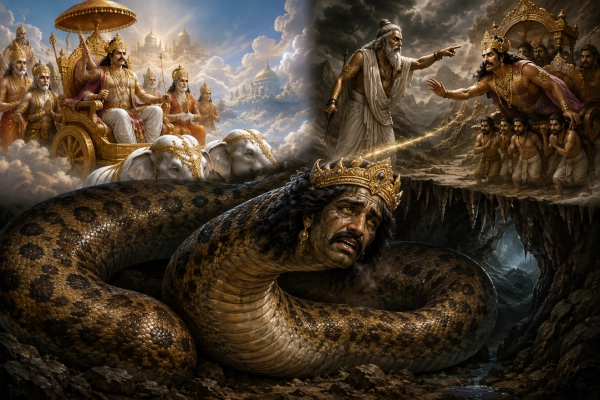
Bhima had faced Rakshasas, wild beasts and warriors whose very names inspired fear. His strength was legendary, and the Mahabharata repeatedly portrays him as possessing the power of thousands of elephants. Yet deep within a Himalayan forest, the mighty Pandava encountered an enemy against whom his enormous physical strength became completely useless.
Hidden inside a mountain cavern lay a gigantic serpent, immense as a hill and terrible to behold. When Bhima came near, the creature suddenly wrapped its enormous coils around him. Bhima struggled with all his power, but something inexplicable happened. The strength upon which he had relied throughout his life simply disappeared.
The serpent was no ordinary creature. It was King Nahusha, an ancient ancestor of the Pandavas who had once possessed extraordinary power and ruled over the celestial realms. Pride had destroyed him, and the sage Agastya had cursed him to fall from his exalted position and live upon earth in the form of a monstrous serpent.
Bhima could not defeat him with his arms. His rescue would instead depend upon the brother whose greatest strength was not physical power, but understanding.
When Yudhishthira finally reached the cavern, he found Bhima helpless within the serpent’s coils. Nahusha agreed to release his captive only if Yudhishthira could answer questions concerning Dharma, human character and the highest knowledge. What followed became one of the Mahabharata’s remarkable philosophical conversations, where the life of the strongest Pandava depended upon the wisdom of the eldest.
The Pandavas in the Himalayan Forest
The episode takes place during the Pandavas’ long exile in the Vana Parva. After travelling through the magnificent Himalayan regions, visiting sacred places and enduring the hardships of forest life, the brothers eventually settled for a time in the beautiful forest of Visakhayupa. The Mahabharata describes the surrounding mountains, waterfalls, forests and lakes in rich detail, creating a landscape that was both enchanting and dangerous.
Bhima was naturally drawn towards the wilderness. Powerful, fearless and restless, he frequently wandered far from the others while hunting. The dense forests and mountainous terrain presented little fear to a warrior who had already fought terrible Rakshasas and overcome dangerous animals with his bare strength.
On one such excursion, Bhima travelled deep into the forest. He crossed wooded slopes and rugged mountain ground while hunting boars, antelope and other animals. The Mahabharata describes him moving through the wilderness with immense confidence, uprooting trees, roaring through the forest and frightening lions and elephants with the sound of his approach.
Nothing in the forest seemed capable of challenging him.
Then Bhima entered a mountain region where his strength would mean almost nothing.
The Giant Serpent in the Cave
As Bhima wandered farther into the wilderness, he saw an enormous serpent occupying a mountain cavern. Its body was so vast that it appeared almost like part of the mountain itself. Its yellowish, spotted form stretched through the cave, while its enormous mouth and glaring eyes made it resemble death waiting in darkness.
The serpent watched Bhima approach.
Then it struck.
Before Bhima could properly react, the creature wrapped its massive coils around his body. The warrior immediately tried to tear himself free, relying upon the tremendous physical force that had saved him countless times before. Yet the harder he struggled, the more astonishing the situation became.
His strength vanished.
The Mahabharata explains that the serpent possessed a supernatural boon. Anyone caught within its grasp would lose his strength, however powerful he might ordinarily be. Bhima, whose might was described as equal to that of ten thousand elephants in this episode, found himself unable to break the serpent’s coils.
For perhaps one of the rarest moments in his life, Bhima realised that physical power could not save him.
Bhima Cannot Understand His Defeat
Bhima had fought lions, elephants, Nagas, Rakshasas and other formidable enemies. Few creatures could survive the force of his arms, and he knew the extent of his own strength. Being captured so easily by a serpent therefore left him bewildered.
Unable to escape, Bhima asked the creature to reveal its identity. He wanted to know how any being could overpower him when even enormous animals and supernatural creatures had failed to withstand him.
The experience forced Bhima into an uncomfortable realisation. Human strength, however impressive, had limits. A warrior could spend his entire life believing that power rested in muscle, weapons and courage, only to encounter a circumstance where none of those things provided an answer.
The serpent then revealed that Bhima had not been captured by an ordinary forest creature.
The being holding him was Nahusha.
The Fallen King Nahusha
Nahusha told Bhima that he belonged to the ancient royal lineage from which the Pandavas themselves descended. He was the son of Ayu and belonged to the Lunar Dynasty. Long before the Pandavas had been born, Nahusha had acquired extraordinary merit through sacrifices, austerities, Vedic study, self-restraint and royal prowess.
His greatness had raised him to an astonishing height.
Nahusha eventually gained dominion of the celestial realms. The king who had once walked upon earth found himself surrounded by gods, sages and supernatural beings. Power, splendour and honour flowed towards him from every direction.
Yet the very success that elevated Nahusha also began destroying him.
He became proud.
The discipline that had enabled him to rise was gradually replaced by arrogance. The king who had once acquired greatness through self-control began believing that his greatness placed him above others.
Thousands of Brahmanas and sages were made to carry his celestial conveyance. Nahusha later admitted that prosperity had intoxicated him and caused him to lose his judgement.
Among those great sages was Agastya.
Pride Brings Nahusha Down
Nahusha’s arrogance eventually led him into an act of disrespect towards Agastya. In the account Nahusha himself gives Yudhishthira, his foot came into contact with the sage while Agastya was helping carry his conveyance. The insult provoked the great Rishi’s anger.
Agastya cursed him to become a serpent.
The transformation was immediate and terrible. Nahusha fell from his celestial position and descended towards earth, losing the splendour and authority that had once surrounded him. As he fell, he begged the sage for forgiveness and asked whether the curse might eventually end.
Agastya did not condemn him forever.
The sage foretold that a righteous king named Yudhishthira would one day free Nahusha from his serpentine existence. When the pride responsible for his fall had been extinguished and the destined encounter took place, the ancient king would finally be released.
Thus Nahusha waited through the ages.
Eventually, destiny sent Bhima into his cavern.
Bhima Becomes the Serpent’s Prey
Nahusha told Bhima that he intended to eat him. The mighty Pandava had entered the serpent’s territory at the appointed time, and Nahusha considered him the food destiny had provided.
Bhima could do nothing.
The coils held him tightly, and the supernatural force associated with Nahusha’s curse had taken away his strength. The warrior who could uproot trees and crush enemies now remained trapped like an ordinary man.
Yet Bhima was not alone.
Back at the Pandavas’ dwelling, Yudhishthira realised that something was wrong. Disturbing signs and Bhima’s unusually long absence caused him concern, and he began searching for his younger brother.
Following Bhima’s trail through difficult and desolate terrain, Yudhishthira eventually reached the mountain cavern.
There he saw a sight that must have seemed almost impossible.
Bhima lay motionless within the coils of an enormous serpent.
Yudhishthira Arrives
Yudhishthira immediately asked what had happened. Bhima explained that the creature holding him was the ancient royal sage Nahusha and that the serpent intended to consume him.
The eldest Pandava did not attack.
He could see that violence would accomplish little where Bhima’s enormous strength had already failed. Instead, Yudhishthira addressed the serpent respectfully and asked it to release his brother. He even offered to provide other food so that Nahusha would not remain hungry.
Nahusha refused.
Bhima, he said, had arrived in accordance with the conditions governing his strange existence. After waiting a long time for food, he was unwilling to exchange Bhima for another meal.
Yet Nahusha offered another possibility.
If Yudhishthira could answer the questions he placed before him, Bhima would be freed.
The battlefield suddenly changed.
Bhima’s life would not be decided through mace, bow or physical combat. It would depend upon the quality of Yudhishthira’s understanding.
“Who Is Truly a Brahmana?”
Nahusha began with a profound question.
What, he asked, truly makes a person a Brahmana, and what is the highest reality that a person should seek to know?
Yudhishthira’s answer moved beyond birth and lineage. He explained that the qualities recognised in a true Brahmana include truthfulness, generosity, forgiveness, good conduct, compassion, benevolence and proper discipline. The status worthy of respect therefore rested upon character and conduct rather than merely upon ancestry.
As for the highest object of knowledge, Yudhishthira pointed towards the Supreme Brahman, beyond ordinary experiences of pleasure and suffering.
Nahusha immediately challenged him.
If virtues such as truth, compassion and generosity could also be found in a person born outside the Brahmana order, what then should determine that person’s true status?
Yudhishthira remained firm.
Character Above Birth
Yudhishthira answered that birth alone could not settle the matter. If the qualities of a Brahmana existed in a person conventionally called a Shudra, those virtues could not simply be ignored. Likewise, a person born into a Brahmana family who lacked the required character could not claim genuine superiority merely because of ancestry.
His argument placed conduct at the centre of human worth.
Yudhishthira explained that human society had become deeply intermixed and that birth alone could not reliably reveal inner character. Human beings shared the fundamental experiences of birth, speech, relationships and death. For this reason, virtuous conduct had to remain the essential measure.
Nahusha was impressed.
The ancient king had asked a difficult question, but Yudhishthira had refused to hide behind a superficial answer. Dharma, in his understanding, demanded that qualities actually be lived.
Having heard the response, Nahusha declared that he could no longer simply consume Bhima.
Yet the conversation did not end there.
Yudhishthira Questions Nahusha
Now Yudhishthira turned the discussion towards Nahusha himself.
The serpent clearly possessed great knowledge. He understood the Vedas and philosophical questions, even though pride had once destroyed him. Yudhishthira therefore asked what actions enable a person to reach a higher state.
Nahusha answered that generosity towards worthy recipients, truthful speech, kindness and refraining from harming living creatures lead a person towards heaven.
Yudhishthira then asked a subtler question. Which is greater: truth or charity? Which carries greater weight: speaking kindly or avoiding injury to living beings?
Nahusha did not give a rigid answer.
He explained that the relative importance of these virtues depends upon their consequences in a particular circumstance. Sometimes truth may be more important than a particular act of charity, while in another situation charity may have greater value. Similarly, avoiding harm may sometimes outweigh pleasant speech, while circumstances may alter the relative importance of the two.
The exchange reveals an important characteristic of Mahabharata Dharma.
Moral life cannot always be reduced to a mechanical list of rules.
Dharma Depends Upon Understanding Consequences
Nahusha’s response acknowledged that virtues may sometimes appear to compete. Truthfulness is noble, generosity is noble, kindness is noble and non-injury is noble, yet circumstances can place them into tension with one another.
The wise person must therefore understand not only the rule but also its purpose and consequence.
This theme appears repeatedly throughout the Mahabharata. Dharma becomes most difficult precisely where several legitimate duties meet. Yudhishthira himself repeatedly faces such dilemmas throughout his life, and his conversation with Nahusha becomes another examination of this deeper moral reasoning.
The giant serpent who had begun the encounter as Bhima’s captor now became a philosophical teacher.
The conversation moved from social identity and conduct towards karma, rebirth, consciousness and liberation.
Nahusha Speaks of Karma and Rebirth
Yudhishthira asked how the embodied being passes from one state of existence to another and experiences the consequences of its actions.
Nahusha explained the process through karma. According to his discourse, actions influence the conditions into which a being moves after death. Virtuous conduct leads upward, while actions driven by cruelty, greed, anger and harmful desire lead towards lower states.
He described living beings as moving through different forms while experiencing the consequences of their deeds. The wise person, however, seeks something beyond this continuous movement and turns towards the everlasting Supreme Spirit.
The lesson had a deeply personal meaning for Nahusha.
He was not merely describing the dangers of wrong action theoretically.
He himself was living inside the consequence of his own arrogance.
Mind, Intellect and the Self
The conversation became still more philosophical as Yudhishthira questioned Nahusha about perception. How does the embodied Self experience sound, touch, form, flavour and other objects through the senses?
Nahusha explained that the senses, mind and intellect act as instruments through which the Self experiences the world. The mind directs attention through the senses, while perception occurs successively rather than as an unlimited simultaneous grasp of everything.
Yudhishthira then asked about the distinction between mind and intellect. Nahusha responded by describing their different functions and their relationship with perception and the Self.
The scene is remarkable when one remembers its setting.
This was not a philosophical debate held peacefully in a royal hall. Bhima remained trapped inside the coils of a gigantic serpent while Yudhishthira and the fallen celestial king discussed the nature of character, karma, consciousness and liberation.
Physical danger and philosophical inquiry existed together.
That combination is deeply characteristic of the Mahabharata.
Yudhishthira Asks the Most Personal Question
Yudhishthira eventually turned from abstract philosophy towards Nahusha’s own life.
Here was a being who clearly possessed great knowledge. Nahusha understood scripture, Dharma, karma and the nature of the mind. He had performed extraordinary deeds and had once lived in celestial splendour.
How, Yudhishthira asked, could someone with such knowledge have fallen into arrogance?
Nahusha’s answer contains perhaps the most important lesson of the entire episode.
Prosperity can intoxicate even the wise and courageous.
Luxury, success and power can cloud judgement. Knowledge does not automatically protect a person from pride. Nahusha admitted that his own great prosperity had overwhelmed his reason and caused him to fall from his exalted position.
The confession transformed the serpent from a monster into a tragic figure.
Nahusha had not fallen because he lacked intelligence.
He had fallen because success made him forget humility.
The King Who Had Everything Lost Himself
Nahusha’s tragedy is especially striking because his rise had originally rested upon virtue. He had gained greatness through sacrifice, austerity, learning, discipline and strength of character. Yet after attaining power, he abandoned the very qualities that had enabled him to acquire it.
This reversal gives his story lasting force.
Success did not merely provide Nahusha with greater opportunities. It changed the way he viewed himself in relation to others. He began requiring great sages to carry him and treated spiritual greatness as though it were subordinate to royal authority.
The man who had conquered worlds failed to conquer pride.
Agastya’s curse therefore represented more than punishment. Nahusha’s transformation into a serpent reflected the spiritual fall that arrogance had already produced within him.
He had risen towards heaven through self-restraint.
He fell towards the earth when self-restraint disappeared.
Agastya’s Prophecy Is Fulfilled
Nahusha now understood why Yudhishthira had been destined to meet him.
When Agastya cursed him long ago, the sage had also shown compassion. He had foretold that Yudhishthira would eventually end the punishment. Once Nahusha’s pride had been exhausted and the righteous Pandava encountered him, the ancient king could return to his former state.
The long wait had finally ended.
Nahusha had questioned Yudhishthira about Dharma and received answers grounded in character, truth and virtue. In turn, Yudhishthira had questioned Nahusha and drawn from him the wisdom born not merely from learning, but from catastrophic experience.
Nahusha summarised the lesson he had learned. Truth, charity, self-restraint, austerity, non-injury and steadfast virtue, rather than mere family or lineage, form the path towards spiritual elevation.
Then the curse broke.
The Serpent Disappears
The monstrous form that had filled the mountain cavern no longer remained necessary.
Nahusha released Bhima.
Then the giant serpent form disappeared, and the ancient king regained his celestial appearance. Having completed the long expiation of his pride, he departed once again for heaven.
Bhima’s strength returned, but the experience had given the mighty warrior a lesson that no battlefield could have taught him.
Yudhishthira, Bhima and the priest Dhaumya returned to their dwelling. When the other Pandavas, Draupadi and the Brahmanas learned what had happened, Bhima was admonished for wandering recklessly into danger. The family was nevertheless overjoyed to see him alive and unharmed.
The forest returned to its quiet rhythm.
Yet the encounter had revealed profound truths about strength, pride and wisdom.
Bhima’s Strength and Yudhishthira’s Strength
The story deliberately places two very different forms of power beside one another.
Bhima possesses immense physical strength. His arms can defeat warriors, break trees and overpower monsters. Against most physical enemies, he is the brother the Pandavas need.
Yet Nahusha defeats him without effort.
Yudhishthira possesses another kind of strength. He does not uproot trees or terrify elephants. His power lies in patience, reasoning, knowledge and the ability to remain composed when someone he loves is in mortal danger.
Bhima could not break the serpent’s coils.
Yudhishthira loosened them through wisdom.
The story does not diminish Bhima. Instead, it demonstrates why the Pandavas are strongest together. Different crises require different virtues.
The Fall of Nahusha Is a Warning About Power
Nahusha’s story contains a warning that reaches far beyond kingship.
Power itself does not necessarily corrupt a person, but it creates conditions in which pride can grow unnoticed. Respect becomes expected. Privilege begins to feel natural. Those once considered equals may gradually be treated as instruments.
Nahusha had once deserved his greatness.
That fact did not protect him from losing it.
His story therefore warns that previous virtue provides no permanent immunity against future arrogance. A person who has performed noble deeds must continue practising restraint after success arrives.
Indeed, greater power demands greater vigilance.
Nahusha’s own words make the lesson unmistakable: prosperity can cloud even a wise person’s judgement.
Conduct Is Greater Than the Label
The discussion concerning who should truly be called a Brahmana is another important feature of the episode.
Yudhishthira’s answer focuses upon lived virtues such as truthfulness, charity, forgiveness, benevolence, discipline and compassion. When Nahusha points out that these qualities may exist in someone born outside the Brahmana order, Yudhishthira refuses to retreat into birth alone.
His emphasis falls upon character.
A respected identity without the qualities that justify that respect becomes hollow. Conversely, genuine virtue cannot simply be dismissed because of the circumstances of a person’s birth.
The philosophical exchange therefore asks the listener to look beyond external classifications and examine what a person actually does.
The principle fits the larger moral pattern of the story.
Nahusha had once possessed the highest external status imaginable, yet arrogance brought him down.
Yudhishthira remained a dispossessed king living in the forest, yet his conduct revealed his true greatness.
Wisdom Can Be Born From Failure
Nahusha is not presented only as a warning.
By the time he meets Yudhishthira, he has understood his mistake. His suffering has turned experience into wisdom, and the fallen king is capable of articulating profound truths about virtue, karma and liberation.
This gives the story an important dimension of redemption.
A terrible failure need not become the final definition of a person. Nahusha committed an act born from pride and suffered a long consequence, but he also recognised what had destroyed him.
His liberation came after arrogance had been extinguished.
The serpent therefore represented both punishment and transformation.
Nahusha entered the curse as a proud king.
He left it as a being who understood the danger of pride.
Dharma Defeats What Strength Cannot
Bhima’s capture initially appears to be another adventure involving a supernatural monster. Yet the Mahabharata quickly transforms the incident into something far more significant.
No weapon kills Nahusha.
No battle defeats him.
Instead, conversation resolves the crisis.
Yudhishthira listens, answers, questions and understands. Through that exchange, Bhima is rescued and Nahusha himself is liberated.
The encounter therefore presents knowledge not as something removed from action, but as a form of power capable of changing reality.
Bhima’s arms could not open the serpent’s coils.
Dharma could.
What the Story of Nahusha Teaches
The story teaches first that no form of worldly strength is absolute. Bhima’s power fails before a curse, while Nahusha’s celestial authority had earlier failed before his own arrogance. Strength without humility eventually encounters something stronger.
The episode also teaches that Dharma depends upon character rather than appearance alone. Yudhishthira repeatedly directs attention towards truth, compassion, generosity, restraint and conduct. Those qualities matter because they are practised, not merely because someone claims a respected identity.
Nahusha adds another lesson from his own bitter experience. Knowledge alone is insufficient if pride controls the mind. A person may understand Dharma intellectually and still abandon it when wealth, power or prestige creates intoxication.
Finally, the story presents wisdom as an active force. Yudhishthira does not rescue Bhima through violence. He rescues him because he can think clearly while facing fear and because his understanding reaches the being hidden beneath Nahusha’s terrible form.
When the Strongest Brother Needed the Wisest
Deep in the Himalayan wilderness, Bhima entered a cavern believing that little in the world could overpower him. Moments later, the mighty warrior lay helpless within the coils of a gigantic serpent.
The creature was Nahusha, an ancient king who had once reached the heights of celestial power only to fall because pride destroyed his judgement. Agastya’s curse had transformed him into a serpent and bound his liberation to a future meeting with Yudhishthira.
When that meeting finally came, the confrontation required no mace and no sword. Nahusha asked what makes a person truly worthy, what should be known, and what qualities lead towards higher existence. Yudhishthira answered by placing truth, compassion, generosity, restraint and conduct above empty status.
The conversation then turned towards karma, rebirth, mind, intellect and liberation. At its most personal moment, Yudhishthira asked how a knowledgeable and accomplished king such as Nahusha could ever have fallen so far.
Nahusha’s answer was the confession of a man who had learned through suffering: prosperity had intoxicated him.
With that understanding, the ancient curse reached its end. Nahusha released Bhima, abandoned the terrible serpent form and returned to heaven.
Bhima walked away alive, but the episode had reversed the ordinary expectations of strength. The warrior capable of defeating armies had been completely helpless. The brother often regarded as gentle and contemplative had saved him.
In the forest that day, the Mahabharata placed Bhima’s strength beside Yudhishthira’s wisdom and showed that there are prisons the strongest arms cannot break, but Dharma can open.
Mahabharata Source
The episode belongs to the Ajagara Parva within the Vana Parva of the Mahabharata. In the Kisari Mohan Ganguli numbering, Bhima’s encounter with the enormous serpent begins in Sections CLXXVII–CLXXVIII (177–178). Yudhishthira’s dialogue with Nahusha occupies Sections CLXXIX–CLXXX (179–180), after which Nahusha is released from his curse and returns to his celestial state.
The episode is distinct from the later and more famous Yaksha Prashna, even though both stories place Yudhishthira in a crisis where his brothers’ survival becomes connected with philosophical questioning. In the Nahusha episode, Bhima is captured by the cursed king in serpent form, while the Yaksha episode occurs later at the enchanted lake.
You may also like
-
Durga versus Mahishasura: Weapons, Battlefield Tactics and the Triumph of Shakti
-
National Institute of Naturopathy Opens Admissions for BNYS Programme at Pune for 2026–27
-
Yudhishthira’s Counter-Diplomacy With Shalya: Working With an Ally Who Has Joined the Other Side
-
Gnani AI Launches Nationwide Challenge Offering Up to 100 Paid AI Internships
-
NMMSS Scholarship Application Deadline Extended to October 31, 2026
