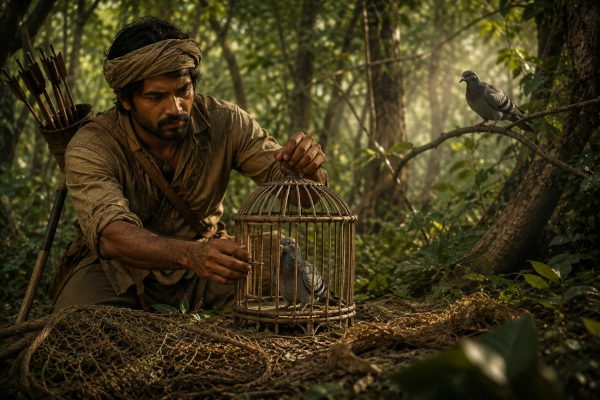
The storm descended suddenly upon the forest. Dark clouds gathered over the treetops and swallowed the fading light of evening. Fierce winds tore through the branches, scattering leaves across the ground, while heavy rain turned the forest paths into streams of mud. Animals rushed towards caves, hollows and thick bushes in search of shelter. Through this violent wilderness walked a hunter whose life had been spent trapping and killing birds. Nets, cages and weapons were the tools of his trade, and years of hunting had hardened him to the suffering of the creatures he captured.
Earlier that day, the hunter had caught a female pigeon and placed her inside a cage. To him, it was an ordinary event. He had captured countless birds before and rarely thought about the fear of the creatures struggling behind the bars. The pigeon was simply another prize from the forest. Yet before the day was over, this apparently insignificant bird and her mate would change the hunter’s life completely.
As the storm grew stronger, the hunter realised that he could travel no farther. His clothes were soaked, his body trembled from the cold and darkness was spreading rapidly through the forest. The man who had spent years pursuing frightened creatures now found himself vulnerable before the forces of nature. Searching desperately for shelter, he saw a large tree whose wide branches offered some protection from the rain. He hurried beneath it, placed the cage beside him and crouched against the trunk.
The hunter did not know that the tree beneath which he had taken shelter was the home of the very pigeon he had captured.
A Pigeon Waits for His Mate
High among the branches lived the female pigeon’s mate. The male pigeon had been waiting anxiously for her return. She had gone out earlier in search of food, but the evening had arrived and the storm had become fierce. He repeatedly looked beyond the nest, hoping to see the familiar movement of her wings through the rain. Each passing moment increased his fear that something terrible had happened.
The male pigeon called to her again and again, but only the wind answered. The nest around him suddenly seemed empty and lifeless. The same twigs remained in place, yet without his companion they no longer felt like a home. His thoughts turned entirely towards her safety. He wondered whether she had been injured by the storm, attacked by a predator or trapped somewhere in the forest.
He did not know that she was only a short distance beneath him, imprisoned inside the hunter’s cage.
From within the cage, the female pigeon heard her mate lamenting among the branches. She immediately recognised his voice and called out to him. The male pigeon was overwhelmed when he discovered that his beloved companion was alive, but his relief quickly turned to grief when he saw that she had been captured by the hunter sheltering beneath their tree.
The natural response would have been anger. The hunter had taken his mate prisoner and might eventually kill her. Yet the female pigeon did not urge her husband to attack the man or drive him away. Instead, she reminded him that the exhausted hunter had come beneath their tree seeking shelter from the storm. Whatever wrong he had committed, he was now a helpless traveller standing at their dwelling, and the duties of hospitality could not simply be abandoned.
Her words created a painful conflict for the male pigeon. The man beneath the tree was responsible for his wife’s captivity, yet he was also cold, hungry and dependent upon the protection of their home. The pigeon had to decide whether he would look upon the hunter only as an enemy or whether he would recognise the duty that had arisen because the man had become a guest.
The Hunter Becomes a Guest
The male pigeon mastered his anger and descended from the branches. He approached the hunter with courtesy and welcomed him beneath the tree. The hunter could scarcely have expected such kindness from a bird whose mate he had imprisoned, yet the pigeon treated him not according to what the hunter deserved, but according to the standards of conduct he believed a host must follow.
The hunter explained that he was suffering badly from the cold. His wet clothes clung to his body, and he was shivering uncontrollably. The pigeon immediately set about helping him. He gathered whatever dry leaves, grass and twigs he could find and arranged them beneath the shelter of the tree. A fire was eventually kindled, and the hunter moved close to the flames.
Slowly, warmth returned to the man’s body. The fire pushed back the darkness and cast a golden light across the wet forest floor. As the hunter recovered, he began to look more carefully at the small bird before him. He knew that the female pigeon in his cage was this bird’s companion. Yet instead of attacking him or leaving him to suffer in the storm, the male pigeon had given him warmth and protection.
The hunter had spent much of his life thinking of birds only as prey. Now one of those birds was treating him with a generosity he had rarely shown towards any living creature.
The Hunger of the Guest
After the cold had passed, another problem arose. The hunter told the pigeon that he was desperately hungry. The words greatly troubled the little bird. Providing shelter and warmth was not enough. A guest who arrived hungry should also be given food, yet the pigeon had nothing stored in his nest.
He searched around him, hoping that some grain, seed or fruit might be found. The storm had stripped the forest and made it impossible to travel far. Birds did not maintain stores of food like wealthy householders, and the pigeon possessed nothing that could satisfy the man’s hunger. He became deeply distressed because he believed that allowing a guest to remain hungry beneath his roof would leave his duty incomplete.
Then a terrible and extraordinary thought came to him.
If he possessed no food, he still possessed his own body.
The male pigeon moved towards the fire and circled it. He told the hunter that a guest should not leave the home of his host unsatisfied. Since there was nothing else he could offer, he would offer himself. Before the astonished hunter could fully understand his intention, the pigeon entered the flames.
The bird who had every reason to hate the hunter now sacrificed his own life to relieve that man’s hunger.
The Hunter Awakens to His Own Cruelty
The hunter stared at the fire in horror. His hunger vanished from his mind. For years he had captured and killed birds without considering their feelings, their families or the lives they shared among the trees. He had taken creatures from their nests, separated mates and carried them away in cages. Such suffering had once seemed ordinary to him.
Now one of those creatures had willingly sacrificed himself for his sake.
The pigeon had known exactly who the hunter was. He knew that the man had captured his wife. He knew that the hunter survived by killing birds. Yet when that same man arrived cold and hungry beneath his tree, the pigeon had refused to deny him shelter.
The hunter suddenly saw his own life through different eyes. He had always considered himself superior to the creatures he hunted because he was human and possessed greater intelligence. Yet the small pigeon had displayed compassion, loyalty and selflessness far beyond anything the hunter had shown.
Shame overwhelmed him. The weapons he carried, which had once given him confidence and power, now seemed like symbols of cruelty. He began to understand the countless lives he had destroyed and the suffering he had caused simply because he had never considered that the creatures around him possessed bonds and affection of their own.
The Cage Is Opened
The hunter then looked towards the cage beside him. Inside sat the female pigeon whose husband had just entered the fire. Only now did he fully understand the cruelty of keeping her imprisoned. The bird whose mate had sacrificed himself for him still remained his captive.
Unable to continue the injustice, the hunter opened the cage.
The female pigeon was free.
She could have flown immediately into the forest. No bars stood between her and the trees. The man who had captured her no longer intended to harm her. Yet when she looked towards the flames, she understood that the companion she had longed to return to was gone.
Her freedom had come at the moment when the home she wished to return to had become empty.
Overwhelmed by grief and devotion, the female pigeon chose to follow her mate. She entered the same fire into which her husband had sacrificed himself. The hunter stood helplessly watching as the two small creatures he had considered insignificant demonstrated a loyalty and self-sacrifice that shook him to the depths of his heart.
Neither bird had cursed him. Neither had sought revenge. Their response to his cruelty had instead been so extraordinary that the hunter could no longer continue living as he had before.
The Hunter Abandons His Old Life
The storm outside gradually weakened, but a far greater transformation had taken place beneath the tree. The hunter looked at his nets, cages and weapons and saw them differently. They represented years of violence that he had never seriously questioned.
He had entered the forest as a man who believed that the lives of birds existed for his use. He now stood before the remains of two pigeons whose conduct had revealed a moral greatness he had never known.
The hunter abandoned the life of cruelty he had followed. He released his attachment to hunting and turned away from the livelihood that depended upon killing helpless creatures. Fear had never changed him. Punishment had never changed him. Compassion had achieved what force could not.
The pigeons had conquered the hunter without attacking him.
They had defeated the cruelty within him.
The Dharma of Hospitality
At the heart of this story lies the principle of Atithi Dharma, the sacred duty owed to a guest. The male pigeon does not practise hospitality because the hunter deserves kindness. By every ordinary measure, the hunter deserves resentment. He has captured the pigeon’s wife and has spent his life killing creatures like them.
Yet when the hunter arrives beneath the tree cold and helpless, the pigeon sees a suffering guest before he sees an enemy. His conduct is therefore determined not by the hunter’s character, but by his own understanding of Dharma.
This does not mean that the story excuses the hunter’s violence. His actions remain wrong, and the pigeons’ kindness does not erase the harm he has caused. Instead, the tale presents a far more demanding idea. The wrongdoing of another person does not automatically determine how we must behave ourselves.
The hunter controls his own actions.
The pigeons control theirs.
The female pigeon’s role makes the teaching even more powerful. She has suffered directly because of the hunter, yet she is the one who reminds her husband not to abandon his duty. Though trapped inside the cage, she refuses to allow hatred to imprison her mind.
Her physical freedom has been taken away, but her moral freedom remains intact.
The Creature and the Human
The story also reverses the expected roles of teacher and student. The hunter is human. He possesses reason, language and the ability to understand right and wrong. The pigeons are tiny forest birds without wealth, learning or worldly power.
Yet when the moment of testing arrives, it is the birds who demonstrate higher conduct.
The hunter possesses weapons, but he lacks compassion. The pigeons possess almost nothing, yet they display hospitality, loyalty, courage and generosity.
By the end of the story, the hunter has become the student.
The birds have become his teachers.
The Mahabharata repeatedly presents Dharma through unexpected characters because moral greatness does not depend upon social rank, physical strength or worldly achievement. A king may fail in Dharma, while a humble creature may reveal its deepest meaning.
When Compassion Conquers Cruelty
The hunter’s transformation is perhaps the most important part of the tale. Had the male pigeon attacked him, the hunter might simply have defended himself or continued his violent life elsewhere. Had the birds cursed him, he might have dismissed their suffering.
Instead, the pigeon gives him something for which he is completely unprepared: compassion.
That compassion becomes a mirror.
For the first time, the hunter sees what he has become.
The male pigeon loses his life, but his sacrifice destroys something else at the same moment. It destroys the hunter’s indifference. The fire that consumes the bird also begins to consume the cruelty that has shaped the man’s life.
The hunter had captured the female pigeon physically, but the pigeons ultimately freed the hunter spiritually.
A Small Nest and a Great Teaching
The setting of the story is remarkably simple. There is no palace, battlefield or royal court. There is only a forest, a storm, a tree, a hunter and two pigeons.
Yet within that small setting, the Mahabharata explores enormous questions about hospitality, forgiveness, self-control and compassion. The tale asks what Dharma demands when the person seeking our help is someone who has harmed us. It asks whether moral conduct depends upon the worthiness of the recipient or upon the character of the person who chooses to act rightly.
The pigeons possess no kingdom or treasure to give away. Their home consists of a nest in the branches. Yet the male pigeon gives everything he possesses when he believes his duty requires it.
The hunter enters beneath their tree believing himself to be the stronger creature. He controls the cage. He carries the weapons. He decides which animals live and which die.
By the end of the night, that illusion has disappeared.
Physical strength belongs to the hunter.
Moral strength belongs to the pigeons.
The Fire That Changed a Human Heart
When the storm finally passed, the forest returned to its ordinary rhythms. The wind weakened, the rain stopped and the darkness slowly began to lift. Yet for the hunter, nothing could ever return to what it had been before.
He had entered beneath the tree carrying a captive bird and thinking primarily about his own suffering. He left after discovering that the creatures he hunted were capable of love, loyalty and sacrifice.
The fire beneath the tree had first warmed his frozen body.
The sacrifice of the pigeons awakened his conscience.
That is why the story of the pigeon couple and the hunter remains one of the Mahabharata’s most moving teachings on compassion. It shows that Dharma is easiest to praise when it costs nothing, but its true power appears when following it demands sacrifice.
The hunter had captured the pigeon, but in the end it was the pigeon who liberated the hunter from the cruelty that had ruled his life.
The tiny bird did not defeat him with strength.
He defeated him with goodness.
The Mahabharata Source
The story appears in the Shanti Parva of the Mahabharata, where Bhishma instructs Yudhishthira about Dharma after the Kurukshetra War. Often known as the Kapota Upakhyana, or the tale of the pigeons and the fowler, the episode explores the duties of hospitality, compassion towards those who seek refuge, the discipline required to follow Dharma and the power of selfless conduct to transform even a hardened heart.
You may also like
-
NLC India Opens 1,067 Apprenticeship Opportunities in Technical and Professional Fields
-
Indian Physicist Ashoke Sen Becomes First Indian to Receive Prestigious Oskar Klein Medal
-
Indian Army’s Northern Command Opens 75-Day Defence Technology Internship Programme for Young Innovators
-
Ayush Patent Filings Rise Eightfold as India Records 4,077 Applications and 711 Grants in 12 Years
-
DRDO Announces Paid Research Internships at Gwalior for Science and Engineering Students
