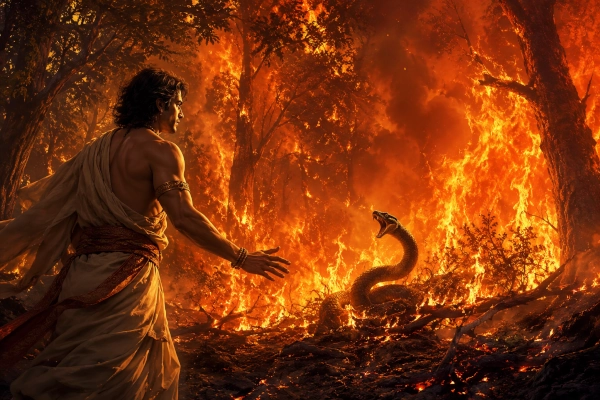
The forest had become both refuge and punishment for King Nala. Once the celebrated ruler of Nishadha, he had possessed wealth, honour, a prosperous kingdom and the love of the incomparable Damayanti. Now he wandered alone beneath unfamiliar trees, stripped of his throne, separated from his beloved wife and tormented by the unseen influence of Kali. Yet destiny had not abandoned him. Deep within that wilderness, amid smoke and flame, Nala was about to meet a mysterious serpent whose venom would change his appearance, conceal his identity and begin the long road toward his restoration.
The episode forms part of the Nalopakhyana, the celebrated story of Nala and Damayanti narrated in the Vana Parva of the Mahabharata. What first appears to be a frightening encounter with a serpent becomes one of the most remarkable examples of misfortune concealing divine purpose. The bite that seems like another punishment eventually becomes the means by which Nala is protected from his enemies, shielded from the influence of Kali and prepared to regain both his kingdom and his life with Damayanti.
Nala Alone in the Wilderness
After losing Nishadha in the disastrous game of dice, Nala had left his kingdom with Damayanti. The royal couple who had once lived amid luxury now wandered through forests wearing simple garments and surviving on whatever the wilderness provided. Their suffering was not merely physical, for Nala carried within him the destructive influence of Kali, who had entered him and gradually clouded his judgement.
Under that dark influence, Nala began behaving in ways that were contrary to his true nature. His love for Damayanti remained deep, yet confusion, despair and shame weakened his judgement. In a moment of terrible anguish, he abandoned her while she slept, convincing himself that she might have a better chance of finding safety without sharing his ruin. The moment he left, however, his burden became even heavier, for he knew that he had deserted the woman who had chosen him freely before kings and gods.
Nala wandered deeper into the forest, haunted by the memory of Damayanti. Every rustle among the leaves seemed to remind him of her presence, and every lonely path seemed to deepen his sense of loss. He had no army, no palace, no trusted minister and no certain destination. The former king of Nishadha had become a solitary traveller moving through an immense and unfamiliar wilderness.
The Forest in Flames
During his wandering, Nala suddenly saw an immense glow ahead of him. A great forest fire had broken out, and the flames were spreading rapidly among the dry trees. Smoke rolled through the woodland in thick clouds as burning branches cracked and fell. Birds fled from the canopy, animals raced through the undergrowth, and the intense heat spread across the forest with terrifying speed.
As Nala watched the fire, he heard a voice calling from within the flames. Someone was crying out to him by name and begging for rescue. Although he had lost his throne and everything that had once marked him as a king, his instinctive commitment to Dharma had not disappeared. Someone was in danger, and Nala could not turn away simply because he himself was suffering.
He moved toward the flames and followed the voice. The heat grew stronger as he advanced, and smoke filled the air around him. Eventually he reached the place from which the cries came and discovered an enormous serpent lying helpless upon the ground. The serpent was Karkotaka, one of the Nagas, yet despite his power he was unable to move even while the fire approached him.
Karkotaka and the Curse of Narada
Karkotaka explained that he had once deceived the great sage Narada and had been cursed for his conduct. As a consequence of the curse, the serpent had been forced to remain motionless in that place until King Nala himself came to rescue him. Thus the meeting that appeared accidental had, in truth, been awaiting Nala long before he entered the burning forest.
The revelation carried a strange significance. Nala believed himself to be a ruined man wandering without direction, yet his arrival had already been foretold in the destiny of another being. Even during the darkest period of his life, events were unfolding around him that he could not yet understand. Karkotaka begged Nala to lift him and carry him away from the advancing fire, and Nala agreed without hesitation.
Using his supernatural power, Karkotaka reduced his enormous body until he became small enough for Nala to carry. Nala lifted the serpent and began walking through the burning forest. The flames roared behind him, trees collapsed in showers of sparks, and ash drifted through the smoky air. Still, he carried Karkotaka carefully until both of them reached safety beyond the reach of the fire.
The Serpent Bites His Rescuer
Once they were safe, Nala prepared to place Karkotaka upon the ground. The serpent, however, instructed him to continue walking and to count his steps aloud. Nala obeyed and began moving forward, speaking each number as he went. When he reached the tenth step, Karkotaka suddenly struck and sank his fangs into Nala.
The king was stunned. He had just risked his life to save the serpent from the flames, and now Karkotaka had repaid him with a bite. Yet the venom did not kill Nala. Instead, an extraordinary transformation began to take place throughout his body.
Nala’s handsome appearance disappeared. His complexion changed, his body became altered and shorter, and his features were transformed until he no longer resembled the celebrated king of Nishadha. The man whose beauty had once been praised across kingdoms now possessed an appearance so different that even those who had known him well might fail to recognise him.
To Nala, the transformation appeared at first like yet another cruelty added to his suffering. He had already lost his kingdom, his wealth and Damayanti, and now even his own face seemed to have been taken from him. Karkotaka, however, quickly explained that the bite was not an act of betrayal. It was a carefully designed protection.
Venom Meant for Kali
Karkotaka knew that Kali still lived within Nala. It was Kali’s presence that had magnified Nala’s weaknesses, disturbed his judgement and helped drive him toward the disastrous game of dice and the separation from Damayanti. The serpent’s venom had therefore been directed not against Nala but against the dark influence dwelling inside him.
As long as Kali remained within Nala, Karkotaka’s poison would torment him. The venom that appeared dangerous to Nala would burn and weaken Kali instead. The king’s body, once exploited as a dwelling place by the destructive spirit, would now become a place of suffering for that same force.
Karkotaka further explained that Nala’s changed appearance would protect him in another way. A famous king could easily be recognised, followed or exploited, but a stranger with an unfamiliar form could travel without attracting suspicion. The loss of his handsome appearance was therefore not merely punishment. It was a disguise that would allow him to survive until the proper time came for him to reveal himself.
What seemed like another humiliation was actually armour. Nala had not been robbed of his identity; his identity had been hidden for his own protection.
Nala Becomes Bahuka
Karkotaka then instructed Nala to adopt a new name. From that moment onward, he would be known as Bahuka. In this altered form, Nala was to travel to Ayodhya and enter the service of King Rituparna.
Rituparna possessed extraordinary knowledge of numbers and the science of dice. Nala, on the other hand, possessed exceptional skill in horses and chariot driving. Their meeting would become crucial because each man held knowledge the other lacked. Nala would teach Rituparna the deeper science of horses, while Rituparna would eventually impart the secret knowledge through which Nala could understand the very game that had once destroyed him.
This instruction revealed the deeper purpose behind Karkotaka’s intervention. Nala had been defeated through dice, and if he was to recover fully, he could not merely avoid the memory of his failure. He had to acquire mastery over what had once mastered him. The path to restoration would therefore lead him directly toward the knowledge he had previously lacked.
Before they parted, Karkotaka gave Nala special garments and told him to preserve them carefully. When the proper time arrived and Nala wished to regain his original appearance, he was to remember the serpent and put on those garments. His true form would then return. The transformation into Bahuka was therefore temporary, even though Nala did not yet know when it would end.
The King Who Entered Another King’s Service
Nala travelled to Ayodhya in the form of Bahuka and presented himself before King Rituparna. His appearance was unusual, but his abilities quickly revealed that he was no ordinary wanderer. He possessed an astonishing understanding of horses, their strength, temperament, endurance and movement, and he could control a chariot with an expertise that few men could match.
Rituparna recognised Bahuka’s value and accepted him into royal service. Thus Nala, who had once ruled a kingdom of his own, became a servant in the household of another king. The change was profound. A man who had once commanded armies and ministers now lived without royal honour, and the world saw only the unfamiliar figure of Bahuka.
Yet this period of service was not meaningless. It became another stage of Nala’s education. He was learning patience, discipline and humility while remaining hidden from those who might have recognised him too soon. His identity as a king had been concealed, but his intelligence, skill and inner nature remained untouched.
Kali Suffers Within Nala
While Nala lived as Bahuka, Karkotaka’s venom continued its hidden work. Kali remained trapped within him and suffered from the poison. The same force that had entered Nala and used his weakness against him was now being tormented by the very body it had occupied.
This reversal lies at the heart of the episode. Kali may have believed that Nala’s ruin marked a complete victory, but the events of the forest had already begun to reverse that triumph. Nala’s suffering had led him to Karkotaka, and Karkotaka’s bite had begun weakening the influence that had helped destroy him.
The apparent disaster of the serpent’s bite therefore became part of Kali’s defeat. The Mahabharata repeatedly shows that the visible meaning of an event may differ greatly from its deeper consequence. What looks like destruction may actually be preparation for recovery.
A King Hidden Beneath Another Face
For Nala, living as Bahuka demanded extraordinary patience. He still loved Damayanti, remembered Nishadha and carried the pain of everything he had lost. Yet he could not simply reveal himself and attempt to reclaim his kingdom. Before returning to his former life, he needed to recover mastery over himself.
The disguise forced Nala to live without the symbols that had once defined him. He had no royal ornaments, no familiar face and no public recognition. His position in the world had changed completely, yet beneath the appearance of Bahuka remained the same intelligence, skill and capacity for kingship.
This experience became part of his inner transformation. Nala had once possessed power without understanding the weakness that could destroy it. As Bahuka, he learned to endure obscurity while gradually gaining the knowledge and strength needed for restoration.
Why Karkotaka’s Bite Was a Blessing
The deeper wisdom of Karkotaka’s act becomes clear only when all its consequences are considered together. If Nala had retained his famous appearance, he could have been recognised before he was ready. If Kali had remained comfortably within him, the dark influence might have continued to disturb his mind. If Nala had never reached Rituparna, he might never have acquired the knowledge necessary to overcome the weakness that had helped bring about his fall.
Through a single act, Karkotaka addressed all three problems. His venom tormented Kali, his bite changed Nala’s appearance, and his instructions sent the king toward Rituparna. What seemed like betrayal was therefore an extraordinary form of protection.
The episode also reveals why Dharma matters even when its reward is invisible. Nala did not enter the burning forest because he expected a benefit. He heard someone calling for help and responded because it was right to do so. Only afterward did he discover that the being he had rescued would become one of the instruments of his own salvation.
Karkotaka as an Instrument of Destiny
Karkotaka himself is not presented as a perfectly virtuous figure. He had once behaved deceptively and had suffered Narada’s curse as a consequence. Nala too was living through the consequences of earlier actions and weaknesses. When their paths crossed, however, each became part of the other’s release.
Nala freed Karkotaka from the curse that had bound him to the forest. Karkotaka, in turn, began freeing Nala from Kali’s influence and from the dangers associated with his identity. Their encounter shows how the consequences of Karma often unfold through relationships rather than in isolation.
One person’s suffering can become the occasion for another person’s deliverance. One act of compassion can set in motion consequences far beyond what the person performing it can foresee. The Mahabharata repeatedly returns to this interwoven nature of human destiny.
The Fire and the Transformation
The forest fire gives the episode an additional symbolic depth. Nala enters the flames as a broken and wandering king, but he emerges carrying the being who will transform him. The fire does not directly change Nala; rather, his act of courage within the fire brings him to the serpent whose bite will alter the course of his life.
The sequence is important because Dharma comes before reward. Nala does not know that rescuing Karkotaka will help him. He simply responds to a cry for assistance. The hidden benefit is revealed only after the righteous action has been completed.
In this sense, the fire marks a turning point. Before the encounter, Nala wanders almost without direction. Afterward, he possesses a new identity, a destination and a path toward knowledge. The king has not yet regained anything outwardly, but inwardly the movement toward restoration has begun.
Damayanti Remains in His Heart
Even while living as Bahuka, Nala never truly escapes the memory of Damayanti. His transformed face may hide him from the world, but it cannot alter the love he carries within him. Their separation remains the deepest emotional wound of his exile.
This is important because Nala’s restoration is not merely about recovering Nishadha. A kingdom regained without Damayanti would still leave his life incomplete. His journey must eventually lead him back not only to a throne but to the woman he abandoned during the darkest period of Kali’s influence.
The path created by Karkotaka will ultimately make that reunion possible. Nala’s disguise protects him until circumstances bring him once more within Damayanti’s reach. What begins with a serpent in a burning forest will eventually contribute to the reunion of husband and wife.
From Misfortune to Preparation
The greatness of the Karkotaka episode lies in the way every apparent misfortune is gradually reversed. A forest fire becomes the setting for rescue. A cursed serpent becomes a benefactor. Venom becomes protection. Disfigurement becomes disguise. Service becomes education, and defeat becomes preparation.
The Mahabharata repeatedly reminds its listeners that human beings rarely understand the full meaning of events while they are still passing through them. Nala could easily have viewed Karkotaka’s bite as one more act of cruelty from an already hostile world. Instead, the serpent revealed that the very event which seemed to diminish him was actually protecting his future.
Nala had not lost himself forever. His kingdom could be recovered, his appearance could be restored, and Damayanti could be found again. The time for those things had simply not yet arrived.
The Deeper Meaning of Karkotaka’s Gift
Karkotaka’s greatest gift was not merely protection from external enemies. He created the conditions through which Nala could defeat an enemy that had taken residence within him. Kali had exploited weakness, confusion and lack of mastery. Therefore Nala’s recovery required more than military strength or royal authority.
He needed knowledge where he had once been vulnerable. He needed patience where he had once acted under emotional pressure. He needed humility after having lived as a king, and he needed time in which to rebuild himself away from the expectations of the world.
The form of Bahuka gave him that time. Beneath an unfamiliar face, Nala could learn, endure and prepare. The serpent’s bite created the hidden space in which the fallen king could become capable of ruling again.
When the Wound Becomes the Medicine
The encounter between Nala and Karkotaka is one of the most memorable moments in the Nalopakhyana because it transforms the meaning of suffering itself. By the time Karkotaka bites him, Nala appears to have lost almost everything. His kingdom is gone, his wealth has disappeared, Damayanti is far away, and even his handsome appearance now vanishes.
Yet it is precisely at that moment that destiny begins to turn in his favour. Karkotaka’s venom starts tormenting Kali. His altered appearance shields him from recognition. His new identity carries him toward Rituparna, and the knowledge he will gain there will eventually help him reclaim what he has lost.
The serpent’s bite is therefore not the end of Nala’s fortune. It is the first medicine for his misfortune. The king has not yet returned, Damayanti has not yet found him, and Nishadha has not yet been restored, but beneath the unfamiliar form of Bahuka, Nala’s recovery has already begun.
The Mahabharata leaves us with a powerful lesson through this episode. A wound may sometimes conceal protection, a loss may create the space for transformation, and an event that appears to destroy a person may quietly prepare him for renewal. Nala entered the burning forest as a wandering king without direction, but he emerged from his encounter with Karkotaka carrying the first real hope of becoming himself again.
You may also like
-
Indian Physicist Ashoke Sen Becomes First Indian to Receive Prestigious Oskar Klein Medal
-
Indian Army’s Northern Command Opens 75-Day Defence Technology Internship Programme for Young Innovators
-
Ayush Patent Filings Rise Eightfold as India Records 4,077 Applications and 711 Grants in 12 Years
-
DRDO Announces Paid Research Internships at Gwalior for Science and Engineering Students
-
PM-SETU: Government Approves ₹1,194.92 Crore to Modernise 25 ITIs Across Maharashtra, Odisha and Jammu & Kashmir
