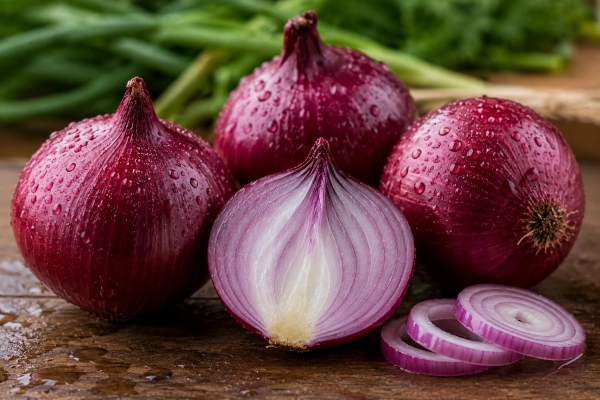
The onion is so familiar in the Indian kitchen that its medicinal identity is often overlooked. Ayurveda, however, knows the common onion as Palandu and describes it as much more than a flavouring vegetable. Classical tradition considers it a nourishing food with distinctive effects on Vata, strength, digestion and reproductive vitality.
Palandu is botanically identified as Allium cepa L. It belongs to the family Amaryllidaceae in modern botanical classification, although older botanical and Ayurvedic references often place it under Liliaceae. Kew’s Plants of the World Online recognises Allium cepa as an accepted species and describes it as a bulbous plant known primarily through cultivation.
The plant is known as Palandu in Sanskrit and Pyaz or Piyaz in Hindi. Malayalam commonly uses Ulli or Savala, while Tamil uses Vengayam and Telugu uses Ullipaya. The fleshy bulb is the principal part used as food and medicine, although traditional practices also employ the seeds and fresh juice.
Palandu in Classical Ayurveda
Palandu occupies an interesting place in Ayurvedic literature because it lies between Ahara and Aushadha — food and medicine. Classical Ayurvedic compilations discuss onion among edible vegetables, while later Nighantus describe its medicinal qualities in greater detail.
Ayurvedic herbal references associate Palandu with the Shaka Varga, or vegetable group, in classical dietary classification. Bhavaprakasha Nighantu compares some of its qualities with those of Rasona, or garlic. It describes Palandu as heavy and strengthening, supportive of vitality and particularly useful for pacifying aggravated Vata.
This is important because Ayurveda does not separate food sharply from medicine. A substance eaten every day can still produce specific effects on Dosha, Agni, Dhatu and Bala. Palandu illustrates this principle especially well.
Ayurvedic Properties of Palandu
Classical descriptions of Palandu vary slightly according to the text and interpretation. It is generally described as having a Madhura, or sweet, predominance with a degree of Katu, or pungent, character. Its qualities include Guru, meaning heavy, and Snigdha, meaning unctuous or nourishing.
Palandu is traditionally regarded as only mildly heating rather than intensely Ushna. Its post-digestive effect is described as Madhura. Bhavaprakasha characterises it as strengthening and specifically notes its ability to reduce Vata while tending to increase Kapha without greatly aggravating Pitta.
This combination gives onion an unusual Ayurvedic personality. Its pungent smell and taste suggest intensity, yet its deeper nutritional effect is regarded as nourishing. It can stimulate appetite while also contributing to strength and tissue building.
Effect on the Doshas
Palandu has its clearest traditional relationship with Vata Dosha. Its heaviness, moisture and nourishing quality oppose the dryness, lightness and instability associated with aggravated Vata.
This explains its traditional use in situations involving physical weakness, dryness and certain Vata-dominant discomforts. Its Snigdha quality can be especially relevant where dryness accompanies a Vata condition.
Palandu can increase Kapha when consumed excessively because it is heavy and nourishing. People with sluggish digestion, excessive mucus or pronounced Kapha characteristics may therefore tolerate large quantities poorly.
Its relationship with Pitta is more nuanced. Classical descriptions do not portray onion as intensely Pitta-provoking, but raw onion can feel heating or irritating to some people. Individual digestive response therefore remains important.
Palandu and Agni
Onion occupies an interesting position in relation to digestion. Its pungent character can stimulate the senses and appetite, while its heavier quality means that large amounts can become difficult for weak digestion.
Traditional Ayurvedic use therefore depends heavily on preparation. Raw onion behaves differently from onion that has been gently cooked with spices and fat.
Cooking reduces some of the sharpness and makes onion easier to incorporate into meals. When prepared with digestive spices, it becomes part of a broader Ayurvedic approach in which the preparation of food modifies its effects on the body.
This illustrates a central principle of Ayurveda: the same Dravya can act differently according to quantity, preparation and the person consuming it.
A Traditional Strengthening Food
One of the prominent classical attributes of Palandu is its association with Bala, or physical strength.
Bhavaprakasha describes onion as Balavirya-kara, indicating its traditional reputation for supporting strength and vitality. This helps explain why onion has historically appeared in the diets of people engaged in demanding physical work.
Its role should not be confused with the effects of a stimulant. Ayurveda sees nourishment as a gradual process involving digestion, assimilation and the proper formation of body tissues.
A strengthening food must therefore be appropriate for the person’s Agni. Even nutritious food can create heaviness when digestion is poor.
Palandu and Vrishya Tradition
Palandu also has a longstanding association with Vrishya, the Ayurvedic concept of supporting reproductive vitality and sexual strength.
Traditional descriptions link onion with nourishment, strength and reproductive vigour. This reputation is shared to some degree with garlic, although Ayurveda does not regard the two plants as identical.
The concept of Vrishya should not be reduced simply to the modern term “aphrodisiac.” Ayurvedic reproductive health involves the proper nourishment of the Dhatus, adequate strength, healthy digestion and the eventual formation of Shukra Dhatu.
Palandu’s traditional role therefore reflects its overall nourishing character rather than a claim that eating onion directly treats infertility or sexual dysfunction.
Palandu in Vata-Related Conditions
Ayurvedic herbal traditions have used onion in conditions associated with aggravated Vata. Classical herbal summaries describe its use in discomforts involving joints, stiffness and certain forms of pain.
Its traditional logic comes from its Snigdha and Guru properties. These qualities oppose the dry and light nature of Vata.
However, joint pain can arise from many causes. Arthritis, injury, autoimmune disease and infection require different approaches. Palandu should therefore not be presented as a substitute for proper diagnosis or treatment.
Traditional Respiratory Use
Onion has also been used in household traditions for cough and respiratory discomfort. Fresh onion juice appears in several regional practices, sometimes combined with honey or other ingredients.
Modern experimental research provides some biological context for these traditions. Reviews of Allium cepa have reported antioxidant, anti-inflammatory and respiratory effects in laboratory and animal models. However, researchers also emphasise that much of this evidence remains preclinical.
A traditional household remedy for a mild cough should therefore not be confused with treatment for asthma, pneumonia or other serious respiratory disease. Persistent breathing difficulty requires medical assessment.
Onion, Quercetin and Modern Research
Modern science has investigated onion extensively because it contains a wide range of biologically active compounds.
Among the best known are quercetin and other flavonoids, together with characteristic organosulfur compounds. These substances contribute to the aroma, flavour and biological properties of the onion. Reviews have investigated their antioxidant, anti-inflammatory, metabolic and cardiovascular effects.
Red and yellow onions can contain substantial concentrations of flavonoids, although the exact composition varies with cultivar, growing conditions and plant part. The dry outer layers can contain particularly concentrated flavonoids.
This research makes onion scientifically interesting, but isolated compounds should not be treated as equivalent to ordinary dietary onion. A concentrated quercetin extract can produce a very different exposure from a serving of cooked Palandu.
Cardiovascular Research
Onion and onion-derived quercetin have received particular attention in cardiovascular research.
One randomised, double-blind study examined a quercetin-rich onion-skin extract in people with overweight or obesity and elevated blood pressure. The researchers found a reduction in 24-hour systolic blood pressure among participants with hypertension, although the same effect was not found in the pre-hypertensive subgroup.
A broader meta-analysis of quercetin trials also found modest reductions in blood pressure. However, this research evaluated concentrated quercetin supplementation rather than ordinary culinary onion.
It would therefore be misleading to claim that eating onion is a treatment for hypertension. Palandu can form part of a balanced diet, but prescribed blood-pressure medication should never be replaced with onion or supplements.
Research on Blood Glucose
Modern researchers have also investigated Allium cepa in relation to glucose metabolism.
Experimental studies and some small human trials have reported effects on blood glucose. Reviews suggest that onion compounds may influence oxidative stress, insulin response and several metabolic pathways.
One small clinical study reported reductions in fasting blood glucose following consumption of fresh onion in participants with diabetes. However, the study was preliminary and cannot establish onion as a replacement for established diabetes treatment.
The evidence is better interpreted as a reason for further research. People using glucose-lowering medicines should not attempt medicinal quantities of onion extracts without professional advice.
Antioxidant and Anti-Inflammatory Activity
A substantial portion of modern onion research focuses on oxidative stress and inflammation.
Laboratory studies have demonstrated antioxidant activity from onion flavonoids and sulfur-containing compounds. Reviews also describe anti-inflammatory effects through several cellular pathways.
These findings offer plausible biological mechanisms for some traditional observations. They do not prove that onion can independently prevent or cure inflammatory diseases.
This distinction is especially important in herbal writing. The presence of an antioxidant compound does not automatically turn a food into a treatment for cancer, cardiovascular disease or autoimmune illness.
Palandu and the Skin
Onion has a particularly interesting modern connection with dermatology because onion extracts are used in some commercial scar preparations.
Clinical studies have examined topical formulations combining onion extract with ingredients such as allantoin. Some trials have reported improvements in scar appearance, while others have found little or no advantage over comparison treatments.
A systematic review concluded that onion-extract gels were not consistently superior to other topical treatments for scars. This mixed evidence is a useful reminder that traditional reputation and commercial popularity do not guarantee clinical effectiveness.
Fresh onion juice should also not be placed directly on open wounds. It can irritate sensitive skin and is not a substitute for sterile wound care.
Raw Onion and Cooked Onion
Ayurveda pays close attention to Samskara, or transformation through processing. Palandu offers an excellent everyday example.
Raw onion retains a sharper aroma and stronger pungency. Some people find it stimulating to appetite, while others experience bloating, burning or digestive discomfort.
Cooking softens both the texture and pungency. A cooked onion incorporated into a meal therefore has a different practical effect from concentrated raw onion juice.
Neither preparation is universally superior. Ayurveda asks whether the food suits the individual’s constitution, digestive strength, season and present imbalance.
The Bulb as the Principal Medicinal Part
The swollen bulb of Allium cepa is the part most familiar as both food and traditional medicine. Botanically, this bulb consists largely of thickened leaf bases that store nutrients for the plant. Oxford University’s botanical collection describes onion as a biennial plant in which these overlapping leaf bases form the familiar storage bulb.
Fresh bulb juice has historically been used in several household remedies. The bulb may also be roasted, cooked or incorporated into food according to the desired effect.
Seeds occur in some traditional medicinal practices as well, but they should not be assumed to have exactly the same properties as the bulb.
Palandu as Food Rather Than a Supplement
For most people, the safest and most useful role of onion remains its ancient one: food.
A normal culinary serving provides flavour and a range of plant compounds without exposing the body to the concentrations found in extracts or supplements. The difference between food and pharmacological dosing is important.
Ayurveda similarly recognises the importance of Matra, or quantity. A substance that is wholesome in one amount can become unsuitable when consumed excessively.
Palandu therefore demonstrates how an ordinary vegetable can have medicinal qualities without needing to become a daily concentrated remedy.
Onion, Sattvic Diet and Ayurvedic Medicine
Palandu also occupies an unusual position in Indian cultural traditions. Some yogic, devotional and ritual dietary systems avoid onion and garlic because they are considered unsuitable for a strictly Sattvic diet.
Ayurvedic discussions may likewise describe onion as increasing Rajas and Tamas in certain contexts. At the same time, Ayurveda recognises its nutritional and medicinal qualities and records its usefulness for Vata, physical strength and other purposes.
These ideas do not necessarily contradict each other. A substance can possess medicinal value while being excluded from a particular spiritual discipline or ritual diet.
Ayurveda asks whether a substance is appropriate for a specific therapeutic purpose. A spiritual dietary tradition may ask whether that same food supports a particular state of mind. The two systems are considering different objectives.
Cultivation and Botanical Character
Allium cepa is a bulb-forming plant that is usually cultivated as an annual for vegetable production, although botanically it behaves as a biennial. If allowed to complete its natural cycle, it produces a tall flowering stalk bearing a rounded umbel of small flowers.
Its hollow green leaves emerge from the base, while the underground bulb enlarges as the plant stores nutrients. Numerous cultivars have produced red, white, yellow and purple onions of different sizes, levels of pungency and storage characteristics.
The species has become one of the world’s most familiar cultivated vegetables. Kew describes it as a cultigen associated with Central Asia and recognises its extensive role as both food and medicinal plant.
Why Cutting Onion Makes the Eyes Water
One of Palandu’s most recognisable characteristics is its ability to make the eyes water when the bulb is cut.
Damage to onion cells initiates chemical reactions involving sulfur-containing compounds. These reactions generate the volatile lachrymatory factor responsible for the familiar eye irritation.
The reaction serves as another reminder of the complex chemistry hidden inside an ordinary vegetable. The same Allium chemistry that gives onion its pungent smell has also attracted considerable pharmacological research.
Who Should Be Careful With Palandu?
Onion is widely consumed as food and is generally well tolerated. Medicinal preparations, concentrated extracts and unusually large quantities require greater caution.
Some people develop abdominal discomfort, gas, reflux or other digestive symptoms after consuming onion, particularly in raw form. People with known onion allergy should avoid it, and topical application can cause irritation or contact reactions in sensitive individuals.
Those taking medicines for diabetes, blood pressure or disorders affecting blood clotting should discuss concentrated onion or quercetin supplements with a healthcare professional. Research suggests that onion-derived compounds can influence several of these physiological systems, but the clinical importance varies with the preparation and dose.
Children, pregnant women and breastfeeding mothers should also avoid experimenting with concentrated medicinal extracts unless appropriately advised. Normal culinary consumption is a different matter from therapeutic dosing.
Palandu as an Example of Ayurvedic Food Wisdom
The importance of Palandu lies partly in its ordinariness.
Ayurveda did not restrict medicine to rare forest herbs. It also studied the properties of grains, vegetables, fruits, oils, milk, spices and foods encountered every day.
Palandu represents this practical philosophy particularly well. It nourishes, adds flavour and influences digestion, yet its effects change according to quantity, preparation and the individual consuming it.
Its classical reputation as a Vata-pacifying and strengthening food also demonstrates the depth with which Ayurveda examined common dietary substances.
Conclusion
Palandu, the familiar Allium cepa, stands at the meeting point of Ayurvedic dietetics, traditional medicine and modern nutritional research.
Classical Ayurveda describes it as heavy, nourishing and particularly useful for reducing Vata. It is also associated with Bala and Virya, reflecting its traditional role in supporting physical strength and vitality. At the same time, its Kapha-increasing potential means that it does not suit every person in unlimited quantities.
Modern science has identified flavonoids such as quercetin and numerous sulfur-containing compounds within onion. Research has explored their effects on oxidative stress, inflammation, blood pressure and glucose metabolism. Yet much of this evidence involves extracts, isolated compounds or preliminary studies rather than ordinary dietary consumption.
Palandu therefore deserves to be understood without exaggeration. It is neither merely a kitchen ingredient nor a miracle medicine.
Its deeper lesson is distinctly Ayurvedic. Food itself can influence health, but its value depends on the person, preparation, quantity, digestive strength and purpose for which it is used.
The humble onion in the kitchen is thus also a Dravya worthy of study. Ayurveda recognised that connection between nourishment and medicine long before the term “functional food” entered modern nutritional science.
References
The botanical identity and accepted taxonomic status of Allium cepa are supported by Royal Botanic Gardens, Kew — Plants of the World Online, which recognises Allium cepa L. as an accepted bulbous cultivated species. Classical Ayurvedic properties and the Bhavaprakasha description of Palandu are reproduced in the medicinal-plant reference of DAV Pharmacy, with reference to Bhavaprakasha Nighantu and the NIIMH e-Nighantu collection.
Modern pharmacological context comes from peer-reviewed reviews of Allium cepa covering its phytochemistry, antioxidant activity, inflammation and metabolic effects. Human research on onion-derived quercetin and blood pressure includes a randomised controlled study of quercetin-rich onion-skin extract and a wider systematic review of quercetin supplementation.
Research concerning topical onion extract and scars includes both favourable individual trials and studies finding no significant improvement, which explains why the evidence remains mixed.
Health Disclaimer
This article is provided for educational and informational purposes and discusses traditional Ayurvedic knowledge alongside modern scientific research. It does not provide medical advice, diagnosis or treatment, and traditional uses described here should not be interpreted as proven treatments for disease.
Onion consumed as an ordinary food is different from concentrated onion juice, extracts or supplements used medicinally. Anyone with a chronic illness, known allergy or ongoing prescription medication should consult an appropriate healthcare professional before using Palandu in medicinal quantities.
Do not use onion preparations as a replacement for prescribed medicines for diabetes, hypertension, respiratory disease, infertility, infection or any other medical condition. Persistent or severe symptoms require proper medical evaluation.
You may also like
-
Bharat Biotech’s Nucelion and VeGen Bio Partner to Manufacture Advanced Dual-Target CAR-T Cancer Therapy in India
-
Ayurveda and Anger: How Emotional Excess Affects Physical and Mental Health
-
Ayurveda and Stress: Daily Practices for Mental Balance and Emotional Well-Being
-
Ayurveda and Bowel Routine: Why Regularity Matters for Digestive Health
-
Why Ayurveda Warns Against Suppressing Hunger, Thirst and Sleep
:%20The%20Everyday%20Onion%20in%20Ayurveda%20as%20Food,%20Medicine%20and%20Strengthening%20Dravya)