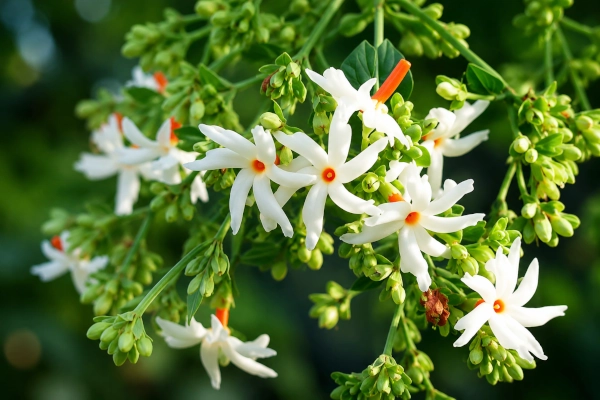
Botanical Name: Nyctanthes arbor-tristis L.
Sanskrit Name: Pārijāta
Other Names: Harsingar, Shefalika, Night-flowering Jasmine, Coral Jasmine
Family: Oleaceae
Parts Traditionally Used: Leaves, flowers, bark and seeds
Few Indian medicinal trees combine beauty, fragrance, sacred association and traditional healing as naturally as Parijata.
During the evening, clusters of delicate white flowers open with brilliant orange-red centres. Their fragrance intensifies through the night. By morning, many flowers have fallen beneath the tree, creating a striking white-and-orange carpet.
Ayurveda knows this plant as Parijata, botanically identified as Nyctanthes arbor-tristis L. It belongs to the Oleaceae family. Ayurvedic institutions record its flowers, leaves and bark among the parts used medicinally.
Parijata has traditionally been associated with Jvara, inflammatory conditions, Krimi, certain skin disorders and Vata-Kapha disturbances. Modern research has begun investigating several of these traditional uses, especially its anti-inflammatory, anti-arthritic, antioxidant and metabolic effects. Much of that evidence, however, remains preclinical.
The Meaning of Parijata
Parijata is one of India’s culturally significant flowering trees.
Traditional Sanskrit literature also refers to the plant as Shefalika. The Hindi name Harsingar is widely used across northern India.
The botanical name Nyctanthes arbor-tristis reflects one of the tree’s most distinctive features. Its flowers bloom after sunset and begin falling by morning.
Although commonly called night-flowering jasmine, Parijata is not a member of the botanical genus Jasminum. It belongs to the Oleaceae family but forms part of the genus Nyctanthes.
Its nocturnal flowering habit gives the tree an almost ethereal presence in an Indian garden.
Botanical Description
Parijata grows as a shrub or small to medium-sized deciduous tree.
Its bark is greyish-brown and slightly rough. The leaves are simple, opposite and usually ovate to lance-shaped. They have a noticeably coarse texture.
The flowers are the tree’s most recognisable feature.
Each flower carries white petals around a vivid orange-red tubular centre. The flowers are intensely fragrant and usually open at night. The fruits develop as small, flattened brown capsules.
CCRAS herbarium collections maintain several medicinal parts of Nyctanthes arbor-tristis, including its leaves, flowers, stem and stem bark.
Ayurvedic Profile of Parijata
The Ayurvedic understanding of a medicinal plant begins with its Rasapanchaka.
| Ayurvedic Property | Parijata |
|---|---|
| Rasa — Taste | Tikta — bitter |
| Guna — Qualities | Laghu, Ruksha — light and dry |
| Virya — Potency | Ushna — heating |
| Vipaka — Post-digestive effect | Katu — pungent |
| Dosha Action | Vata-Kapha Shamaka |
| Traditional Actions | Jvaraghna, Shothahara, Krimighna, Raktaprasadaka |
These properties are recorded in contemporary Dravyaguna teaching material for Parijata.
Its bitterness, dryness and heating potency help explain its traditional application in conditions associated with excess Kapha, Ama and certain Vata-Kapha disorders.
Jvaraghna — Parijata and the Ayurvedic Understanding of Fever
One of Parijata’s best-known traditional actions is Jvaraghna, meaning its use in the Ayurvedic management of Jvara.
Jvara in Ayurveda is broader than simply an elevated body temperature. It involves changes in digestion, strength, appetite, metabolism and the balance of the Doshas.
Parijata leaves have a long history of traditional use in febrile conditions. The plant’s reputation as an antipyretic is also frequently reported in ethnopharmacological literature.
Modern research has explored these traditional observations, but Parijata should never be treated as a substitute for diagnosis or established treatment of persistent fever.
Fever can result from infections and other serious conditions. Medical evaluation is particularly important when fever is severe, prolonged or accompanied by other symptoms.
Shothahara — Traditional Support in Swelling and Inflammation
Parijata is also described as Shothahara, an Ayurvedic action associated with reducing Shotha or swelling.
This traditional use has attracted considerable scientific interest.
Experimental studies using Nyctanthes arbor-tristis leaf extracts have reported anti-inflammatory and anti-arthritic activity in animal models. A 2023 study examining its traditional use in rheumatic conditions also investigated safety and anti-rheumatic effects in laboratory models.
Earlier experimental research likewise reported analgesic and anti-inflammatory effects from extracts of the plant.
These studies support further investigation.
They do not establish Parijata as a replacement for medicines used to treat rheumatoid arthritis, autoimmune disease or other inflammatory disorders.
Parijata and Joint Disorders
Traditional use of Parijata frequently includes conditions involving joint pain, stiffness and swelling.
This is particularly relevant within the Ayurvedic understanding of Vata-Kapha involvement.
Its Ushna Virya may help counter the cold and obstructive characteristics traditionally associated with Kapha and certain forms of aggravated Vata. Its Ruksha quality also fits the classical logic of reducing excessive heaviness and accumulation.
Modern researchers have therefore studied Nyctanthes arbor-tristis in experimental models of arthritis and rheumatic inflammation.
The results remain mainly preclinical, so clinical treatment should remain under qualified medical supervision.
Krimighna — Traditional Use Against Krimi
Ayurveda also describes Parijata as Krimighna.
The Sanskrit concept of Krimi includes more than the modern idea of intestinal worms. It covers several forms of organisms or pathological influences considered capable of disturbing the body’s normal state.
Traditional literature has long recorded Parijata for anthelmintic applications. Modern ethnopharmacological reviews also document this historical use.
This does not mean that homemade Parijata remedies should replace clinically proven anti-parasitic treatment.
Proper diagnosis remains important because different parasites require different medicines.
Parijata and the Skin
Parijata also appears in traditional descriptions of remedies for certain skin conditions.
Its Tikta Rasa and traditional Raktaprasadaka action help explain this association within Ayurveda.
Traditional medical literature has recorded the plant in relation to skin ailments, while modern researchers have investigated antimicrobial, anti-inflammatory and antioxidant activity from different plant extracts.
However, skin disease has many possible causes.
Fungal infection, bacterial infection, allergy, autoimmune disease and inflammatory disorders can appear similar. Persistent skin problems therefore require proper diagnosis.
Parijata and Raktaprasadana
Ayurvedic descriptions sometimes classify Parijata as Raktaprasadaka, referring to its traditional role in supporting the healthy state of Rakta Dhatu.
This Ayurvedic concept should not be translated loosely as “blood purification.”
Rakta in Ayurveda has physiological meanings that extend beyond the modern laboratory definition of blood. Raktaprasadana therefore refers to restoring balance within that classical framework rather than physically removing unspecified “toxins” from the bloodstream.
Using accurate language helps preserve the original Ayurvedic concept.
Leaves — The Most Important Medicinal Part
Parijata leaves occupy a prominent place in traditional medicinal use.
They are characteristically rough, opposite and green. Ayurvedic preparations may use the leaves as powders, decoctions or freshly prepared preparations according to the condition being managed.
CCRAS maintains authenticated leaf material of Nyctanthes arbor-tristis in its research collections, reflecting its importance as a medicinal plant.
Because concentrated leaf preparations can produce physiological effects, medicinal use should not be treated like ordinary herbal tea.
Flowers — Fragrance, Colour and Medicinal Interest
The flowers are gentler in appearance but chemically interesting.
Parijata flowers contain several classes of plant compounds, including iridoid-related constituents, flavonoids and other phytochemicals. Contemporary Ayurvedic teaching references also note iridoid glycosides, flavonoids, tannins and essential oils among the plant’s constituents.
Laboratory studies have investigated antioxidant activity in flower extracts.
One experimental study found that hydro-alcoholic flower extracts displayed antioxidant and free-radical-scavenging properties under laboratory conditions.
Such findings are useful for understanding the plant’s chemistry.
They should not be interpreted as proof that Parijata flowers prevent or cure diseases in humans.
The Orange Centre of the Flower
The vivid orange-red tubular centre gives Parijata its distinctive appearance.
Traditionally, the coloured portion of the flower has also been valued as a source of natural pigment.
The contrast between the white petals and orange centre makes fallen Parijata flowers immediately recognisable beneath the tree each morning.
This colouring also contributes to the plant’s long cultural association with decorative and ritual use.
Parijata and Liver Research
Modern scientific research has also investigated possible hepatoprotective effects.
CCRAS completed a preclinical research project examining the hypoglycaemic, hepatoprotective and anti-dyslipidaemic activity of Parijata flower extract in experimental animals.
This is an important example of traditional medicinal plants entering systematic government-supported research.
However, an animal study does not establish treatment efficacy in humans.
Parijata should not be used to self-treat hepatitis, fatty liver disease, jaundice or other liver disorders.
Research Into Blood Lipids
CCRAS researchers have also investigated Parijata flowers for their possible effects on blood lipids.
In 2025, CCRAS listed research on the antidyslipidaemic activity of hydro-alcoholic Parijata flower extract in Wistar rats.
Such work may help identify useful plant compounds or future therapeutic leads.
At present, however, it does not justify replacing statins or other prescribed lipid-lowering medicines with Parijata preparations.
Research Into Blood Sugar
Parijata has also entered research connected with glucose metabolism.
The CCRAS experimental programme included evaluation of hypoglycaemic activity from the flower extract in animal models.
More recent laboratory research has studied compounds in Parijata flowers and leaves for possible effects on enzymes connected with carbohydrate digestion.
This field remains exploratory.
People with diabetes should not alter medicines or insulin after taking Parijata without medical guidance.
Anti-Arthritic Research
Perhaps the strongest bridge between traditional use and modern investigation involves joint inflammation.
Several experimental studies have examined extracts of Nyctanthes arbor-tristis in models of arthritis and inflammatory disease.
Researchers have reported reductions in selected inflammatory measures in these models.
The findings support Ayurveda’s long-standing interest in the plant, but more high-quality human clinical trials are required before firm therapeutic conclusions can be made.
What Are the Important Phytochemicals?
Researchers have identified several classes of compounds within Parijata.
These include:
- Iridoid glycosides
- Flavonoids
- Phenolic compounds
- Tannins
- Essential-oil constituents
- Sterols and related plant compounds
Contemporary Dravyaguna material specifically highlights iridoid glycosides, flavonoids, tannins and essential oils.
Different parts of the tree contain different concentrations and combinations.
Therefore, leaf extract, flower extract, bark preparation and seed preparation should not be considered chemically identical.
Parijata in Malaria Research
Parijata has an interesting history in traditional fever management, and this has led researchers to investigate its possible activity against malaria.
A reverse-pharmacology study examined Nyctanthes arbor-tristis in the context of malaria and referred to earlier clinical observations involving Parijata leaf preparations.
This area remains investigational.
Parijata must never replace proven antimalarial drugs. Malaria can become life-threatening rapidly, and treatment must follow medical diagnosis and appropriate antimalarial protocols.
Traditional knowledge may provide leads for drug discovery, but that is very different from recommending self-treatment.
Antimicrobial and Antiparasitic Research
Laboratory research has examined several Parijata compounds against microorganisms and parasites.
For example, researchers have studied iridoid glucosides isolated from Nyctanthes arbor-tristis for activity against Leishmania species in laboratory systems.
Other studies have evaluated extracts for antibacterial and related biological activities.
These findings are scientifically interesting but remain far removed from establishing a standard clinical treatment.
Can Parijata Be Used Every Day?
Parijata should not automatically be treated as an everyday wellness herb.
A fragrant flower and a medicinal leaf preparation are very different things.
Ayurveda selects herbs according to Dosha, Agni, disease condition, strength, age, season and accompanying medicines. An herb considered beneficial in one situation may be unsuitable in another.
Because Parijata is Ushna, Tikta and Ruksha, excessive or inappropriate use may not suit everyone.
Medicinal use is best guided by a qualified Ayurvedic practitioner.
A Note on Safety
The existence of traditional use does not mean that unlimited quantities are safe.
A 2023 experimental study of Nyctanthes arbor-tristis leaf extract reported that higher exposures could be associated with effects such as drowsiness, sedation and lethargy in the investigated context.
Safety can also depend on the plant part, extraction method and dose.
Pregnant women, breastfeeding mothers, children and people with chronic illnesses should seek professional advice before medicinal use.
Anyone taking medicines for diabetes, blood pressure, inflammatory disease or other long-term conditions should also discuss herbal products with their clinician.
The Sacred Beauty of the Night
Parijata occupies a special place because its medicinal identity exists alongside its cultural one.
Its fragrant flowers open while most gardens become quiet. Before sunrise, they begin falling gently to the earth.
This unusual rhythm has helped make Parijata one of India’s most memorable sacred and ornamental trees.
The plant demonstrates an important feature of traditional Indian life: medicinal plants were rarely separated completely from gardens, ritual, household culture and ecological knowledge.
A useful tree could also be beautiful.
A sacred flower could also become medicine.
Parijata Through the Ayurvedic Lens
Ayurveda does not value Parijata merely because one laboratory compound has shown activity.
It understands the plant through an integrated set of characteristics.
Its Tikta Rasa provides bitterness. Its Laghu and Ruksha Guna give lightness and dryness. Its Ushna Virya provides heating action, while its Katu Vipaka shapes its post-digestive effect. Together, these qualities help explain its traditional Vata-Kapha balancing applications.
This framework developed long before phytochemical laboratories existed.
Modern research now provides another way of examining the same plant.
The two systems ask different questions, but both can contribute useful knowledge when interpreted carefully.
Parijata — Where Fragrance Meets Medicine
Parijata is much more than a night-blooming ornamental tree.
Ayurveda remembers it as a Jvaraghna, Shothahara and Krimighna medicinal plant. Traditional practice has used its leaves, flowers, bark and other parts for different purposes.
Modern science has found enough biological activity to justify continued research.
Anti-inflammatory effects have been studied. Anti-arthritic activity has been explored. Government-supported researchers have examined its flowers for metabolic and liver-related effects. Scientists have also investigated its iridoid glycosides, flavonoids and other compounds.
Yet much remains to be established through rigorous human trials.
That does not diminish Parijata’s value. Instead, it places the plant exactly where many important Ayurvedic herbs stand today: supported by centuries of traditional knowledge, increasingly explored by modern science, but still requiring careful research before broad medical claims can be made.
Each evening, Parijata quietly opens its flowers.
By dawn, they return to the earth.
Between those two moments lies one of Ayurveda’s most beautiful medicinal trees.
References
Central Council for Research in Ayurvedic Sciences records Nyctanthes arbor-tristis among medicinal plants used in Ayurveda and has conducted pharmacological research involving Parijata flower extract.
Rohilkhand Ayurvedic Medical College and Hospital’s Department of Dravyaguna Vigyan records the botanical identity, Rasapanchaka, Dosha action and principal traditional actions of Parijata.
A peer-reviewed ethnopharmacological review examines the traditional uses, pharmacology, chemistry and research gaps associated with Nyctanthes arbor-tristis.
Experimental studies have investigated anti-rheumatic, anti-inflammatory and anti-arthritic effects from Nyctanthes arbor-tristis extracts.
Health Disclaimer
This article is intended for educational and informational purposes only. It is not medical advice and should not be used to diagnose, treat, cure or prevent any disease. Parijata can have significant physiological effects, and medicinal preparations may interact with medicines or existing health conditions. Pregnant or breastfeeding women, children, elderly people and those with chronic illnesses should consult a qualified physician or registered Ayurvedic practitioner before medicinal use. Parijata must not replace prescribed treatment for fever, malaria, arthritis, diabetes, liver disease, infections or other medical conditions.
You may also like
-
Bharat Biotech’s Nucelion and VeGen Bio Partner to Manufacture Advanced Dual-Target CAR-T Cancer Therapy in India
-
Ayurveda and Anger: How Emotional Excess Affects Physical and Mental Health
-
Ayurveda and Stress: Daily Practices for Mental Balance and Emotional Well-Being
-
Ayurveda and Bowel Routine: Why Regularity Matters for Digestive Health
-
Why Ayurveda Warns Against Suppressing Hunger, Thirst and Sleep
