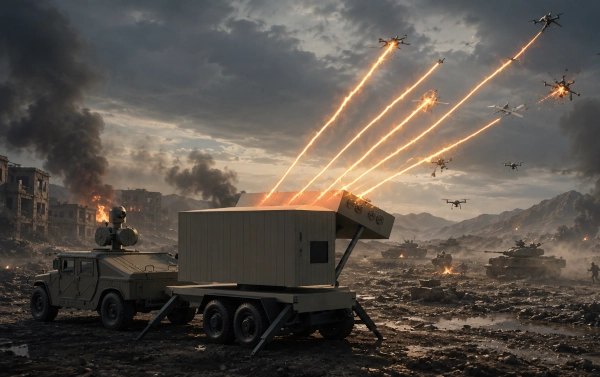
Modern warfare is increasingly decided by the side that can see, identify and engage first.
A soldier operating at night needs a thermal weapon sight. A tank crew needs cameras capable of observing outside the vehicle without exposing themselves. A naval vessel needs passive sensors that can detect aircraft and missiles without continuously radiating like a radar. A precision weapon needs a seeker capable of recognising and following its target. A drone requires a lightweight electro-optical payload that provides useful imagery without consuming much of its limited power or payload capacity.
Bengaluru-based Tonbo Imaging is building precisely this layer of India’s defence technology ecosystem.
The company designs sensing, processing, communications and guidance systems encompassing thermal-imaging cores, weapon sights, surveillance equipment, targeting systems, missile seekers, fire-control equipment and embedded vision systems. Tonbo describes itself as a defence-electronics OEM specialising in electro-optical/infrared, or EO/IR, technologies, with systems intended for soldiers as well as land, naval, airborne and missile platforms.
But what makes Tonbo particularly interesting from a Make in India perspective is not simply the number of cameras it produces.
It is attempting to shrink an entire battlefield sensor-and-processing architecture into increasingly compact packages.
The Technology Behind Seeing in Complete Darkness
Ordinary cameras depend primarily upon visible light.
Thermal imagers work differently.
Objects emit infrared radiation according to their temperature. A thermal detector converts differences in this infrared energy into an image, allowing a person, vehicle, engine or other heat-emitting object to be detected even in darkness.
For soldiers, this means night no longer necessarily provides concealment.
For armoured vehicles, it means drivers and commanders can manoeuvre and detect threats without depending solely upon visible-light cameras.
For missiles, infrared imaging can become part of the guidance system that distinguishes the target from its background.
Tonbo’s portfolio spans visible, mid-wave infrared and long-wave infrared technologies and combines these with image processing, sensor fusion, target tracking and artificial intelligence.
The strategic value therefore lies at the intersection of three technologies:
Optics + infrared sensing + computing.
Miniaturisation Is the Real Battlefield Advantage
A surveillance camera mounted on a building can be large.
A missile seeker cannot.
Neither can a sight attached to a soldier’s rifle or a payload mounted beneath a small drone.
Military electro-optics therefore face a constant engineering challenge known broadly as SWaP — Size, Weight and Power.
The sensor must become smaller without losing useful range.
The electronics must consume less electricity.
The optics must withstand shock, vibration, temperature changes and battlefield conditions.
And increasingly, the system must perform image processing and artificial intelligence locally rather than sending everything to a distant computer.
Tonbo specifically identifies miniaturisation as one of its areas of focus, developing compact thermal weapon sights and scalable sensor packages that can be adapted for remote weapon stations, loitering munitions, ISR systems and soldier-wearable equipment.
That makes miniaturised EO/IR a strategic enabling technology rather than merely another category of defence electronics.
TUVE — Building the Thermal Imaging Core
At the centre of many thermal-imaging systems is the thermal core.
A thermal core combines the infrared detector and associated electronics required to turn incoming infrared radiation into usable imagery. Manufacturers can integrate such cores into weapon sights, binoculars, surveillance systems or larger sensor payloads.
Tonbo’s tactical systems use its TUVE thermal-imaging architecture.
For example, the company’s EK-HHTI uses a 640×480 microbolometer array combined with thermal-image processing and digital connectivity. The company describes the system as suitable for border, coastal and battlefield surveillance across land, air and maritime environments.
Developing the core technology is important because the thermal detector sits very close to the strategic heart of an infrared system.
India has historically depended heavily upon imported infrared detectors.
Indeed, an official iDEX/ADITI challenge issued by the Ministry of Defence specifically identified indigenous infrared-detector production as a strategic requirement, noting that these detectors were being imported and calling for the creation of a domestic manufacturing base.
Tonbo has consequently stated that it intends to invest in indigenous LWIR sensor fabrication, using part of a ₹175-crore funding round announced in 2025 to strengthen domestic infrared technology.
If that programme succeeds at industrial scale, it could represent an important step beyond manufacturing thermal cameras in India toward manufacturing one of their most critical underlying technologies in India.
Spartan — Turning the Rifle Sight Into a Computer
The modern weapon sight is becoming considerably more sophisticated than a simple optical telescope.
Tonbo’s Spartan family includes compact thermal weapon sights, including clip-on systems and digitally connected variants.
The company’s connected sight architecture combines thermal imaging with computing and communications, allowing the weapon sight to interact with other soldier systems such as helmet displays and spotter equipment. Tonbo also lists tactical-network compatibility and integrated communications features within this architecture.
This points toward the emerging concept of the networked soldier.
Instead of every device functioning independently:
the rifle sight can observe the target,
the helmet can display the sight picture,
another soldier can receive the imagery,
and target information can potentially travel through the tactical network.
The weapon sight is therefore evolving from an optical accessory into a battlefield sensor node.
EK Gen2 — Putting a Fire-Control Computer on a Rifle
Tonbo’s EK Gen2 goes another step.
The system combines a thermal imager with a laser rangefinder, meteorological sensors, inertial sensors and an integrated ballistic computer.
The sight can measure range and environmental conditions and calculate ballistic corrections rather than forcing the shooter to perform those calculations manually.
Tonbo lists applications ranging from sniper rifles to the 84-mm Carl Gustaf weapon system.
This demonstrates an important trend in infantry warfare.
Electronic fire control — once associated primarily with tanks and artillery — is progressively moving downward to individual weapons.
The soldier increasingly receives machine-assisted targeting information directly through the sight.
Cobra — Fusing Visible and Thermal Worlds
One sensor rarely provides perfect information.
Visible-light cameras can provide detail and familiar imagery but perform poorly in darkness.
Thermal sensors can detect heat in darkness and difficult visibility but may not always provide the same identification detail as visible imagery.
Sensor fusion attempts to combine both.
Tonbo’s tactical portfolio includes the Cobra fused thermal weapon sight, part of a broader family of multispectral equipment designed to combine information from different parts of the electromagnetic spectrum.
The operator can consequently receive richer information than would be available from either sensor independently.
This same principle scales upward from an infantry sight to tanks, ships, aircraft and missiles.
Giving Armoured Vehicles 360-Degree Vision
One of Tonbo’s more ambitious systems is STAR — See Through Armour.
An armoured vehicle presents a basic visibility problem.
The armour that protects the crew also prevents them from seeing the surrounding battlefield directly.
Historically, crews have relied upon periscopes, observation ports and individual cameras. Modern technology makes something much more sophisticated possible.
Tonbo’s STAR architecture uses multiple visible and thermal cameras positioned around the vehicle to create a continuous panoramic representation of its surroundings.
Its Wolfpack sensor configuration can combine several camera heads containing both daylight and uncooled thermal sensors. The feeds are digitally stitched together and can be presented to a crew member through a head-mounted display.
When the crew member turns his head, the display can present the corresponding external view.
The effect is conceptually similar to looking through the armour itself.
Artificial Intelligence Inside the Tank
STAR also demonstrates Tonbo’s transition from imaging toward machine vision.
The system incorporates automatic target-recognition functions intended to detect and follow objects around the vehicle.
This matters because future armoured vehicles will confront an information-overload problem.
A tank may eventually carry dozens of sensors.
Humans cannot continuously watch every camera simultaneously.
Artificial intelligence can instead analyse multiple feeds and call the crew’s attention to objects that potentially matter.
The progression therefore becomes:
Camera → Thermal camera → Fused camera → AI-assisted battlefield awareness.
The sensor does not merely show the battlefield.
It increasingly helps interpret it.
Atlas IRST — Finding Targets Without Broadcasting Your Presence
Tonbo’s technology also extends into Infrared Search and Track systems — IRST.
Radar is extraordinarily powerful, but an active radar transmits electromagnetic energy.
An opponent may be able to detect those emissions.
An IRST works passively by detecting infrared signatures emitted by objects themselves.
Tonbo’s ATMUS system combines its Atlas IRST architecture with fire-control and command-and-control elements.
Atlas uses multi-sensor infrared surveillance to search, classify and track aerial and surface targets while remaining passive. Tonbo lists potential targets including vehicles, UAVs, missiles, helicopters and aircraft.
Artificial-intelligence algorithms are then used to help classify objects detected in the imagery.
This has significant implications for naval vessels, armoured formations and fixed installations that need to maintain situational awareness without relying exclusively upon radar.
Rodimus — Connecting Detection to the Gun
Finding a target is only the first half of the engagement chain.
The information must ultimately reach the weapon.
Tonbo’s Rodimus fire-control architecture uses stabilised electro-optics incorporating thermal imaging, visible cameras and laser ranging. It can receive targeting information from the Atlas surveillance system and assist the weapon system in acquiring the designated target.
The overall architecture therefore creates a chain:
Search → Detect → Classify → Track → Handover → Engage.
Tonbo is attempting to supply several pieces of that chain rather than merely supplying the camera at the beginning.
MGS-30 — Digitising the Grenade Launcher
The same philosophy extends to crew-served weapons.
Tonbo’s MGS-30 is a multisensor EO/IR fire-control system designed for automatic grenade launchers such as the AGS-30.
It integrates a thermal imager, daylight camera, laser rangefinder, meteorological sensors, navigation sensors and ballistic computer. The system automatically generates ballistic corrections intended to reduce engagement time and improve first-round hit probability.
This represents another important transformation.
A weapon originally dependent heavily upon the operator’s judgement becomes connected to a digital fire-control system.
Range, atmospheric conditions and ballistic behaviour can increasingly be calculated electronically.
TRAP1 — Putting Artificial Intelligence Inside a Missile
Perhaps the most technologically significant part of Tonbo’s portfolio is its work on missile seekers.
The seeker is effectively the eye and part of the brain of a precision-guided weapon.
Tonbo’s TRAP1-128 is described by the company as an indigenous dual-band electro-optical/infrared seeker combining a visible-band camera and an uncooled LWIR sensor through a common optical path.
Onboard processing is intended to perform automatic target recognition, classification, lock-on and tracking.
The seeker is designed for integration with:
missiles,
jet-powered munitions,
glide bombs and other precision-strike weapons.
Because the terminal guidance is optical/infrared rather than dependent upon continuous radio-frequency emissions, such systems can provide an alternative means of terminal targeting against certain classes of target.
This is an enormously important area for Indian defence indigenisation.
A country can manufacture the missile body, propulsion system and warhead domestically, but dependence upon a foreign seeker still creates dependence at one of the weapon’s most technologically sensitive points.
PROMAHON — The Soldier and Missile Looking at the Same Target
Tonbo has also developed PROMAHON, a command-launch unit intended for man-portable and other anti-tank guided missile applications.
The system combines cooled infrared imaging, a daylight camera, laser ranging, navigation sensors and missile-interface electronics.
Tonbo says the architecture can transfer target imagery and coordinates to the missile seeker before launch and interact with the missile during the engagement cycle.
The significance is again integration.
The launcher, human operator and missile seeker become part of one electro-optical targeting architecture.
From Cameras to Fire-and-Forget Weapons
Technologies such as TRAP1 and PROMAHON point toward one of Tonbo’s larger ambitions: autonomous precision engagement.
A traditional guided weapon may require the operator to continuously illuminate or manually follow the target.
A sophisticated imaging seeker can instead recognise the target and maintain its own track.
That allows the firing platform to move away, seek another target or reduce its exposure.
The progression is essentially:
Human sees target → sensor sees target → computer recognises target → weapon independently follows target.
The increasingly important component is therefore not simply the infrared detector.
It is the combination of infrared imaging, computer vision and onboard artificial intelligence.
Small Sensors for Drones and Aircraft
The same miniaturisation expertise naturally lends itself to unmanned aircraft.
Small drones face severe payload constraints. A surveillance payload that weighs several kilograms may be unsuitable for a tactical UAV.
Reducing the size of the optics, electronics and stabilisation system allows increasingly sophisticated sensors to be carried aboard smaller aircraft.
Tonbo’s platform portfolio includes electro-optical systems designed for airborne applications, and its IPO disclosures identify work on high-performance airborne EO/IR gimbal systems for an Indian defence R&D organisation.
Such gimbals can combine daylight cameras, infrared imaging, stabilisation, target tracking and sometimes laser systems into a compact turret beneath an aircraft.
The UAV then becomes not merely a flying camera but a multispectral intelligence platform.
VAULT — Using Tonbo Sensors to Hunt Drones
Tonbo has also moved into counter-drone systems.
Its VAULT C-UAS architecture combines several technologies:
radar for initial detection,
panoramic EO/IR sensors,
AI-based classification,
long-range electro-optics for identification and tracking,
and electronic countermeasures for neutralisation.
This again demonstrates the company’s movement from component supplier toward integrated defence systems.
Instead of simply manufacturing the thermal camera used by somebody else’s counter-drone system, Tonbo is assembling the sensor and processing layers into a complete detection-to-engagement architecture.
The Next Step — Directed-Energy Weapons
Tonbo’s ambitions have now moved beyond electro-optics.
In 2026, the company was selected for an Indian Navy programme under ADITI 3.0 involving integration and commissioning of a High-Power Microwave weapon system for naval platforms.
The original ADITI 3.0 challenge called specifically for the design and development of a High-Power Microwave Weapon System for the Indian Navy and offered development support under India’s iDEX framework.
High-power microwave systems represent a very different form of weapon.
Instead of physically striking a target with explosives, they attempt to use concentrated electromagnetic energy against electronic systems.
The programme therefore places Tonbo at the intersection of:
electro-optics, artificial intelligence, electronic warfare and directed energy.
That is a significant technological expansion for a company that began primarily with imaging.
Building an Indian Infrared Supply Chain
One of the most strategically important questions surrounding India’s thermal-imaging industry remains the detector itself.
India can design housings, lenses, electronics and software domestically while still depending upon imported infrared focal-plane arrays.
The Ministry of Defence has explicitly identified this as a capability gap. Its ADITI programme stated that infrared detectors were not being manufactured domestically at the required level and called for indigenous production to reduce foreign dependence.
Tonbo’s stated effort to establish indigenous LWIR detector fabrication is therefore potentially much more consequential than simply launching another weapon sight.
If India controls:
the detector,
the optics,
the processing electronics,
the image-processing software,
and the artificial-intelligence algorithms,
then the country controls almost the entire thermal-imaging technology stack.
That is the deeper objective of Aatmanirbhar Bharat.
Tonbo’s Manufacturing Model
Tonbo’s approach deserves an important clarification.
The company is not vertically integrated in exactly the same manner as a manufacturer that fabricates every electronic component inside one factory.
Its IPO disclosures indicate that Tonbo retains key design and intellectual-property ownership in optics, electronics and software, while working with certified electronics-manufacturing partners for parts of production. Prototype development, system integration and qualification testing are carried out internally.
This can still represent meaningful indigenisation.
For strategic electronics, control of the design authority and intellectual property is often more important than physically manufacturing every circuit board under one roof.
The challenge is progressively localising the particularly sensitive components that remain imported.
More Than 20,000 Systems Across 24 Countries
Tonbo has also developed an unusually large international footprint for an Indian private defence-electronics company.
According to information disclosed around its IPO filing, more than 20,000 Tonbo systems had been deployed across 24 countries as of June 2025.
The company reported ₹469.08 crore in revenue from operations in FY2025, with overseas customers accounting for approximately 65.5% of operating revenue.
That export orientation is particularly significant.
India’s traditional defence industrial model was built largely around supplying domestic requirements.
Companies such as Tonbo represent a newer model in which an Indian defence company develops intellectual property domestically and then competes internationally with that technology.
India Becoming an Exporter of Thermal Imaging
Tonbo’s IPO disclosures also indicate that the company accounted for a very large proportion of India’s thermal-imaging exports in FY2024 and FY2025. Business Standard, citing its filings, reported Tonbo’s share at 93% of Indian thermal-imaging exports during the relevant period.
That marks a striking reversal.
Thermal imaging was once precisely the kind of high-technology defence capability for which India depended overwhelmingly upon overseas suppliers.
Indian-developed systems are now being exported.
The long-term goal, however, must be to ensure that increasing portions of the underlying detector and semiconductor technology are also manufactured domestically.
From Bengaluru to the Capital Markets
Tonbo’s growth has now taken it toward the public markets.
The company filed its Draft Red Herring Prospectus with SEBI in December 2025.
By July 2026, SEBI had cleared Tonbo Imaging’s proposed IPO.
Its disclosed order book stood at approximately ₹266.57 crore as of September 30, 2025, with another roughly ₹71.68 crore in orders received during October and November 2025.
The significance goes beyond the fortunes of one company.
India is beginning to create privately owned defence-technology businesses large enough to progress from venture investment and government programmes toward public capital markets.
That provides another potential source of funding for long-duration research and development in technologies that historically depended almost entirely upon government laboratories and defence public-sector enterprises.
How Tonbo Strengthens Make in India
Tonbo Imaging illustrates an important evolution in India’s defence-industrial strategy.
A thermal weapon sight may appear to be a comparatively small piece of equipment.
But underneath it lies an entire chain of sophisticated technology:
infrared detectors
specialised optics
precision mechanics
image processors
embedded electronics
computer vision
artificial intelligence
ballistic computation
sensor fusion
communications
ruggedisation
The same technologies can then be scaled upward into:
tank sights,
remote weapon stations,
UAV payloads,
naval surveillance systems,
missile seekers,
counter-drone systems and precision weapons.
This makes electro-optics one of the fundamental building blocks of modern military power.
The Eye Is Becoming the Brain
Perhaps the most important transformation is that the military camera itself is changing.
Yesterday’s camera merely produced an image.
Today’s sensor can detect movement.
Tomorrow’s sensor identifies the object, classifies its threat level, calculates its coordinates, transfers the information to another platform and helps decide how the target should be engaged.
In other words, the boundary separating the sensor from the computer is disappearing.
Tonbo’s work in target recognition, sensor fusion, missile seekers, networked weapon sights and autonomous surveillance reflects precisely this transition.
From Night Vision to Machine Vision
India’s first objective in electro-optics was essentially to see at night.
The next objective is far more ambitious.
It is to build machines that can understand what they are seeing.
An indigenous thermal detector gives India control over the raw image.
Indigenous optics determine what enters the sensor.
Indian processing electronics turn that signal into useful imagery.
Indian artificial intelligence interprets it.
And an indigenous seeker or fire-control system converts that information into action.
That entire chain represents technological sovereignty.
Tonbo Imaging’s importance to the Make in India story therefore does not lie simply in producing thermal cameras in Bengaluru.
It lies in India’s gradual acquisition of the technologies that allow a soldier, tank, drone, ship or missile to detect, recognise, track and ultimately engage a target using an Indian-designed electronic eye.
In the battlefield of the future, seeing first will increasingly mean thinking first.
And companies such as Tonbo Imaging are working on the technology that connects the two.
You may also like
-
ICAR Scientists Develop Indigenous Protective Gloves for Cotton Farmers, Sign Commercial Manufacturing Agreement
-
India Moves Towards Five-Year Assured Orders for Defence Startups Under New Procurement Reforms
-
BHEL–Coal India Joint Venture Begins Construction of ₹25,016 Crore Indigenous Coal Gasification Project in Odisha
-
Zen Technologies Introduces Indigenous Hyper-Strike Falcon AI-Guided Counter-Drone Interceptor
-
L&T and Germany’s SCHOTTEL Expand Partnership for Controllable Pitch Propeller Systems in Indian Shipbuilding
