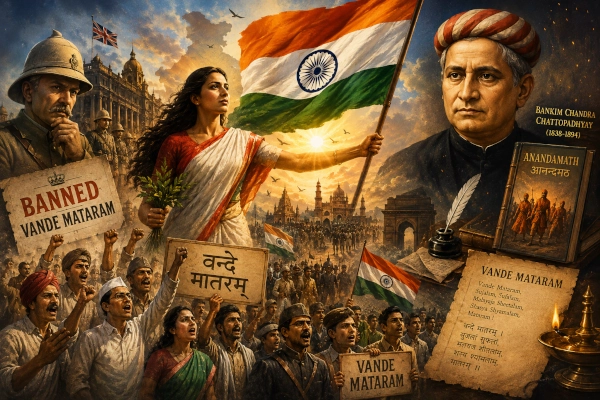
Few compositions in India’s modern history have travelled as far from literature into political life as Vande Mataram. Written by Bankim Chandra Chattopadhyay and later incorporated into Anandamath, the song gradually became much more than poetry. During the freedom struggle, it became a declaration of national consciousness, a rallying cry of the Swadeshi movement and a source of courage for people confronting colonial authority.
The British administration did not attempt to suppress Vande Mataram because it feared music. It feared what the song was beginning to achieve.
By the early twentieth century, two words could unite students, workers, political activists and ordinary citizens around an idea that directly challenged the legitimacy of the Raj. The motherland was no longer being described merely as territory under British administration. She was being imagined as a living national entity whose children possessed both the right and the responsibility to restore her freedom.
That transformation helps explain why colonial authorities tried to restrict the song. It also helps explain why Vande Mataram continues to generate political argument in independent India.
The two situations, however, should not be treated as identical. British hostility arose from an imperial government’s fear of anti-colonial mobilisation. Contemporary disagreements involve questions of history, religion, political symbolism, compulsory participation and the use of patriotic traditions in party politics.
Understanding that distinction is essential if the history of Vande Mataram is to be discussed seriously.
A Song That Became Larger Than Its Literary Origins
Bankim Chandra Chattopadhyay composed Vande Mataram in the nineteenth century and later placed it within Anandamath, published in 1882. The song imagined the motherland through her rivers, fertile fields, natural abundance, strength and sacred character.
The Partition of Bengal became a catalyst for the Swadeshi movement. Indians began boycotting foreign goods, promoting indigenous production and organising public demonstrations against colonial policy.
During this period, Vande Mataram moved from the literary world into the streets.
According to a Government of India historical backgrounder, the slogan was used politically on August 7, 1905, when thousands of students marched towards Calcutta Town Hall during the anti-partition mobilisation. The gathering adopted the boycott of foreign goods and the Swadeshi pledge.
This was precisely the kind of political transformation that worried the colonial administration.
Why the British Actually Feared Vande Mataram
The British did not fear the vocabulary of Vande Mataram in isolation. They feared its ability to create a shared political identity.
Colonial government depended upon more than soldiers and administrators. It also depended upon the acceptance of imperial authority. Once large numbers of people stopped viewing British rule as permanent or legitimate, maintaining that rule became considerably more difficult.
Vande Mataram attacked that psychological foundation.
Its message encouraged Indians to think of the country as their motherland rather than simply as a collection of provinces governed by an empire.
Once that idea entered popular consciousness, resistance acquired an emotional dimension that administrative orders could not easily control.
A political speech might reach a few thousand people. A newspaper might be seized. A political organisation might be banned.
A song could be memorised.
Once memorised, it no longer required a printing press, headquarters or political leader. Every person capable of singing it became capable of carrying its message.
That made Vande Mataram extraordinarily difficult to contain.
When the Colonial State Tried to Silence the Song
The British response provides some of the strongest evidence of how seriously the authorities regarded its growing influence.
The Government of India records that the administration of the newly created province of Eastern Bengal issued circulars restricting the singing or chanting of Vande Mataram in educational institutions. Schools faced threats of derecognition, while students involved in political agitation could face exclusion from government employment.
In November 1905, around 200 students at a school in Rangpur were each fined five rupees for chanting Vande Mataram. Colonial officials also directed local figures to prevent the slogan from being raised.
At Barisal in April 1906, colonial authorities prohibited the public chanting of Vande Mataram during the Bengal Provincial Conference. Delegates defied the restriction, and police repression followed.
The slogan travelled well beyond Bengal.
In Lahore, protesters used it while demonstrating against colonial repression. Workers of the Coral Mills in Tuticorin marched while chanting it during the Swadeshi-era labour mobilisation of 1908. Thousands also gathered during Lokmanya Tilak’s trial in Bombay and sang Vande Mataram as an expression of solidarity.
The British authorities therefore faced something far more difficult than a song. They faced an increasingly portable language of resistance.
Vande Mataram Turned Patriotism Into Mass Participation
The political genius of Vande Mataram was its simplicity.
A person did not need extensive political education to participate. He did not need to understand constitutional theory or economic arguments about colonial exploitation.
He could simply join the chorus.
When thousands of voices repeated the same words, the difference between observer and participant began to disappear.
This is why songs have played such important roles in freedom movements throughout history. They allow political emotion to move across social boundaries.
In India’s case, Vande Mataram became deeply associated with Swadeshi, sacrifice and resistance.
A slogan that could be shouted by students could also be repeated by workers, political leaders and revolutionaries. Its emotional reach was broader than any single political organisation.
The British administration recognised this danger. Attempts to suppress the song often gave it even greater symbolic value. Each restriction strengthened the perception that chanting Vande Mataram itself represented defiance of colonial power.
The Motherland Was the Central Political Idea
The deeper challenge presented by Vande Mataram came from its conception of India.
An empire sees territory primarily in administrative terms. Provinces can be divided, rearranged and governed according to political convenience.
The song presented an entirely different idea.
India was the mother.
If the country was merely an administrative territory, partitioning Bengal could be defended as bureaucratic reorganisation.
If the land was understood emotionally as the motherland, political division acquired an entirely different meaning.
That was why Vande Mataram fitted so powerfully into the anti-partition movement.
Bankim’s imagery gave cultural expression to an emerging political idea: India belonged ultimately to her people.
For colonial rule, that idea was inherently dangerous.
Independent India Gave Vande Mataram a Special Place
The importance of the song did not disappear after Independence.
On January 24, 1950, Constituent Assembly President Dr Rajendra Prasad formally stated that Vande Mataram, because of its historic role in India’s freedom struggle, should be honoured equally with Jana Gana Mana and accorded equal status.
The Constituent Assembly had already demonstrated the song’s place in the national moment. At the historic session beginning on the night of August 14, 1947, the Assembly’s proceedings included the singing of Vande Mataram.
Its status therefore rests on much more than contemporary party politics.
The song belongs to the history of India’s freedom movement and to the institutional memory of the Republic.
Political Parties Also Fear Losing Control of the Narrative
National symbols possess enormous emotional power. Political parties naturally compete to associate themselves with those symbols.
Vande Mataram is particularly powerful because no modern political party created it.
It predates the Republic and much of India’s modern party system. Its legitimacy comes from the freedom struggle itself.
That makes the song difficult for any single political organisation to own.
When one group places Vande Mataram at the centre of its patriotic campaign, rivals can face a political dilemma. At the time Vande Mataram becomes entangled in partisan rivalry, the larger national purpose is diminished. Political parties may compete over who can claim greater ownership of patriotism, but a song that inspired generations during the freedom struggle is never about any party, ideology or electoral campaign. Party egos and appeasements to coalition parties and politics should take a back seat when the subject is Vande Mataram. The song belongs to the nation, and its historical legacy is far greater than the ambitions of any political organisation.
This tension often explains why arguments over Vande Mataram quickly become larger than the specific event that triggered them.
National Symbols Should Rise Above Coalition Egos
There is also a broader lesson here.
Political parties have every right to disagree over economic policy, education, welfare, taxation, federalism and countless other questions. Coalition partners will naturally negotiate and compromise on many of them.
But the historical legacy of Vande Mataram should not become hostage to the anxiety of keeping one political constituency pleased or another political constituency angry.
The song existed before today’s alliances were formed, and it will remain part of India’s national memory long after those alliances disappear.
The appropriate response to disagreement is therefore neither coercion nor political surrender. It is historical clarity.
What weakens public confidence is the impression that leaders say one thing in one political setting and another elsewhere because coalition arithmetic has changed
The 2026 Debate Shows How Powerful the Symbol Remains
The continuing intensity of the issue was visible again in 2026.
The Ministry of Home Affairs issued updated orders relating to the singing or playing of the National Song and National Anthem.
Parliament also passed the Prevention of Insults to National Honour (Amendment) Bill, 2026 in both Houses. The measure seeks to extend to Vande Mataram the statutory protection already associated with the National Anthem by penalising intentional prevention of its singing or deliberate disturbance of an assembly engaged in singing it.
Respect for Vande Mataram Should Not Depend on Party Ownership
There is a danger when a national song becomes viewed primarily through the lens of contemporary party competition.
Vande Mataram belongs to a much larger historical inheritance.
It was sung before today’s political parties existed. It was sung by revolutionaries, students, workers and nationalists from different regions and political traditions.
Its history cannot reasonably be reduced to one twenty-first-century political contest.
At the same time, national respect becomes stronger when it arises from historical understanding rather than merely from political compulsion.
Citizens should know why students were punished for chanting Vande Mataram.
They should know why crowds sang it during Tilak’s prosecution.
They should know why British administrators tried to suppress it.
They should also know why debates over portions of the composition arose within the nationalist movement itself.
History becomes weaker when inconvenient parts are removed from either side of the argument.
The British Feared What Vande Mataram Could Awaken
Ultimately, the British fear of Vande Mataram can be explained in one word: awakening.
Colonialism becomes vulnerable when subjects begin thinking of themselves as citizens of a nation.
Vande Mataram helped make that psychological transition possible.
It turned geography into motherland, political protest into emotional commitment and individual dissatisfaction into collective national consciousness.
That is why colonial officials tried to prevent students from chanting it.
That is why police confronted gatherings that raised the slogan.
That is why the words travelled from Bengal to Maharashtra, Punjab, Tamil Nadu and eventually beyond India.
The Raj possessed armies, laws, prisons and an immense administrative machinery. Yet it still found two words dangerous because those words increasingly represented an idea that imperial power could not permanently suppress.
Vande Mataram Should Be Cherished, Not Reduced to a Political Test
Treating Vande Mataram casually ignores the sacrifices associated with it. Turning it exclusively into a partisan loyalty test can also diminish a song whose historical stature is much greater than any political party.
There should be enough historical honesty to recognise that Vande Mataram was one of the great emotional forces of India’s freedom struggle.
Political disagreement cannot erase that history.
The British attempted to silence Vande Mataram because they understood that a nation was beginning to discover its own voice.
More than a century later, the strength of the song remains visible in the intensity of the arguments surrounding it.
Perhaps that is the most remarkable part of its story.
Empires have disappeared, governments have changed and generations have passed, but the words that once echoed through anti-colonial processions continue to command attention.
Vande Mataram survived because it ceased to belong only to its author. It entered the memory of a civilisation and became part of the story through which India learned to imagine itself as free.
References
Press Information Bureau, Government of India — “150 Years of Vande Mataram: A Melody That Became a Movement.” The official historical backgrounder documents its role in the Swadeshi movement, British restrictions, student punishments, the Barisal confrontation and its spread across India.
Constituent Assembly Debates — January 24, 1950. Dr Rajendra Prasad’s statement records the historic role of Vande Mataram and declares that it should be honoured equally with Jana Gana Mana.
Constituent Assembly Debates — August 14, 1947. The historic Independence session records the singing of Vande Mataram as part of the Assembly proceedings.
Prime Minister’s Office — Special Lok Sabha discussion on 150 years of Vande Mataram, December 8, 2025. This provides the government’s interpretation of the 1937 controversy surrounding the song.
Ministry of Home Affairs — National Song and National Anthem orders, 2026. The Ministry published updated official instructions regarding the rendition of the National Song and National Anthem.
Press Information Bureau — Prevention of Insults to National Honour (Amendment) Bill, 2026. The official backgrounder explains the proposal to extend statutory protection to Vande Mataram.
You may also like
-
Sindhu: The Indus Kingdom of Jayadratha in the Mahabharata
-
Kuninda or Kulinda: The Himalayan Realm of the Mahabharata in Uttarakhand and Himachal Pradesh
-
Durga versus Mahishasura: Weapons, Battlefield Tactics and the Triumph of Shakti
-
Kuluta: The Kullu Valley Kingdom of the Mahabharata
-
Trigarta: The Kangra–Jalandhar Kingdom of the Mahabharata
