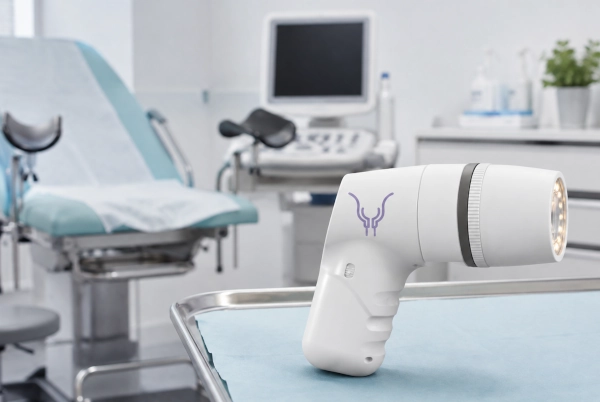
India is moving to strengthen access to early cervical cancer detection with government support for the commercialisation of an indigenous AI-powered screening device developed by Visakhapatnam-based Griva Healthcare Pvt. Ltd.
The Technology Development Board under the Department of Science and Technology has entered into an agreement with the company to support the manufacturing and commercial rollout of GrivaVision, a portable digital colposcope designed to assist healthcare professionals in detecting pre-cancerous cervical lesions at an early stage.
Under the TDB-supported project, Griva Healthcare will establish manufacturing capabilities at Kollam in Kerala, paving the way for commercial-scale production of the device. The initiative is aimed at expanding access to cervical cancer screening beyond specialised hospitals and making diagnostic services more affordable and deployable in primary and community healthcare settings.
Cervical cancer screening assumes particular importance because early identification of pre-cancerous changes can significantly improve opportunities for timely intervention. In India, where large numbers of women may have limited access to specialised diagnostic facilities, portable screening systems could help extend preventive healthcare into smaller clinics, community health centres and resource-constrained regions.
GrivaVision combines a high-definition camera, integrated display, advanced optical system, user-friendly interface and indigenous artificial intelligence-enabled software within a portable diagnostic platform. The system is designed to provide visual examination of the cervix and vaginal canal and assist gynaecologists and other trained healthcare professionals in identifying abnormalities that may indicate pre-cancerous lesions.
The technology has been designed in accordance with World Health Organization-approved Automated Visual Evaluation standards, while its software is compliant with the Ayushman Bharat Digital Mission ecosystem. This allows the device to potentially integrate with India’s expanding digital health infrastructure and support digital recording and management of screening-related information.
The device has been classified as a Class B non-invasive medical device and has received a CDSCO Class B manufacturing licence. It is being developed in accordance with ISO 13485 quality management standards for medical devices, while the underlying hardware architecture is proprietary and has been patented in India by Griva Healthcare.
The company is currently conducting its research and development activities at AIC-AMTZ Medivalley in Visakhapatnam. The latest support from TDB is intended to help the company move beyond the research and product-development stage and establish the manufacturing capacity required for wider commercial deployment.
A major element of the project is its emphasis on localisation. According to the Department of Science and Technology, the technology has been developed and built in India, with more than 50 per cent of its components currently sourced domestically. Scaling up production is expected to increase localisation further and contribute to the development of India’s domestic medical-device supply chain.
The programme also seeks to reduce reliance on imported diagnostic equipment by creating a lower-cost Indian alternative in the cervical cancer screening segment. Developing indigenous medical technologies at scale has increasingly become a priority as India seeks to expand domestic manufacturing capabilities in healthcare equipment while making advanced diagnostic tools more affordable.
The portability of GrivaVision could be one of its most important advantages. Conventional cervical diagnostic infrastructure is generally concentrated in larger healthcare facilities and urban centres. A compact digital system equipped with AI-assisted assessment could allow trained healthcare workers to undertake preliminary screening closer to patients, particularly in rural and underserved communities.
Artificial intelligence in the device is intended to assist rather than replace clinical judgement. By analysing digital cervical images and highlighting potentially abnormal areas, the system can provide healthcare professionals with additional decision-support during routine examinations and potentially improve the consistency of screening in settings where specialist expertise is limited.
TDB Secretary Rajesh Kumar Pathak said early detection can play a decisive role in tackling cervical cancer and noted that technologies such as GrivaVision demonstrate the potential of combining medical devices, digital health systems and artificial intelligence to address major public-health challenges.
He said TDB’s support is intended to help indigenous technologies move from development to commercial manufacturing while simultaneously improving access to advanced screening tools and strengthening India’s self-reliance in medical technology.
Griva Healthcare said the government support would allow it to transition from development to commercial-scale manufacturing and expand access to AI-assisted cervical cancer screening. The company has emphasised that its objective is to bring reliable screening technology closer to women, particularly in regions where specialised diagnostic infrastructure remains difficult to access.
The initiative represents another step in India’s effort to build an indigenous medical-device ecosystem in which domestic research, artificial intelligence and manufacturing capabilities are combined to address large-scale healthcare needs. If deployed widely through primary and community healthcare networks, portable systems such as GrivaVision could help increase the reach of cervical cancer screening and enable more women to be identified for further evaluation at an earlier stage.
Source: PIB: https://www.pib.gov.in/PressReleasePage.aspx?PRID=2297106®=48&lang=1
You may also like
-
India’s Economic Warfare Challenge: Strategic Autonomy, Energy Security and the Rise of a Global Power
-
India-US Trade Deal Stalemate: Why Washington’s Tariff Pressure Has Failed to Secure an Agreement
-
US Double Standards in Foreign Policy: 16 Recent Cases Involving India, Russia, China and Global Trade
-
India’s Arctic Energy Ambitions: Russian Oil, LNG and a New Sea Route to Indian Ports
-
India and Russia Explore Joint Icebreaker Construction as Maritime Industrial Cooperation Expands
