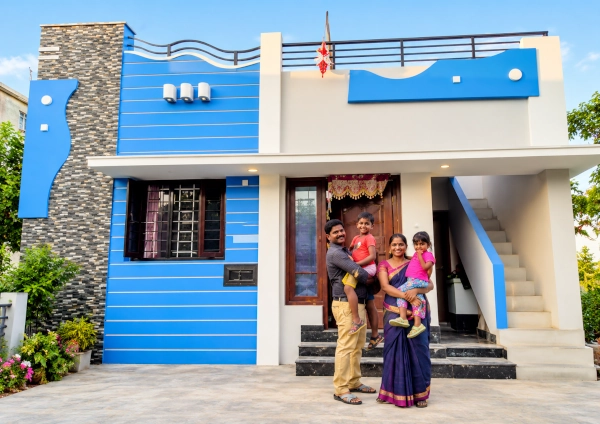
India’s flagship urban housing programme has crossed a major milestone, with more than 1.25 crore houses sanctioned under Pradhan Mantri Awas Yojana–Urban and PMAY-U 2.0, while over 1 crore homes have already been completed and delivered to beneficiaries across the country.
The achievement marks a significant expansion of affordable urban housing since the original PMAY-U programme was launched in June 2015 with the objective of providing pucca houses to eligible urban families.
Alongside the overall housing milestone, the programme has also emerged as a major instrument of women’s asset ownership. Of the approximately 1.25 crore houses sanctioned under PMAY-U and PMAY-U 2.0, around 1 crore houses have been allotted either in the name of the female head of the household or under joint ownership involving women.
This has made women’s ownership one of the central features of the housing programme, linking affordable housing with long-term financial security and household asset creation.
Another 2.09 Lakh Houses Sanctioned Under PMAY-U 2.0
The latest expansion came during the 8th meeting of the Central Sanctioning and Monitoring Committee under PMAY-U 2.0, held on August 6, 2026, at Sankalp Bhawan in New Delhi.
The meeting, chaired by Satendra Singh, Secretary, Department of Urban Development, Ministry of Housing and Urban Affairs, approved more than 2.09 lakh additional houses for Economically Weaker Section families.
The sanctioned houses are spread across Andhra Pradesh, Arunachal Pradesh, Bihar, Chhattisgarh, Gujarat, Jammu & Kashmir, Jharkhand, Madhya Pradesh, Maharashtra, Manipur, Odisha, Rajasthan, Tamil Nadu, Telangana, Uttar Pradesh and Uttarakhand.
The committee also reviewed implementation across States and Union Territories, including construction progress, geo-tagging, beneficiary verification, fund utilisation, occupancy and completion of previously sanctioned houses.
1.42 Lakh Families to Build Homes on Their Own Land
Of the latest 2.09 lakh houses approved, around 1.42 lakh have been sanctioned under the Beneficiary Led Construction, or BLC, vertical.
Under this component, eligible families possessing their own land can receive financial assistance of up to ₹2.5 lakh for constructing a pucca house.
The model is particularly significant for lower-income families who possess small plots but lack the financial resources required to construct durable housing.
Another 67,045 houses have been sanctioned under the Affordable Housing in Partnership, or AHP, vertical.
Under AHP, affordable housing projects are developed through public or private agencies in partnership with States and Union Territories, with eligible EWS beneficiaries receiving Central assistance towards the allotted homes.
PMAY-U 2.0 Sanctions Cross 18.38 Lakh
With the latest approvals, the total number of houses sanctioned under PMAY-U 2.0 has crossed 18.38 lakh.
Of these:
- 14.40 lakh houses fall under Beneficiary Led Construction.
- 2.48 lakh houses have been sanctioned under Affordable Housing in Partnership.
- 1.36 lakh beneficiaries have received allocations under the Interest Subsidy Scheme.
- 13,046 houses have been sanctioned under the Affordable Rental Housing component.
The figures indicate that the second phase of PMAY-U is now moving into a larger implementation stage across multiple housing models rather than relying on a single approach.
Women Receive Over 2 Lakh of Latest Houses
Women constitute the overwhelming majority of beneficiaries under the latest round of sanctions.
Out of the 2.09 lakh houses approved during the 8th CSMC meeting, around 2.03 lakh have been allotted to women.
The approach reflects the broader policy under PMAY-U of encouraging ownership in the name of women or through joint ownership.
Housing represents one of the largest assets held by most Indian households. Placing ownership rights in women’s names can therefore provide families with not merely shelter but a significant long-term economic asset.
It can improve women’s financial security, strengthen their position within households and potentially provide greater access to formal credit and inheritance protection.
Special Focus on Vulnerable Sections
The latest sanctions also include substantial allocations for socially and economically vulnerable groups.
Among the houses approved during the meeting:
21,954 houses have been sanctioned for Scheduled Caste beneficiaries, while 14,252 houses have been approved for Scheduled Tribe beneficiaries.
Another 75,511 houses have been sanctioned for OBC beneficiaries, while 16,662 houses have been allotted to senior citizens.
PMAY-U 2.0 also provides for the housing requirements of minorities, persons with disabilities, transgender persons and other vulnerable sections.
The objective is therefore broader than simply increasing the number of dwelling units. The programme attempts to use affordable housing as an instrument for social inclusion and household economic security.
PMAY-U 2.0 Targets Another One Crore Urban Families
PMAY-U 2.0 builds upon the first phase of the scheme and aims to address the housing requirements of an additional 1 crore eligible urban families belonging to EWS, LIG and MIG categories.
Eligible families can have annual household incomes of up to ₹9 lakh, subject to the conditions applicable under the respective components of the scheme.
The programme is structured around different housing requirements.
Families possessing land can construct homes under Beneficiary Led Construction, while others can purchase homes in affordable housing projects. Eligible households can also receive interest assistance on home loans, while Affordable Rental Housing seeks to address the needs of families who require decent rental accommodation rather than immediate ownership.
This multi-track structure reflects the changing nature of India’s urban housing challenge, where families have widely different incomes, land ownership patterns and employment conditions.
From Housing Scheme to Asset-Creation Programme
The scale reached by PMAY-U increasingly makes it more than an infrastructure or welfare programme.
A completed house gives a family a durable asset, protects it from rental uncertainty and can improve access to sanitation, electricity, water and other urban services.
For economically weaker families, home ownership can also become one of the most important forms of inter-generational wealth creation.
The emphasis on women’s ownership adds another dimension by ensuring that a significant share of these publicly supported assets is placed directly in women’s names.
With more than 1 crore houses already completed and delivered, the scheme has now entered a stage where its impact can increasingly be measured not only by sanctions but by actual occupancy, living conditions and asset ownership among beneficiary families.
The government has consequently asked States and Union Territories to accelerate construction, release funds in time, strengthen beneficiary verification and closely monitor unfinished projects.
India’s Urban Housing Push Enters Its Next Phase
The latest sanction of 2.09 lakh houses indicates that the affordable housing programme continues to expand even after crossing the landmark of 1.25 crore sanctioned homes.
The larger challenge ahead will be ensuring that houses already sanctioned are grounded quickly, completed on schedule and occupied by verified beneficiaries.
If implementation keeps pace with sanctions, PMAY-U 2.0 could significantly extend formal home ownership among India’s lower- and middle-income urban families over the coming years.
The programme’s importance ultimately lies not simply in the number of houses built, but in turning millions of urban households from occupants or tenants into owners of durable family assets.
Source: Ministry of Housing and Urban Affairs / Press Information Bureau, Government of India — August 9, 2026
You may also like
-
India’s First Port-Based e-Methanol Plant at Kandla to Supply Green Fuel to Global Shipping
-
India’s Recent Oil and Gas Discoveries: New Finds, Offshore Frontiers and How Much Crude India Produces at Home
-
India’s Hidden Gold Mountain: How Households Came to Own an Estimated 31,000 Tonnes of Gold
-
India–Afghanistan Air Cargo Corridor Returns to Focus as Both Sides Push for Stronger Trade Connectivity
-
India’s Defence Shipyards Build Common Indigenous Supply Chain for Specialised Naval Cables
