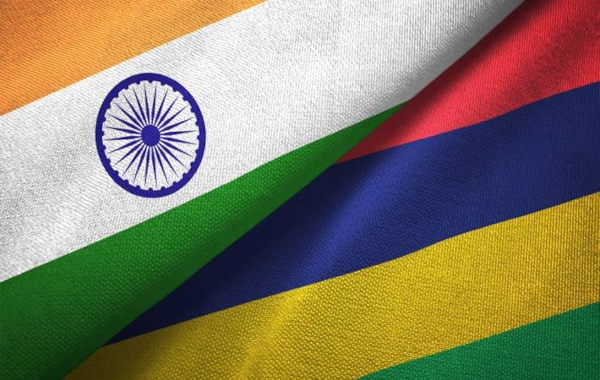
India and Mauritius are moving to further strengthen their maritime security partnership as Chief of the Naval Staff Admiral Krishna Swaminathan begins a four-day official visit to Mauritius from August 10 to 13, 2026.
The visit comes amid India’s sustained effort to deepen defence and security cooperation with key partners across the Indian Ocean Region, where Mauritius occupies an important strategic position along major maritime routes.
During the visit, Admiral Swaminathan will meet senior members of the Mauritian government and security establishment for discussions covering maritime security, defence cooperation, capacity building and military-to-military engagement.
The visit is also significant as it is Admiral Swaminathan’s first official engagement with Mauritius after assuming charge as Chief of the Naval Staff, reflecting the importance India attaches to its long-standing relationship with the island nation.
Mauritius: A Key Indian Ocean Maritime Partner
India and Mauritius share geographical, historical and civilisational ties, but their modern strategic relationship has increasingly developed around maritime security.
Located in the south-western Indian Ocean, Mauritius sits within an important maritime space linking the African coast, the wider Indian Ocean and major international shipping routes.
For India, cooperation with Mauritius contributes to maintaining stability across this region while helping smaller Indian Ocean states strengthen their ability to monitor and protect their maritime territories.
Unlike partnerships centred only on occasional naval exercises, the India-Mauritius maritime relationship involves sustained operational cooperation.
The Indian Navy and the Mauritius National Coast Guard regularly conduct training exchanges, operational interactions and joint surveillance activities, creating institutional links between the two maritime forces.
Joint Surveillance of Mauritius’ Exclusive Economic Zone
One of the most practically important elements of the partnership is Joint Exclusive Economic Zone surveillance.
Mauritius possesses a large maritime jurisdiction relative to the size of its land territory. Protecting such waters requires persistent surveillance against illegal fishing, smuggling, trafficking and other forms of unlawful maritime activity.
Indian naval and maritime assets have supported Mauritius in maintaining awareness across these waters.
Such missions also provide operational experience for personnel from both countries and strengthen interoperability between the Indian Navy and the Mauritian National Coast Guard.
The cooperation illustrates India’s broader approach of helping Indian Ocean partners develop their own maritime-security capabilities rather than limiting engagement to conventional naval diplomacy.
India Supports Mauritian Maritime Capacity
Capacity building has remained another major pillar of bilateral defence cooperation.
Indian assistance has included training, operational engagement, hydrographic cooperation and regular visits by naval vessels.
Hydrographic surveys are particularly valuable for island nations.
Accurate mapping of the seabed and coastal waters contributes to safe navigation, port development, maritime infrastructure planning and the management of territorial waters.
India has developed considerable hydrographic capability through the Indian Navy and has made this expertise available to several friendly Indian Ocean countries, including Mauritius.
Such cooperation provides a relatively low-profile but strategically important foundation for long-term maritime partnerships.
Mauritius Participates in Major Indian Naval Initiatives
Mauritius has also become a regular participant in several maritime initiatives led or hosted by India.
These include the Indian Ocean Naval Symposium, the multinational naval exercise MILAN, the International Fleet Review, the Goa Maritime Conclave, IOS SAGAR and Exercise AIKEYME.
Its participation in these forums helps connect the relatively small Mauritian maritime-security establishment with a much larger network of Indian Ocean navies and coast guards.
The Indian Ocean Naval Symposium, in particular, provides naval leaders from across the region with a platform for discussions on maritime safety, humanitarian assistance, disaster response, piracy and other common security challenges.
MILAN and similar exercises take that cooperation from the diplomatic level into actual naval interoperability.
Exercise AIKEYME Adds New Dimension
Mauritius’ participation in Exercise AIKEYME demonstrates the widening scope of India’s engagement with African and Indian Ocean maritime partners.
Such initiatives enable regional navies and coast guards to work together on challenges that frequently cross national boundaries.
Illegal fishing, narcotics trafficking, piracy, maritime terrorism and natural disasters cannot be effectively addressed by individual countries operating in isolation.
Regular exercises and information-sharing mechanisms consequently form an increasingly important component of regional maritime security.
For Mauritius, which must protect extensive maritime zones with comparatively limited resources, cooperation with India provides access to training, technical knowledge and operational support.
For India, such partnerships strengthen a network of trusted maritime relationships across the Indian Ocean.
MAHASAGAR Shapes India’s Regional Maritime Approach
The visit is also being framed within India’s MAHASAGAR — Mutual and Holistic Advancement for Security and Growth Across Regions — vision.
MAHASAGAR builds upon India’s long-standing emphasis on cooperative security in the Indian Ocean while giving the concept a wider geographic and developmental dimension.
The underlying principle is that maritime security cannot be separated from economic development, connectivity, disaster resilience and the ability of countries to protect their own maritime resources.
Mauritius fits naturally within this framework because bilateral cooperation extends beyond traditional defence relations into hydrography, maritime surveillance, training and wider regional engagement.
The Strategic Importance of the Western Indian Ocean
India’s growing engagement with Mauritius also reflects the increasing strategic importance of the western Indian Ocean.
The region contains important shipping routes connecting Asia with Africa, the Persian Gulf and Europe.
Large volumes of India’s energy imports and merchandise trade transit the Indian Ocean, making the security of these sea lanes critical to the Indian economy.
The western Indian Ocean also connects India with the rapidly growing economies and strategic partners of eastern and southern Africa.
Countries such as Mauritius therefore have importance far exceeding their territorial size.
Strong partnerships with island states can contribute to better maritime-domain awareness, quicker humanitarian responses and stronger regional mechanisms for responding to transnational threats.
More Than a Ceremonial Naval Visit
Admiral Swaminathan’s four-day visit consequently carries significance beyond routine naval diplomacy.
Discussions with the Mauritian leadership are expected to reinforce existing programmes while identifying additional areas for defence cooperation, capacity building and operational coordination.
Regular high-level interaction also ensures that the partnership keeps pace with new maritime challenges, including emerging technologies, changing patterns of illegal activity at sea and the growing importance of maritime-domain awareness.
The relationship remains based on an unusual degree of continuity.
Training exchanges, joint EEZ surveillance, hydrographic surveys, port visits and participation in multinational naval initiatives mean that cooperation continues at several levels simultaneously.
India-Mauritius Partnership Strengthens Indian Ocean Security
India’s relationship with Mauritius offers an example of how maritime partnerships can be built through persistent cooperation rather than episodic military exercises.
The Indian Navy provides expertise and operational capabilities, while Mauritius contributes an important geographic position and a trusted regional partnership.
As strategic competition and commercial activity increase across the Indian Ocean, such relationships are likely to become increasingly important for maintaining a stable maritime environment.
Admiral Krishna Swaminathan’s visit from August 10-13, 2026 therefore reinforces both the bilateral defence relationship and India’s broader effort to develop a cooperative maritime-security architecture across the Indian Ocean Region.
For New Delhi and Port Louis, the objective remains closely aligned: secure seas, stronger national maritime capabilities and a stable Indian Ocean built through regional cooperation rather than isolated action.
Source: Ministry of Defence / Press Information Bureau, Government of India — August 10, 2026
You may also like
-
India and Uzbekistan Strengthen Counter-Terrorism Cooperation, Focus on Terror Financing and Regional Security
-
India and Poland Target Doubling Bilateral Trade by 2030, Expand Defence and Technology Cooperation
-
Sigma Advanced Systems Secures ₹174 Crore Export Order for 155mm Artillery Ammunition Subsystems
-
Bharat Electronics Secures ₹1,011 Crore in New Defence Orders for Radar, Communication and Sonar Systems
-
India Calls for Legally Binding International Treaty to Prevent Weaponisation of Outer Space
