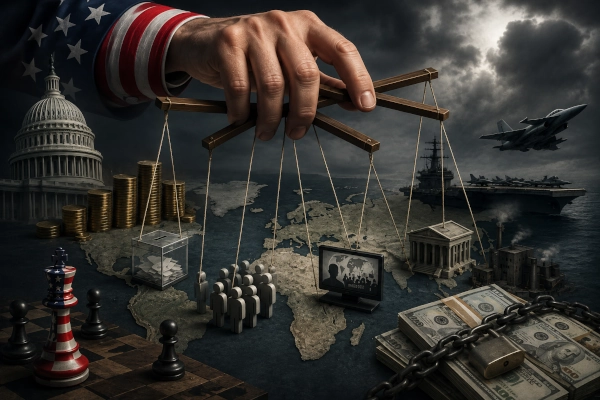
For much of history, powerful states exercised influence over weaker countries through armies, occupation and direct colonial administration. In the modern international system, influence can be exercised far more subtly.
A government does not necessarily need to occupy another country to alter its choices. Access to financial markets can be restricted. Banks can be threatened with exclusion from the dollar system. Defence purchases can trigger sanctions. Development assistance can be conditioned. Technology can be withheld. Foreign civil-society organisations, media institutions and advocacy networks can be financially supported.
The United States, because of the size of its economy, the role of the dollar, its technological power and its global network of institutions, possesses an unusually extensive collection of such instruments.
Describing this simply as a policy of “controlling other countries” would be too sweeping. The more precise term used in international relations is coercive statecraft: attempting to change another government’s behaviour by imposing—or threatening—economic, diplomatic or political costs.
The United States itself openly describes sanctions as instruments for advancing its foreign-policy and national-security objectives. The U.S. Congressional Research Service goes further, describing sanctions as a constellation of “coercive measures” intended to change behaviour, raise costs or deter particular actions.
For India, this raises a larger question.
If foreign governments openly employ finance, sanctions, institutions and funding networks to advance their interests abroad, should a sovereign state allow foreign money to flow unrestricted into organisations capable of influencing its politics, public policy or national discourse?
That question lies close to the philosophy underlying India’s Foreign Contribution (Regulation) Act — FCRA.
Economic Power as an Instrument of Foreign Policy
The most visible instrument of American coercive statecraft is economic sanctions.
The U.S. Treasury’s Office of Foreign Assets Control, or OFAC, administers sanctions involving asset freezes, trade restrictions and prohibitions on financial transactions. Its stated purpose is to use these measures in pursuit of American foreign-policy and national-security objectives.
The enormous reach of these measures comes partly from America’s position in global finance.
A company may have no factory in America and conduct no direct business with the U.S. government, yet it can still have strong reasons to comply with American sanctions if it depends upon:
dollar transactions,
American banks,
U.S. technology,
American customers,
insurance,
international financing,
or access to the world’s largest capital markets.
This converts economic weight into geopolitical leverage.
Secondary Sanctions: Pressuring Those Who Are Not the Original Target
The most controversial form of this system is the secondary sanction.
Primary sanctions tell American citizens and companies that they cannot transact with a particular target.
Secondary sanctions go further.
They can effectively tell companies, banks or governments in other countries that doing business with the sanctioned target could result in losing access to American markets or finance.
The Congressional Research Service explicitly identifies secondary sanctions as measures designed to pressure third parties dealing with the principal sanctions target.
This gives Washington the ability to influence commercial decisions occurring far outside American territory.
Iran offers one of the clearest examples.
U.S. sanctions against Iran have targeted not only Iranian entities but also foreign individuals and companies dealing with sanctioned Iranian sectors. Washington has used these measures to constrain Iran’s nuclear and missile programmes, military capabilities, regional activities and other policies it considers threatening.
The intended mechanism is straightforward:
Make the economic price of a policy so high that the targeted state changes its behaviour.
That is coercion in the classical international-relations sense, although it remains well below the threshold of conventional warfare.
Cuba Shows How Far Extraterritorial Pressure Can Reach
American sanctions against Cuba provide another remarkable example.
The United States has maintained restrictions against Cuba for decades. In 2026 Washington further expanded sanctions authorities, including provisions exposing certain non-Cuban foreign persons and foreign financial institutions to sanctions risk for specified dealings involving Cuba.
This illustrates why American economic sanctions have global consequences.
Washington is not merely deciding what American businesses may do.
Through secondary pressure, it can influence what companies belonging to other countries decide is economically safe to do.
From the American perspective, this extends the effectiveness of its sanctions.
From the perspective of targeted governments, it represents the extraterritorial application of American power.
Both descriptions can simultaneously be true.
India Has Experienced This Pressure Through CAATSA
India itself encountered a version of this dilemma after deciding to purchase the Russian S-400 Triumf air-defence system.
The United States adopted the Countering America’s Adversaries Through Sanctions Act — CAATSA in 2017.
Under Section 231, significant transactions with specified elements of Russia’s defence and intelligence sectors can expose the purchaser to American sanctions.
India nevertheless proceeded with its multibillion-dollar S-400 acquisition because New Delhi considered the system important to its national-security requirements.
The possibility of CAATSA sanctions consequently became an issue in India-U.S. relations.
The same legislation was not merely theoretical.
The United States imposed CAATSA sanctions on Turkey, a NATO ally, after Ankara acquired the S-400 from Russia. The measures targeted Turkey’s defence-procurement authority and officials associated with it.
India was ultimately treated differently, reflecting Washington’s growing strategic relationship with New Delhi and congressional calls for flexibility. But the episode illustrated the underlying mechanism.
A sovereign country made a defence-procurement decision.
Another sovereign country possessed legislation capable of imposing economic punishment because it disliked that transaction.
Whether one considers such legislation justified or excessive, it is clearly an instrument intended to influence the choices of other states.
Sanctions Do Not Always Work
American power should not be exaggerated either.
Coercion is not the same thing as control.
Countries frequently resist.
Cuba survived decades of American sanctions without producing the political outcome Washington originally sought.
Iran adapted parts of its economy and developed alternative trading arrangements.
Russia has continued its war against Ukraine despite extensive American, European and allied sanctions.
The Congressional Research Service itself notes continuing debate over whether sanctions actually compel the desired change in behaviour. Their effectiveness depends heavily upon international cooperation, the target’s economic dependencies and its ability to find alternatives.
India’s S-400 decision similarly demonstrated that sufficiently important national interests can outweigh the threat of sanctions.
Power creates leverage.
It does not guarantee obedience.
Aid Can Also Become Leverage
Coercive influence does not have to involve freezing bank accounts.
Foreign assistance itself can be conditional.
The Congressional Research Service includes the denial or conditioning of foreign assistance, loans and investment, as well as restrictions involving international financial institutions, among the instruments available within sanctions policy.
The political logic is obvious.
A state that depends heavily upon another country for military assistance, budgetary support or development funding has less freedom of manoeuvre than a state able to finance itself.
The donor can say:
Change this policy.
Meet this governance standard.
Abandon this military purchase.
Adopt this economic reform.
Cooperate on this security matter.
Otherwise assistance may be reduced.
Some conditionality may serve legitimate purposes—for example preventing corruption, human-rights abuses or weapons proliferation.
But from the recipient state’s perspective, foreign dependency always creates potential political leverage.
That is why economic self-reliance and strategic autonomy are ultimately connected.
Influence Does Not Stop at Governments
There is another dimension that brings the subject much closer to the FCRA.
States can attempt to influence societies as well as governments.
The United States has an extensive architecture for supporting civil society, democratic institutions, independent media, political participation and human-rights organisations overseas.
One prominent organisation is the National Endowment for Democracy, or NED.
NED describes itself as an independent nonprofit institution largely financed through congressional appropriations. It provides more than 2,000 grants annually to nongovernmental organisations operating in more than 100 countries. Its supported activities include independent media, civil society, human rights, accountability, democratic political processes and rule-of-law initiatives.
NED itself presents these programmes as transparent assistance to people seeking democratic government and fundamental freedoms.
That perspective deserves to be stated clearly.
Funding a human-rights organisation or training independent journalists is not automatically an attempt to overthrow a government.
But equally, money directed towards political culture, public opinion, journalism, civil society, advocacy and institutional reform can have political consequences.
Indeed, the fact that governments fund such activities abroad demonstrates that states themselves believe they can influence the political development of other societies.
This Is Where the FCRA Question Begins
India’s Foreign Contribution (Regulation) Act, 2010 is built around a simple principle:
foreign money entering politically or socially influential institutions cannot be treated in exactly the same way as ordinary domestic money.
The Act’s stated purpose is to regulate foreign contributions and foreign hospitality and prevent their use for activities detrimental to India’s national interest. The Ministry of Home Affairs similarly describes the FCRA regime as intended to ensure that organisations receiving foreign contributions operate consistently with the values of a sovereign democratic republic.
FCRA does not prohibit all foreign donations.
Registered organisations may receive foreign contributions, and organisations without regular registration may obtain prior permission for specified funding.
Instead, the law creates scrutiny over who receives foreign money, where it comes from and how it is used.
Politics Is Given Special Protection
Section 3 of the FCRA is particularly revealing.
Foreign contributions are prohibited for several politically sensitive categories, including:
candidates for election,
members of legislatures,
political parties and their office-bearers,
organisations officially designated as being of a political nature,
certain public servants,
and specified organisations and individuals involved in news and current-affairs media.
The logic is straightforward.
India does not want the outcome of its political process determined through foreign financial power.
The principle is not uniquely Indian.
American law itself prohibits foreign nationals from donating money or other things of value in connection with federal, state or local elections. Foreign nationals are also prohibited from participating in decisions concerning election-related spending.
In other words, both India and the United States accept a basic democratic proposition:
Political sovereignty requires limits on foreign financial influence.
The 2020 FCRA Changes Tightened the Firewall
India strengthened the FCRA considerably in 2020.
Among the important changes, organisations receiving foreign contributions can no longer transfer those funds onwards to another person covered by the restriction under Section 7.
The proportion of foreign contributions ordinarily available for administrative expenditure was reduced to 20%, unless prior approval is obtained for spending above that level.
Foreign contributions must also initially enter through a designated FCRA account at the specified State Bank of India branch in New Delhi, although utilisation accounts may subsequently be maintained in other scheduled banks.
These measures greatly increase the state’s ability to identify:
the original donor,
the initial recipient,
the amount transferred,
and the eventual utilisation of foreign money.
Conceptually, the system attempts to prevent foreign funding from disappearing through layers of intermediaries before reaching politically or socially influential activity.
The Supreme Court Upheld the Core 2020 Amendments
The strengthened provisions were challenged before the Supreme Court in Noel Harper v. Union of India.
In its April 2022 judgment, the Court upheld the principal challenged amendments.
The Court held, among other things, that there is no absolute right to receive foreign contributions and accepted Parliament’s concerns regarding previous misuse and diversion of foreign donations as relevant to imposing stricter regulation.
That judgment provides an important constitutional dimension to the debate.
Foreign donations may support valuable charitable activity.
But foreign money is also foreign economic power entering domestic institutions.
The state can therefore legitimately subject such inflows to regulation, provided constitutional requirements are respected.
America Protects Itself From Foreign Political Influence Too
There is an additional irony in some international criticism of India’s desire to monitor foreign influence.
The United States itself operates the Foreign Agents Registration Act — FARA.
FARA requires certain persons acting inside the United States on behalf of foreign principals to register and disclose their activities, funding and relationships.
The U.S. Department of Justice explicitly says its purpose is to identify foreign influence and ensure that the American government and public know when information or political activity is being conducted on behalf of foreign interests.
Again, FARA and FCRA are not identical laws.
FARA is primarily a transparency and foreign-agency disclosure regime, whereas India’s FCRA directly regulates the receipt and utilisation of foreign contributions and is considerably broader in its application to NGOs.
But the underlying concern is related:
foreign money and foreign direction can affect domestic politics.
Washington recognises this risk when foreign actors operate in America.
New Delhi recognises it when foreign actors finance organisations in India.
Why NGOs Matter in Modern Geopolitics
The modern state does not derive power only from armies and ministries.
Civil society affects:
environmental policy,
industrial projects,
religious activity,
education,
human rights,
electoral narratives,
media coverage,
international reputation,
court litigation,
public demonstrations,
and legislative debates.
Most NGOs are engaged in genuine social, educational, developmental or humanitarian work.
But the political importance of civil society means that foreign financing deserves transparency.
Consider a hypothetical situation.
A foreign government strongly opposes an Indian infrastructure project.
It could formally pressure New Delhi.
But it could also finance organisations that campaign against the project, produce research opposing it, mobilise public opinion, support litigation and generate international media attention.
Every individual organisation might sincerely believe in the cause it is pursuing.
Yet at the system level, foreign money would still be affecting India’s domestic decision-making environment.
That is the strategic problem FCRA attempts to address.
Foreign Influence Is Often More Effective When It Does Not Look Like Government Influence
Traditional propaganda bearing the seal of a foreign embassy is easy to recognise.
Modern influence is more sophisticated.
Funding can pass through:
foundations,
international charities,
research institutions,
advocacy organisations,
media-development programmes,
university centres,
civil-society networks,
and intermediary NGOs.
Again, the existence of foreign funding does not by itself prove malicious intent.
But tracing the source of funding becomes important precisely because influence exercised through nominally independent organisations can carry greater credibility than a message issued directly by a foreign government.
NED itself explains that its nongovernmental structure gives it greater flexibility to work in countries where direct U.S. government involvement would be difficult and allows it to support groups that might hesitate to accept money directly from Washington.
That is not a secret allegation made by its opponents; it is part of NED’s own explanation of its institutional role.
From an Indian national-security perspective, this is exactly why the origin of funding matters even when the immediate recipient is nongovernmental.
FCRA Is Ultimately About Strategic Autonomy at Home
India frequently speaks of strategic autonomy in foreign policy.
That generally means maintaining the freedom to cooperate with the United States, Russia, France, Japan, Israel, the Gulf states and others without surrendering India’s independent decision-making.
But strategic autonomy cannot exist only in diplomacy.
It also has a domestic dimension.
A country whose political organisations, public discourse or policy advocacy become financially dependent upon external states eventually creates channels through which those states can exercise leverage.
And the United States provides perhaps the clearest contemporary demonstration of how seriously great powers themselves take such leverage.
Washington uses sanctions to alter the behaviour of foreign governments.
It uses secondary sanctions to influence third-country companies.
It uses export controls to regulate access to technology.
It attaches conditions to certain forms of international assistance.
It finances democracy, media and civil-society programmes abroad.
And simultaneously, through FARA and election law, it regulates foreign political influence within the United States itself.
India’s FCRA should be understood within this broader reality.
Sovereignty in the Twenty-First Century Is Financial as Well as Territorial
In the colonial period, sovereignty meant keeping foreign armies outside the frontier.
In the twenty-first century, the challenge is more complicated.
Influence can enter through a bank transfer.
It can arrive through a grant.
It can operate through access to technology or credit.
It can appear as the threat of sanctions.
It can travel through institutions that genuinely believe they are pursuing universal causes.
None of this means every American programme is sinister, every foreign-funded NGO is compromised, or every U.S. sanction is illegitimate.
American policymakers frequently employ these instruments in pursuit of objectives they regard as legitimate—counterterrorism, non-proliferation, human rights, defence of allies or deterrence of aggression.
But intentions do not alter the fundamental geopolitical lesson:
money, markets, institutions and networks are instruments of national power.
The United States understands this exceptionally well.
India’s FCRA is, at its core, India’s attempt to apply the same understanding internally—to ensure that foreign capital cannot quietly acquire disproportionate influence over the country’s political and social decision-making.
Its legitimacy therefore rests on a careful balance.
Foreign charity and international cooperation should remain possible.
Independent civil society should remain vigorous.
At the same time, the authority to determine India’s political direction must ultimately remain with Indian citizens, Indian institutions and an Indian democratic process—not with whoever possesses the deepest pockets overseas.
That is the strategic argument for the FCRA.
References
U.S. Congressional Research Service — U.S. Sanctions: Overview for the 119th Congress: Describes sanctions as coercive measures used for foreign-policy and national-security objectives.
U.S. Treasury / OFAC: Official description of American economic and trade sanctions and their foreign-policy role.
Congressional Research Service — India-Russia Relations: Details India’s S-400 acquisition and potential exposure to CAATSA sanctions.
National Endowment for Democracy: Official description of NED’s overseas grants supporting civil society, independent media and democratic institutions.
Ministry of Home Affairs, Government of India: Official FCRA framework and purpose.
India Code — Foreign Contribution (Regulation) Act, 2010: Sections governing prohibited recipients, transfers, administrative expenditure and designated banking arrangements.
Supreme Court — Noel Harper v. Union of India (2022): Judgment upholding key provisions of the 2020 FCRA amendments.
U.S. Department of Justice — FARA: American disclosure regime governing certain activities conducted on behalf of foreign principals.
You may also like
-
India’s Economic Warfare Challenge: Strategic Autonomy, Energy Security and the Rise of a Global Power
-
India-US Trade Deal Stalemate: Why Washington’s Tariff Pressure Has Failed to Secure an Agreement
-
US Double Standards in Foreign Policy: 16 Recent Cases Involving India, Russia, China and Global Trade
-
India’s Arctic Energy Ambitions: Russian Oil, LNG and a New Sea Route to Indian Ports
-
India and Russia Explore Joint Icebreaker Construction as Maritime Industrial Cooperation Expands
