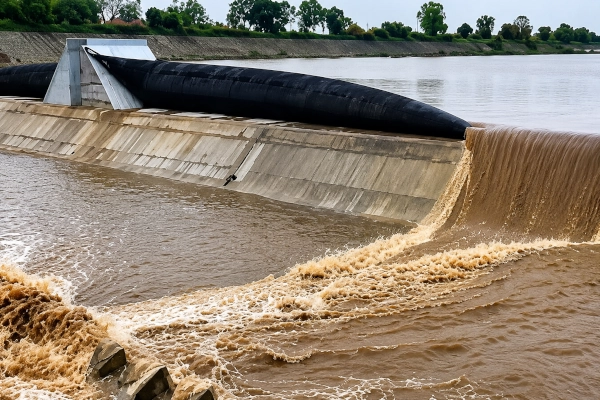
Gujarat is introducing a new form of hydraulic infrastructure in which a flexible rubber barrier, inflated with air and controlled electronically, replaces the conventional steel gates of a barrage.
The Rajvasana Rubber Dam, being constructed across the Heran River near Rajvasana village in Bodeli taluka of Chhota Udepur district, is one of Gujarat’s first two modern air-filled rubber-dam projects. The second is being built across the Ambika River near Pathakwadi village in Tapi district.
Together, the projects represent an investment of more than ₹162 crore in irrigation, water conservation, groundwater recharge and flood management. Instead of permanently obstructing the river with a rigid wall, the new structures can be inflated when water needs to be retained and deflated when floodwater and sediment must pass downstream.
An Important Factual Distinction
The Rajvasana project has frequently been described as “India’s first rubber dam.” That description is not technically correct.
The Indian Council of Agricultural Research inaugurated what it called South India’s first rubber dam at the Sillahalla watershed near Udhagamandalam in Tamil Nadu in March 2017. The structure was designed as a flexible check dam that could be inflated for water storage and deflated during floods to release water and accumulated silt.
The Hindustan Urvarak and Rasayan Limited complex at Gorakhpur in Uttar Pradesh also incorporated an air-operated rubber dam. The Union government described that installation, measuring 65 metres long and two metres high, as India’s first air-operated rubber dam when the plant was inaugurated in December 2021.
The Rajvasana structure should therefore be accurately described as Gujarat’s first major air-filled rubber dam for river-based irrigation and water management, rather than India’s first rubber dam.
The Rajvasana Rubber Dam
The Rajvasana project is being developed on the Heran River at an estimated cost of ₹82.97 crore. According to the Gujarat government’s July 2026 project statement, approximately 75 per cent of the work had been completed, with overall completion targeted for September 2027.
The central component is an inflatable rubber bladder measuring approximately:
- 180 metres in length
- 3.5 metres in height
- Installed across the existing river structure
- Operated through an automated inflation and deflation system
Once operational, the project is expected to increase water storage to approximately 3.5 million cubic metres, or 3.5 billion litres. The stored water is intended to support irrigation across around 3,420 hectares of agricultural land in 25 villages.
The project includes ten years of operation and maintenance responsibility within the contract. This provision is important because the rubber bladder, air-control equipment, anchoring system, sensors and automation infrastructure will require regular inspection and specialised upkeep.
What Exactly Is a Rubber Dam?
Despite its name, a rubber dam is not a large conventional dam made entirely from rubber.
It is a flexible hydraulic barrier consisting of a reinforced rubber-composite bladder fixed to a concrete foundation across a river, canal or stream. Pipes connect the bladder to pumps or compressors installed within a control facility.
When the bladder is filled with air, it rises from the riverbed and forms a barrier. Water begins accumulating behind it, raising the upstream level and creating temporary storage.
When the air is released, the bladder collapses onto the concrete base. Water, flood flows, floating material and sediment can then pass over the flattened structure.
This creates a barrier whose height can be altered according to river conditions rather than remaining permanently fixed.
The operating principle can be summarised in four stages:
- Inflation: Air is pumped into the rubber bladder.
- Storage: The raised bladder retains water upstream.
- Controlled lowering: Some air can be released to regulate the water level.
- Complete deflation: The structure lies flat during heavy floods or when sediment must be flushed downstream.
ICAR’s earlier rubber-dam programme similarly highlighted flexibility, flood-time deflation and the ability to release silt as important advantages of this technology.
Why Rajvasana Needed a New Solution
The Heran River already had a conventional weir intended to retain water. Over time, however, sand and silt accumulated around the structure and reduced its effective storage capacity.
Conventional fixed weirs can interrupt the natural movement of sediment. During repeated monsoon seasons, material deposited upstream may gradually occupy space that was originally intended to store water.
Removing this accumulation can require excavation, machinery and repeated expenditure.
The Rajvasana rubber dam has been designed to address this problem. When the flexible bladder is deflated during strong river flows, floodwater can carry part of the accumulated sediment downstream instead of allowing it to remain trapped permanently behind the barrier.
The project is therefore not merely adding height to an existing structure. It is attempting to restore storage capacity while introducing a more adaptable mechanism for managing water and sediment.
Automated Operation Through SCADA
The Gujarat rubber dams will use a Supervisory Control and Data Acquisition system, commonly known as SCADA.
SCADA allows operators to monitor and control infrastructure through computers, sensors and communication equipment. In the case of a rubber dam, the system can collect information such as:
- Upstream water level
- Downstream water level
- Air pressure inside the bladder
- River-flow conditions
- Pump and compressor status
- Valve position
- Equipment alarms
- Rate of inflation or deflation
The system can then operate the air pumps and release valves according to predetermined conditions.
For example, when the upstream level rises beyond the permitted limit, the control system can reduce the pressure inside the bladder. This lowers the barrier and allows more water to pass.
During an approaching flood, the bladder can be deflated further or laid completely flat. When the flood recedes, it can be inflated again to restore water storage.
The computer-operated system reduces dependence on workers manually operating large mechanical gates during rapidly changing river conditions.
Automation, however, does not remove the need for human supervision. Operators must continue monitoring weather forecasts, river inflows, equipment health and the condition of downstream areas.
Irrigation for 25 Villages
The Rajvasana project is expected to provide irrigation benefits to 3,420 hectares across 25 villages in the surrounding region.
Water retained behind the rubber dam will be supplied through the existing canal network for both Kharif and Rabi agriculture. Kharif crops depend primarily on the monsoon, while Rabi cultivation requires water during the cooler and drier months following the rains.
The ability to retain monsoon water into the post-monsoon season can therefore allow farmers to cultivate a second crop where water availability previously restricted agricultural activity.
The government also plans to connect the canal network with village ponds in the future. Filling these ponds can create decentralised local reserves while supporting groundwater recharge in the surrounding area.
Potential agricultural benefits include:
- More reliable irrigation after the monsoon
- Greater certainty while planning crop cycles
- Reduced dependence on irregular rainfall
- Improved availability of water for livestock
- Better recharge of wells and borewells
- Expansion of Rabi cultivation
- Reduced risk of crop loss during dry spells
The actual gains will depend on canal maintenance, equitable water distribution, rainfall, cropping choices and the long-term operating reliability of the dam.
Supporting Groundwater Recharge
A river does not need to fill a very deep reservoir to improve groundwater conditions.
When the rubber dam raises the upstream water level, water remains in contact with the riverbed and surrounding soil for a longer period. A portion can seep through permeable layers and recharge the local aquifer.
This may gradually improve water levels in nearby wells, borewells and village water sources.
The planned connection between the Rajvasana canals and local ponds could extend this recharge effect across a wider area. Water stored in ponds can infiltrate slowly instead of flowing rapidly out of the district during the monsoon.
Groundwater improvement should nevertheless be measured through observation wells rather than assumed. Recharge rates depend on local geology, soil composition, groundwater extraction and rainfall.
Flood Management
A rigid dam or weir remains in the river even when a major flood arrives. Gates can be opened, but piers, gate mechanisms and the permanent crest continue to occupy part of the channel.
A deflated rubber dam presents a much lower obstruction.
During heavy rainfall, air can be released and the flexible bladder can lie against its concrete foundation. Floodwater then receives a more open path through the river channel.
At Rajvasana, the project also includes approximately 900 metres of flood-protection work on the left bank and 500 metres on the right bank. These structures are intended to protect neighbouring areas when river levels rise.
The system can contribute to flood management by:
- Increasing the effective waterway during peak flows
- Reducing pressure against the inflated barrier
- Allowing sediment and debris to pass
- Regulating upstream water levels
- Limiting avoidable obstruction within the river
- Supporting faster discharge during intense monsoon events
A rubber dam does not prevent every flood. Its advantage lies in changing its profile according to river conditions rather than remaining permanently raised.
The Pathakwadi Project on the Ambika River
Gujarat’s second air-filled rubber dam is being constructed near Pathakwadi village in Dolvan taluka of Tapi district.
The project is valued at approximately ₹79.13 crore and had reached around 90 per cent construction progress according to the state government’s July 2026 statement. It is intended to irrigate around 650 hectares, benefiting Pathakwadi and neighbouring settlements including Dhodiyawad, Unai and Sindhai.
The location has flat terrain and relatively low riverbanks. These conditions made the construction of a tall conventional check dam or weir technically difficult. Engineers therefore selected an inflatable structure capable of providing storage without requiring the same type of permanently raised barrier.
The Pathakwadi structure is designed according to the Japanese Code 2000 and uses a specialised rubber bladder manufactured in South Korea. The bladder is reported to have a thickness ranging from 18 to 32 millimetres and to be capable of operating in temperatures exceeding 50°C. Its expected design life is approximately 30 years, subject to maintenance and operating conditions.
The dam consists of:
- A rubber bladder approximately 2.5 metres high
- A concrete base approximately two metres high
- A combined barrier height of about 4.5 metres
- A total length of approximately 280 metres
- Four separate spans
Like the Rajvasana project, it will use SCADA-based inflation and deflation controls.
South Korean Bladder Technology and Japanese Design
The two projects combine Indian civil construction and water-management requirements with imported specialised technology.
The rubber bladder is not an ordinary sheet of natural rubber. It is an engineered composite consisting of multiple layers intended to resist:
- Water pressure
- Repeated inflation and deflation
- High temperatures
- Sunlight and ultraviolet exposure
- Abrasion from sand and sediment
- Impact from floating material
- Chemical and biological exposure
- Long periods of continuous immersion
Reinforcing fabric within the rubber provides tensile strength, while external layers protect the material from weathering and physical damage.
The Pathakwadi project’s design follows Japanese engineering standards, while the principal bladder material is being sourced from South Korea.
The projects should therefore be described as an Indian water-infrastructure initiative using international rubber-dam technology, rather than as a fully indigenous invention.
India is, however, beginning to work on its own materials for this sector. In March 2026, ICAR institutions and the Indian Rubber Materials Research Institute signed an agreement to develop technical rubber-composite sheets for rubber dams, ponds and canal-lining applications.
Successful domestic development could eventually reduce dependence on imported bladders and create a specialised Indian manufacturing capability.
Advantages Over Conventional Barrages
Rubber dams are particularly useful where a project requires a relatively low and adjustable barrier rather than a massive storage reservoir.
Adjustable height
The height can be altered by changing the pressure inside the bladder. This permits more precise seasonal management of the upstream water level.
Easier flood passage
The dam can be deflated during heavy river flows, reducing obstruction within the channel.
Sediment flushing
A flattened bladder allows silt, sand and some debris to move downstream instead of remaining trapped behind a permanent crest.
Fewer mechanical gate components
Conventional barrages depend on steel gates, hoisting machinery, bearings, cables and multiple moving assemblies. A rubber dam replaces much of this equipment with the bladder, pumps, valves and control system.
Lower visual and physical obstruction
When deflated, the structure lies close to the riverbed and produces relatively little obstruction.
Adaptability to low riverbanks
Inflatable barriers may be suitable in flat areas where a permanently high structure could require extensive embankments, land acquisition or protective works.
Faster alteration of river levels
Controlled inflation and deflation can adjust storage according to rainfall, irrigation demand and incoming flows.
These advantages explain why Gujarat selected the technology for the Heran and Ambika river locations.
Limitations and Risks
Rubber dams are not suitable for every river or every water-storage requirement.
They are generally intended for low- or medium-head applications. They cannot replace large multipurpose reservoirs that provide enormous storage, hydropower generation or long-term inter-basin water transfers.
Important operational risks include:
Damage to the bladder
Sharp debris, deliberate vandalism, abrasion or an inadequately protected anchoring point can damage the rubber surface.
Dependence on compressors and control equipment
The barrier depends on pumps, valves, sensors, electrical supply and automation. Backup power and manual operating procedures are therefore essential.
Ageing of the material
Heat, sunlight, water chemistry and repeated movement gradually affect rubber and reinforcing layers. Inspection and eventual replacement must form part of lifecycle planning.
Sediment and debris
Although the dam can be deflated to release sediment, large logs, stones or accumulated debris may still damage the bladder or interfere with operation.
Specialised maintenance
Repairing a reinforced hydraulic bladder requires trained personnel and appropriate materials. Ordinary civil-maintenance teams may not possess the required expertise.
Incorrect operation
Deflating too slowly during a rapidly rising flood or maintaining excessive pressure could create avoidable risks. Reliable sensors, clear operating procedures and trained controllers are critical.
The ten-year operation and maintenance provision within the Rajvasana contract is therefore as important as the initial construction.
A Climate-Responsive Water Structure
Gujarat regularly faces two contrasting water-management challenges.
During the monsoon, large quantities of water can pass rapidly through rivers and leave the region. During the dry season, farms and villages may experience shortages.
Climate variability can make both conditions more difficult. Intense rainfall may increase flood peaks, while longer dry periods raise the importance of storing available runoff.
The rubber dam offers a way to respond to both conditions:
- Inflate after the major flood risk has passed
- Retain water for agriculture and recharge
- Adjust the height according to available flow
- Deflate before or during a major flood
- Reinflate when safe storage conditions return
It is therefore better understood as a dynamic river-control structure rather than as a miniature version of a large concrete dam.
Possible Coastal Application
The Gujarat government has also identified the possibility of using similar inflatable structures as tidal regulators in coastal areas.
A tidal regulator can help prevent saline seawater from travelling upstream into a freshwater river or canal during high tide. When freshwater must be discharged, the barrier can be lowered.
Such applications could be relevant in coastal Gujarat, where salinity intrusion can affect agricultural soil, groundwater and drinking-water sources.
The Pathakwadi project is inland, but the experience gained from operating it could help the state evaluate future coastal applications.
A Potential Model for Other Regions
The value of the two Gujarat projects will ultimately depend on their performance over several monsoon and dry-season cycles.
Authorities will need to evaluate:
- Actual irrigation delivered
- Changes in groundwater levels
- Sediment movement
- Flood-time performance
- Reliability of the SCADA system
- Electricity and maintenance costs
- Bladder wear and repair frequency
- Effects on river ecology
- Distribution of water among villages
- Cost compared with conventional alternatives
Should the projects perform reliably, similar structures could be considered for other low-gradient rivers, irrigation channels, industrial-water systems and coastal regulators.
They may be particularly useful where seasonal water must be retained without creating a large permanent barrier.
Conclusion
The Rajvasana Rubber Dam marks an important technological shift in Gujarat’s water-management infrastructure.
Built across the Heran River in Chhota Udepur district, the air-filled barrier is designed to store approximately 3.5 million cubic metres of water and provide irrigation to 3,420 hectares across 25 villages. Its flexible bladder can be raised for storage and lowered during floods, allowing water and sediment to move through the river channel.
The companion Pathakwadi project on the Ambika River extends the same approach to Tapi district, where conventional structures are constrained by flat terrain and low riverbanks.
These are Gujarat’s first major air-filled rubber dams, although they are not India’s first rubber-dam installations. Their real distinction lies in their scale, automated SCADA operation and planned use for irrigation, groundwater recharge, sediment management and flood regulation.
The structures demonstrate that water infrastructure does not always have to be massive, rigid and immovable. Sometimes the more effective solution is one capable of rising when water must be conserved and disappearing into the riverbed when the river needs to flow freely.
Reference
- Gujarat government project statement on the Rajvasana and Pathakwadi air-filled rubber dams, reported on July 6–7, 2026.
- Detailed project specifications for the Rajvasana and Pathakwadi rubber dams.
- Indian Council of Agricultural Research — inauguration of South India’s first ICAR flexi dam in Tamil Nadu, March 2, 2017.
- Press Information Bureau — air-operated rubber dam at the HURL Gorakhpur fertiliser complex.
- ICAR–CIRCOT — collaborative research agreement for indigenous rubber-composite sheets for rubber dams and water-management applications, March 5, 2026.
You may also like
-
FUJIFILM India Dedicates First Serial-Numbered Made-in-India Endoscopy System Through AIIMS New Delhi
-
India’s Defence Production Hits Record ₹1.78 Lakh Crore as Private-Sector Share Rises to 24%
-
US Hosts 91% of Overseas Unicorns Built by Founders Who Grew Up in India, Prosus-Dealroom Report Finds
-
India Approves Pioxaniliprole, Indigenous Insecticide Molecule Developed by PI Industries
-
India Overtakes Hong Kong to Become Asia’s Fourth-Largest REIT Market
