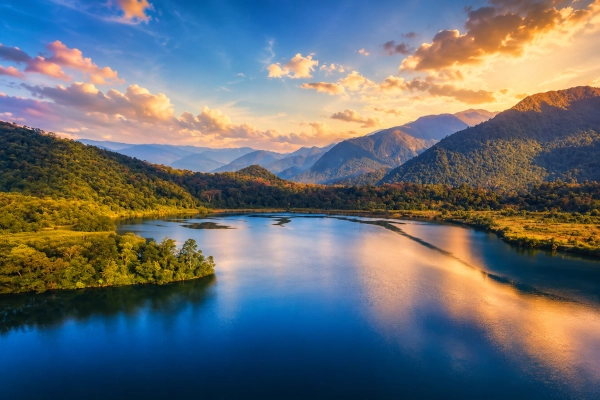
India has added another ecologically important wetland to its growing network of internationally recognised Ramsar Sites, with Glaw Lake in Arunachal Pradesh receiving the prestigious designation.
The inclusion makes Glaw Lake the first Ramsar Site in Arunachal Pradesh and raises India’s total number of designated wetlands of international importance to 101.
Union Minister for Environment, Forest and Climate Change Bhupender Yadav announced the development on August 3, 2026, describing it as an important achievement for biodiversity conservation, water security, climate resilience and sustainable livelihoods.
A Major Conservation Milestone for Arunachal Pradesh
The Ramsar designation gives Arunachal Pradesh its first wetland recognised under the international framework for the conservation and responsible use of wetlands.
Located within the Kamlang Tiger Reserve and Wildlife Sanctuary, Glaw Lake is a pristine freshwater ecosystem situated in the Eastern Himalayas. The surrounding landscape forms part of one of India’s richest biodiversity regions.
The lake is nourished by perennial mountain streams and is surrounded by dense natural vegetation. Its ecological setting supports a wide variety of plant species and contributes to the environmental stability of the wider forest landscape.
According to the Environment Ministry, more than 150 tree species and 49 orchid species have been documented within the wetland and its catchment area.
This rich floral diversity highlights the importance of protecting not only the lake itself but also the forests, streams and mountain catchments that sustain it.
India Moves Beyond 100 Ramsar Sites
With the recognition of Glaw Lake, India’s Ramsar network has expanded to 101 sites.
The country had 26 Ramsar Sites in 2014. The increase to 101 reflects a substantial expansion in the identification and international recognition of important wetland ecosystems across India.
Environment Minister Bhupender Yadav said the growth of the network demonstrated India’s continuing commitment to environmental protection, biodiversity conservation and sustainable development.
He noted that each newly designated site strengthens efforts to protect natural ecosystems while also supporting communities whose livelihoods depend on wetlands.
Importance of Wetland Conservation
Wetlands are among the most productive ecosystems in the natural world. They store and regulate water, support wildlife, reduce the impact of floods and contribute to groundwater recharge.
Mountain wetlands such as Glaw Lake also play an important role in maintaining local water systems. Their streams and catchments support forests, wildlife habitats and communities located downstream.
Healthy wetlands can contribute to climate resilience by storing carbon, moderating local temperatures and protecting landscapes from environmental degradation.
They also provide breeding, feeding and resting habitats for numerous species of plants, birds, fish, insects and other forms of wildlife.
The conservation of Glaw Lake therefore has significance beyond the boundaries of the wetland. It supports the ecological integrity of the Kamlang landscape and strengthens protection for the wider Eastern Himalayan ecosystem.
Located Within a Protected Wildlife Landscape
Glaw Lake’s location within the Kamlang Tiger Reserve and Wildlife Sanctuary adds to its conservation importance.
Protected landscapes containing forests, lakes, streams and wildlife habitats are often closely interconnected. Changes in one part of the ecosystem can affect water availability, vegetation, animal movement and biodiversity across the entire region.
The Ramsar recognition is expected to bring greater national and international attention to the wetland and encourage stronger scientific monitoring, conservation planning and community participation.
It can also support the preparation of long-term management measures addressing habitat protection, catchment conservation, invasive species, pollution risks and responsible tourism.
Supporting Local Communities and Sustainable Livelihoods
Wetlands often provide direct and indirect benefits to communities living around them. These benefits may include access to water, forest resources, traditional livelihoods and protection from environmental hazards.
Conservation programmes are most effective when local communities participate in protecting the ecosystem and share in the economic and social benefits generated through sustainable management.
The Ramsar designation can encourage livelihood models based on conservation, ecological education, responsible tourism and the promotion of local knowledge.
However, tourism and infrastructure development around ecologically sensitive wetlands require careful regulation. Uncontrolled visitor movement, waste generation and construction can place pressure on fragile mountain ecosystems.
A community-centred conservation strategy can help protect Glaw Lake while creating sustainable opportunities for residents of the surrounding region.
Strengthening India’s Wetland Protection Efforts
India’s expanding Ramsar network represents a wider effort to recognise wetlands as essential environmental assets rather than unused or unproductive land.
International designation can improve public awareness, attract scientific interest and encourage cooperation between government agencies, conservation organisations, researchers and local communities.
It also places greater responsibility on authorities to maintain the ecological character of the wetland.
For Glaw Lake, future conservation efforts will need to focus on the protection of perennial streams, surrounding forests and the wider catchment area. Regular ecological assessments will also be important for understanding changes in water quality, vegetation and biodiversity.
A New Symbol of Arunachal Pradesh’s Natural Heritage
The designation of Glaw Lake as Arunachal Pradesh’s first Ramsar Site gives the state a new symbol of its extraordinary natural heritage.
The lake’s freshwater ecosystem, mountain streams, forests, orchids and diverse tree species represent the ecological richness of the Eastern Himalayas.
Its inclusion in the Ramsar network also demonstrates how wetland conservation can be linked with biodiversity protection, water security, climate resilience and sustainable development.
As India moves beyond the milestone of 100 Ramsar Sites, the challenge will be to ensure that international recognition is translated into effective protection on the ground.
The future of Glaw Lake will depend on sustained conservation, scientific management and the active participation of the communities that share the landscape.
Reference
Press Information Bureau, Government of India. “Glaw Lake becomes Arunachal Pradesh’s First Ramsar Site; India’s Ramsar Sites tally reaches 101.” Ministry of Environment, Forest and Climate Change, published on 3 August 2026 at 8:10 PM, PIB Delhi.
You may also like
-
Mushika — The Northern Malabar Kingdom Beneath Ezhimala and Beside the Arabian Sea
-
Tosala — The Ancient Heartland of the Daya, Mahanadi and Odisha’s Coastal Plain
-
Odra — The Mahanadi Country of Forested Hills and River Valleys
-
Utkala — The River-Bound Eastern Land Between the Highlands and the Sea
-
Kalinga — The Eastern Kingdom Between Mahendra and the Sea
