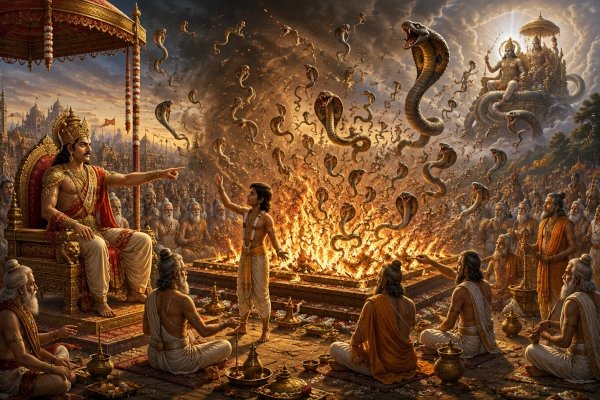
The great hall of Hastinapura was silent when the young king first heard the full account of his father’s death.
King Janamejaya, son of Parikshit and heir to the Kuru throne, sat beneath the white royal umbrella while ministers, priests and warriors stood before him. Lamps burned along the carved pillars, but their light could not soften the anger gathering in the king’s face.
Before him stood the sage Uttanka, his matted hair dusty from long travel.
“Your father did not die by chance,” Uttanka said. “He was slain by Takshaka, king of the Nagas. The serpent came in disguise, overcame every protection placed around Parikshit and burned him with venom.”
Janamejaya’s hands tightened around the arms of his throne.
He had grown up with the shadow of that death over him. He knew that his father had been cursed by a young ascetic to die from snakebite within seven days. He knew that Parikshit had withdrawn into a guarded palace, surrounded by physicians, priests and protective rites.
Yet Takshaka had still reached him.
The serpent king had hidden inside a fruit carried by Brahmanas into the royal chamber. When the fruit was opened, a tiny worm appeared. Before the watching king could understand what he saw, the creature expanded into the terrible form of Takshaka.
Fire seemed to pour from the serpent’s eyes.
His fangs entered Parikshit’s body.
In an instant, the palace chamber blazed like dry grass struck by lightning. When the flames died, the Kuru king was dead.
Janamejaya had inherited the throne, but not peace.
Now Uttanka’s words reopened the wound.
“Takshaka lives,” the sage continued. “He dwells proudly among the Nagas, untouched by punishment. Will the son of Parikshit allow his father’s killer to go free?”
The king rose.
“No,” he said.
His voice was low, but it carried through the entire hall.
“Takshaka killed my father. For that crime, he shall perish.”
Then anger carried him beyond justice.
“Not Takshaka alone,” Janamejaya declared. “Let every serpent race be destroyed. I shall perform a sacrifice so powerful that all Nagas, wherever they hide, will be dragged into the fire.”
The priests lowered their eyes.
Some were troubled. Others saw only the will of the king.
Thus began the preparation for the terrible Sarpa Satra, the great snake sacrifice.
The Sacrificial Ground
A vast area was cleared for the ritual.
Workers raised an enormous altar from carefully measured bricks. Pavilions were built for priests, kings, sages and spectators. Sacred fires were kindled, vessels of gold and copper were arranged, and heaps of clarified butter, fragrant wood and offerings were brought from every part of the kingdom.
The ritual ground looked like a city built for the gods.
Yet dread hung over it.
Astrologers studied the sky. Priests examined the soil. Some among them whispered that the sacrifice would begin but would not reach its intended end. One architect warned that a Brahmana would eventually stop it.
Janamejaya ignored every warning.
Clad in dark ceremonial robes, the king took his place before the fire.
His face was stern.
“Begin,” he commanded.
The chief priests lifted their voices.
They did not merely chant praises to the gods. They pronounced the names of serpent clans and invoked the power of the sacrifice against them.
The flames rose.
At first, nothing seemed to happen.
Then the sky darkened.
The Nagas Fall
Far away, in forests, rivers, caves and underground palaces, serpents began to tremble.
An invisible force seized them.
Some were torn from tree branches. Some were pulled from beneath rocks. Others were dragged from jewelled halls in the depths of Nagaloka.
They rose helplessly into the air.
Thousands of serpents flew towards the sacrificial ground, twisting and hissing against the power that carried them. Great cobras with expanded hoods, water serpents shining like silver, black snakes, green snakes and serpents marked with gold all whirled through the sky.
They fell into the flames.
The fire roared.
The sound of hissing filled the air like rain striking burning wood.
Some Nagas were small enough to vanish instantly. Others were enormous, with bodies like tree trunks. Their coils struck the edges of the altar before the fire consumed them.
The priests continued chanting.
More names were called.
More serpents came.
The smell of smoke spread across the sacrificial field. Birds fled from the sky. Animals in the nearby forests grew restless. Even the spectators who had first welcomed the king’s revenge began to look away.
But Janamejaya did not soften.
“Where is Takshaka?” he demanded.
The priests searched through their sacred knowledge.
“He has not yet fallen, O King.”
“Then strengthen the rite.”
Terror in the Realm of the Nagas
In the subterranean kingdom of the serpents, panic spread.
Vasuki, lord of the Nagas, watched his brothers and kinsmen vanish one after another. The halls of his palace, once filled with glittering jewels and thousands of voices, became places of mourning.
He remembered the ancient curse of their mother, Kadru.
Long ago, Kadru had ordered her serpent sons to deceive Vinata in a wager concerning the celestial horse Uchchaihshravas. Some Nagas had refused to take part in the deception.
In anger, Kadru cursed them.
“You shall be consumed in the snake sacrifice of King Janamejaya.”
That curse had waited through generations.
Now it was being fulfilled.
Yet hope had also been planted long before.
The gods and sages had foretold that a child named Astika, born of the sage Jaratkaru and Vasuki’s sister, would one day save the serpent race.
Vasuki turned to his sister.
“The hour has come,” he said. “Only your son can protect us now.”
Astika was still young, but his wisdom exceeded his years. He had learned the Vedas, mastered sacred conduct and possessed a gentle nature joined with extraordinary intelligence.
When he saw the grief of the Nagas, he understood his purpose.
“Do not fear,” Astika told his mother and uncle. “I shall go to the king.”
Takshaka Seeks Refuge
Takshaka, meanwhile, had fled to the court of Indra, king of the gods.
The serpent king entered the celestial city and bowed before the lord of heaven.
“Protect me,” Takshaka pleaded. “Janamejaya’s sacrifice is dragging my race into the fire.”
Indra granted him refuge.
“Remain close to me. The ritual power of mortal priests shall not reach you here.”
Takshaka coiled himself near Indra’s throne, believing he was safe.
But on earth, Janamejaya’s anger grew.
“Why has Takshaka not come?”
The priests replied, “He has taken shelter with Indra.”
The king’s eyes flashed.
“Then summon them both.”
Some priests hesitated.
To drag the king of heaven into a mortal sacrifice was no small act.
Janamejaya leaned forward.
“Chant the mantra.”
The officiating priests poured ghee into the fire and cried:
“Let Takshaka fall into the flames together with Indra!”
The heavens shook.
In Indra’s palace, the throne began to move.
Takshaka felt himself pulled downward.
He tightened his coils around Indra, but the sacrificial force was relentless. Together they began descending from the celestial realm towards the blazing altar.
Clouds spun around them. Thunder rolled. Takshaka saw the flames far below and knew that death was near.
It was at that moment that Astika reached the entrance of the sacrificial ground.
The Young Brahmana at the Gate
The guards looked at him with suspicion.
Astika was young, plainly dressed and alone. Yet his face shone with calm intelligence.
“No one may enter without permission,” said the gatekeeper.
Astika smiled and praised the sacrifice, the king, the priests and the generosity of the Kuru line. His words were graceful, learned and perfectly suited to the occasion.
Those who heard him were impressed.
The guards informed the priests, and the priests informed Janamejaya.
“Bring him in,” said the king.
Astika entered the great pavilion.
Around him, serpents continued to fall through the air. The fire thundered. Priests chanted with fierce concentration. Above the altar, Takshaka and Indra were being drawn steadily downward.
Astika looked upon the destruction but showed no fear.
He approached Janamejaya and spoke with respect.
“O King, this sacrifice is vast. Its priests are learned, its offerings abundant and its purpose carried forward with extraordinary power. The fame of your generosity and strength will travel across the earth.”
Janamejaya was pleased.
The young Brahmana’s speech contained neither flattery nor fear. It carried the dignity of true learning.
“Ask a boon,” the king said. “Gold, cattle, land or any treasure you desire shall be yours.”
The chief priest suddenly turned.
“Great King, wait. Takshaka has not yet entered the fire. Grant no boon until he falls.”
Janamejaya looked upward.
Through the smoke, he could see the serpent king descending with Indra.
The priests chanted more loudly.
Astika remained silent.
The king, bound by his own word, spoke again.
“I have promised. Ask.”
Astika folded his hands.
“O King, let this sacrifice end. Let the remaining serpents live.”
The entire pavilion became still.
Only the fire continued to roar.
Janamejaya stared at him.
“Ask for anything else.”
“I desire nothing else.”
“I shall give you gold beyond measure.”
“I do not seek gold.”
“Then villages, horses, elephants, jewels.”
“I seek only the end of the sacrifice.”
The king’s face darkened.
“These serpents killed my father.”
“Takshaka killed your father,” Astika replied gently. “Yet countless others have burned for his crime.”
Janamejaya said nothing.
Astika continued.
“Justice must know its limit. When punishment destroys the guilty and innocent together, it becomes another form of wrongdoing.”
The words entered the hall like cool rain.
Some priests lowered their chanting voices. Sages seated nearby nodded in approval. The king’s ministers looked towards Janamejaya, waiting.
Above them, Takshaka continued to fall.
“Stay, Takshaka”
Astika raised his hand and spoke three times:
“Stay, Takshaka.”
The serpent’s descent slowed.
“Stay, Takshaka.”
He hung suspended in the sky.
“Stay, Takshaka.”
The power of the sacrifice and the power of Astika’s virtue met in the air. Takshaka remained frozen between heaven and earth, trembling above the flames.
Janamejaya struggled within himself.
He remembered his father.
He remembered the rage that had filled him when Uttanka described Takshaka’s act. He remembered the thousands of serpents already consumed.
Revenge had promised relief.
Yet the emptiness inside him remained.
Destroying more creatures would not bring Parikshit back.
At last, the king raised his hand.
“Let the sacrifice cease.”
The priests stopped chanting.
The pull upon the serpent world vanished.
Takshaka escaped the flames. The surviving Nagas returned to their forests, rivers and subterranean realms.
A deep silence settled over the sacrificial ground.
Then the sages praised Janamejaya for honouring his promise and praised Astika for saving an entire race.
The End of the Sacrifice
The king gave Astika rich gifts and treated him with honour.
Among the Nagas, Astika’s name became sacred. They blessed him and promised that those who remembered his story with reverence would be protected from fear of serpents.
The sacrifice ended, but its lesson endured.
Janamejaya had begun with a just grievance. His father had been killed, and Takshaka bore responsibility. Yet grief had grown into hatred, and hatred had expanded until the king sought to destroy an entire race.
Astika did not deny Janamejaya’s sorrow.
He taught him that sorrow cannot excuse limitless vengeance.
The death of Parikshit was not undone. The serpents already consumed did not return. But the destruction stopped before it became complete.
And so the young sage saved not only the Nagas.
He also saved Janamejaya from becoming the author of a greater injustice than the one he had set out to avenge.
Long after the fires of the Sarpa Satra had gone cold, the story remained in the Mahabharata as a warning:
Anger may begin with a wound, but when it loses discernment, it demands the innocent along with the guilty.
Justice seeks balance.
Revenge seeks only more fire.
You may also like
-
Semicon 2.0 Targets 200 Chip-Design Companies and One Lakh Semiconductor Technicians
-
Centre to Lower NEET-SS 2025 Cut-Off to 30th Percentile as 1,857 Super-Speciality Seats Remain Vacant
-
Krishna’s Last Peace Mission: The Five Villages That Could Have Prevented Kurukshetra
-
The Frog King and the Serpent: The Enemy Invited Into the Well
-
The Serpent and the Meaning of Violence: When Grief Turned Ruru Against Every Snake
