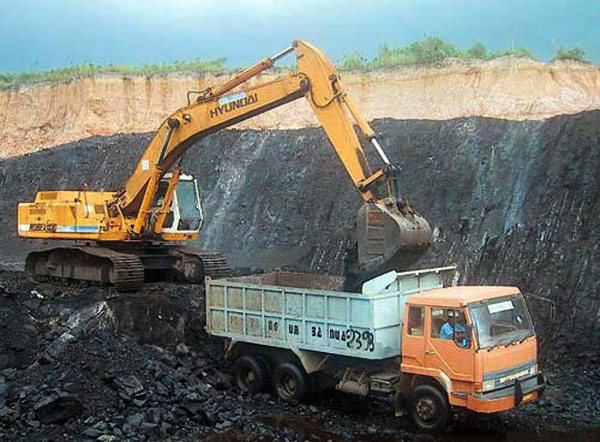
India’s thermal power sector recorded a sharp reduction in coal imports during 2025–26 as higher domestic availability, revised allocation policies and improvements in coal transportation helped power producers reduce their dependence on overseas supplies.
Thermal power plants imported 45.4 million tonnes of coal in FY 2025–26, compared with 62.5 million tonnes in FY 2024–25. This represented a year-on-year decline of approximately 27.4 per cent.
The downward trend continued into the new financial year. Coal imports by power plants specifically designed to operate on imported coal declined to 2.88 million tonnes in April 2026, from 3.97 million tonnes in April 2025—a reduction of nearly 27.45 per cent.
The figures were presented by Union Minister of State for Coal and Mines Satish Chandra Dubey in a written reply in the Rajya Sabha.
Higher Domestic Coal Allocation Supports Power Plants
A major element of the government’s strategy has been to increase the Annual Contracted Quantity of domestic coal supplied to thermal power stations.
The contracted quantity has been restored to as much as 100 per cent of the normative requirement for plants where coal allocation had earlier been limited to 90 per cent for non-coastal plants and 70 per cent for coastal plants.
The higher allocation enables power producers to obtain a larger share of their fuel requirements from domestic coal companies, reducing the need to purchase more expensive imported coal.
The government had also decided in 2022 that coal companies would supply enough fuel to meet the complete Power Purchase Agreement requirements of existing power-sector linkage holders, irrespective of their trigger levels or contracted quantities.
This policy allows power plants with long-term electricity supply commitments to secure sufficient domestic coal for fulfilling their generation obligations.
Revised SHAKTI Policy Opens Domestic Supply to Imported-Coal Plants
Imported Coal-Based power plants have been permitted to obtain domestic coal under the Revised SHAKTI Policy, 2025.
These plants were originally designed around imported coal specifications and traditionally depended heavily on overseas fuel. Access to domestic supplies under the revised policy is expected to reduce their exposure to international coal prices, currency fluctuations and global supply disruptions.
Existing Fuel Supply Agreement holders can also obtain additional coal through the revised SHAKTI framework after lifting their entire contracted quantity under their current agreements. This provides power producers with another route to secure coal beyond their regular allocation.
Coal India Limited conducted three short-term auction tranches and one long- or medium-term auction tranche under Window II of the Revised SHAKTI Policy during 2026 up to June.
According to the government, sufficient coal was made available through these auctions, enabling power plants to book supplies at premiums close to zero for their short-, medium- and long-term requirements.
CoalSETU to Improve Availability of Washed Coal
The government has also introduced the CoalSETU window under coal-linkage auctions for the non-regulated sector.
The mechanism is intended to improve the availability of washed coal within the country. Coal washing removes part of the ash and impurities from raw coal, improving its suitability for certain industrial and power-generation applications.
Greater domestic availability of washed coal could replace part of the higher-grade coal currently imported by consumers requiring specific quality parameters.
Logistics Plan Targets Faster Coal Movement
Alongside production and allocation reforms, the Ministry of Coal has launched an Integrated Coal Logistics Plan in coordination with other ministries and industry stakeholders.
The plan seeks to identify and address bottlenecks across the coal transportation chain, from mines and loading terminals to power stations and industrial consumers.
It includes the development of 33 critical railway projects, expansion of First Mile Connectivity infrastructure, enhancement of rail-based evacuation capacity and greater use of coastal shipping and inland waterways.
A total of 139 First Mile Connectivity projects, with a combined coal-handling capacity of 1,319 million tonnes, are planned for completion by FY 2029–30.
These projects generally involve mechanised transportation systems such as conveyor belts, silos and rapid loading arrangements that move coal directly from mines to railway wagons. They reduce reliance on road transport, lower loading times and improve the reliability of coal dispatches.
Coal public-sector enterprises are also implementing eight railway projects in coal-producing states to ease congestion and strengthen evacuation capacity.
Domestic Coal Becomes More Competitive
Coal continues to remain under the Open General Licence import policy, allowing consumers to source it from overseas suppliers of their choice after paying the applicable duties.
The government’s approach is therefore focused on eliminating non-essential imports rather than imposing a general restriction on overseas coal purchases.
Improved domestic production, expanded linkages, competitive auctions and better transportation are expected to encourage consumers to meet a greater share of their requirements from Indian mines.
The removal of the Goods and Services Tax compensation cess has also improved the price competitiveness of domestic coal compared with imported alternatives.
Coal public-sector companies have continued to supply fuel at regulated and affordable prices. The notified price of most Coal India coal grades has reportedly increased by only ₹20 per tonne over the past eight years.
Stable domestic prices are particularly important for thermal power generators because coal costs influence electricity-generation expenses and, ultimately, consumer tariffs.
Reduced Imports Strengthen Energy Security
The reduction in thermal coal imports can help India limit foreign-exchange expenditure and reduce the power sector’s exposure to international commodity-price volatility.
It also strengthens energy security by increasing reliance on domestically produced fuel and infrastructure controlled within the country.
The long-term sustainability of this progress will depend on consistent domestic production, adequate coal quality, timely railway evacuation, efficient mine-to-plant logistics and environmental compliance.
The latest import figures indicate that India’s combination of higher coal allocations, revised linkage policies, competitive auctions and logistics expansion is beginning to reduce the power sector’s dependence on imported coal while maintaining fuel availability for thermal electricity generation.
Reference
Press Information Bureau, Government of India. “Decline in Coal Imports.” Ministry of Coal, published July 27, 2026. Statement based on a written reply by Union Minister of State for Coal and Mines Satish Chandra Dubey in the Rajya Sabha.
You may also like
-
India and Uruguay Agree Trade and Connectivity Roadmap as Montevideo Ratifies International Solar Alliance
-
The Return of Multipolarity: Why the World Is Moving Beyond a Single Centre of Power
-
The Financial Chokepoint: Why BRICS Can No Longer Depend on SWIFT and the Dollar Alone
-
India Expands Market Access for South African Citrus With New In-Transit Cold Treatment Rules
-
South Africa Invites Indian Firms Into $100-Billion Infrastructure Pipeline as BRICS Ties Deepen
