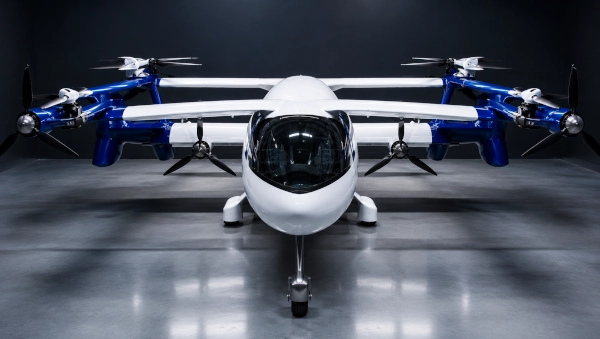
e200X-PT01: IIT Madras-Incubated Compact Electric Plane Advances India’s Urban Air-Mobility Programme
The e200X-PT01 is a full-scale electric vertical take-off and landing aircraft developed by The ePlane Company, an aerospace startup incubated at the Indian Institute of Technology Madras. Designed as a compact platform for urban and regional air mobility, the aircraft combines vertical lift, wing-borne cruise, distributed electric propulsion, composite construction and high-voltage power electronics in a single indigenous programme.
The 2.2-tonne PT-01 marks the transition of the e200X programme from subscale demonstrators to an integrated full-size aircraft. Its airframe, propulsion units, battery system, avionics, landing gear and flight-control architecture have been assembled at the company’s approximately 60,000-square-foot manufacturing and testing facility at the IIT Madras Discovery Campus in Thaiyur near Chennai. The prototype is intended for ground validation, progressive flight testing and certification development.
Developed for Dense Urban Environments
The ePlane Company was founded in 2019 by IIT Madras aerospace engineering professor Satya Chakravarthy. Its aircraft programme was conceived around the infrastructure limitations of Indian cities, where large vertiports may be difficult to build near hospitals, airports and commercial districts.
The e200X therefore follows a compact configuration designed for existing helipads, suitable open areas and potentially reinforced rooftops. Its operating footprint is listed at approximately 8 metres by 10 metres, with some programme descriptions placing the full prototype near 8 metres by 11 metres. This compact geometry is central to the aircraft’s intended use as an urban air taxi, emergency medical aircraft and time-sensitive cargo platform.
Before constructing PT-01, the company tested its aerodynamic and control concepts through the ATVA demonstrator and the larger e50 subscale aircraft. These platforms were used to study vertical flight, forward flight, transition behaviour, composite fabrication and control-law performance. The programme recorded more than 10,000 kilometres of cumulative subscale flight testing before progressing to the full-size prototype.
Synergistic Lift Architecture
The aircraft uses the company’s patented Synergistic Lift architecture. Dedicated lift propellers provide vertical thrust during take-off, hover and landing, while a separate forward-propulsion system accelerates the aircraft into wing-supported cruise.
As airspeed increases, aerodynamic lift transfers progressively from the powered vertical-lift system to the wings. This arrangement avoids the large mechanical tilt mechanisms used by tilt-rotor and tilt-wing aircraft. The principal engineering challenge instead lies in coordinating thrust, attitude and altitude through the transition using flight-control software, power-distribution systems and aerodynamic integration.
Separating the vertical and cruise functions allows each propulsion group to be optimised for its primary operating regime. The lift rotors are configured for high thrust at low forward speed, while the cruise propellers and wings support more energy-efficient horizontal flight.
Aircraft Configuration and Performance
The e200X is planned as a piloted aircraft carrying one pilot and two passengers. In cargo or specialised configurations, it is designed to accommodate approximately 200 kilograms of useful payload.
The company states a planned range of about 110 kilometres and a maximum speed near 160 kilometres per hour. These specifications place it within the short- and medium-distance advanced air-mobility segment, suitable for airport transfers, hospital connections, inter-district travel and movement between industrial or commercial centres.
Its mission radius will depend on payload, wind, ambient temperature, battery condition, hover duration and mandatory energy reserves. The aircraft’s compact dimensions and vertical-flight capability are intended to shorten the ground portion of a journey by enabling operations closer to the passenger’s origin or destination.
Carbon-Fibre Composite Airframe
PT-01 is built around a carbon-fibre composite structure. Composite construction provides a high strength-to-weight ratio and allows complex aerodynamic shapes to be manufactured with fewer structural joints than conventional metallic assemblies.
For battery-electric aircraft, structural mass directly affects payload, range and vertical-lift power requirements. The use of carbon fibre therefore supports both airframe efficiency and propulsion performance.
The company developed and moulded the principal composite structures within its programme. It has also developed major aircraft systems including the propellers, landing gear and battery pack, giving the engineering team direct control over mass distribution, structural integration and subsystem interfaces.
800-Volt Electrical Architecture
The e200X uses an 800-volt electrical system to supply its distributed propulsion network. Increasing system voltage allows a given power level to be transmitted at lower current, reducing resistive losses and enabling lighter electrical cabling.
The architecture supports multiple electric motors, inverters, propulsion units and onboard systems. It is also designed around thermal management and rapid operational turnaround, both of which are essential for maintaining a commercially useful flight frequency.
Vertical take-off and landing produce high short-duration power demands. The battery-management system must therefore regulate cell temperature, monitor state of charge and health, isolate faults and prevent thermal propagation. Certification testing will examine the cells, modules, enclosure, cooling arrangement, high-voltage distribution and protective software under normal and abnormal conditions.
Distributed Electric Propulsion
Multiple electric propulsion units provide precise thrust control and create opportunities for functional redundancy. The flight-control system can monitor motor, inverter and propeller performance continuously and respond to selected component failures by adjusting thrust distribution.
The propulsion units also interact aerodynamically with the wings, fuselage and neighbouring propellers. These interactions become particularly important during hover, crosswinds and transition flight. PT-01 allows the company to compare full-scale aerodynamic behaviour against the computational and subscale data generated earlier in the programme.
Flight Computing and Avionics
The aircraft integrates NVIDIA’s IGX Thor computing platform for onboard processing and sensor fusion. Sensor fusion combines information from navigation, inertial and situational-awareness systems to produce a consistent estimate of the aircraft’s position, motion and operating environment.
The computing architecture can support flight-control assistance, aircraft-health monitoring and the gradual development of higher levels of automation. A HENSOLDT avionics suite provides capabilities associated with navigation, situational awareness and secure telemetry.
Initial commercial operation is planned around a human pilot. Greater autonomy would depend on technical validation, certification requirements and the development of air-traffic-management systems capable of integrating eVTOL aircraft with helicopters, conventional aircraft and unmanned platforms.
Digital Engineering and Full-Scale Validation
The e200X programme uses computational fluid dynamics, structural analysis, thermal modelling and control-system simulation to evaluate the aircraft before physical testing.
Computational models can predict rotor-wing interaction, airframe loads, power-system behaviour, battery temperature and responses to propulsion or sensor failures. PT-01 provides the physical platform required to correlate those predictions with measured full-scale data.
This correlation process is important because material tolerances, vibration, motor heating and three-dimensional airflow may differ from idealised simulations. Results from the prototype can be used to refine structural components, control laws, cooling systems and later certification aircraft.
Ground and Flight-Test Programme
PT-01 is scheduled to undergo structured ground testing covering the airframe, propulsion, landing gear, electrical system, battery pack, avionics and flight-control software.
Structural tests will reproduce aerodynamic, manoeuvre and landing loads. Propulsion trials will measure thrust, power consumption, vibration, cooling and motor response. Electrical testing will examine charging, discharge, fault isolation and high-voltage protection, while hardware-in-the-loop and system-level tests will evaluate the aircraft’s response to sensor, actuator and software failures.
Following satisfactory ground results, the programme can progress through restrained trials, low-risk hover tests, expanded hover operation, transition testing and forward-flight envelope development. Each stage will add speed, altitude and manoeuvre complexity while generating evidence for the certification process.
DGCA Certification Programme
The ePlane Company became the first private Indian enterprise to receive Design Organisation Approval from the Directorate General of Civil Aviation for an electric-aircraft programme. This approval recognises the company’s engineering organisation, procedures, responsibilities and capability to work within a regulated aircraft-development framework.
The DGCA has also accepted the Type Certification application for the e200X, with the programme under way since December 2024. The company has separately advanced certification activity for its internally developed propeller system.
Type certification will require compliance evidence covering structural integrity, propulsion reliability, battery safety, electromagnetic compatibility, software assurance, flight characteristics, maintainability and system behaviour during foreseeable failures.
Commercial deployment would subsequently require production approvals, individual aircraft airworthiness, approved maintenance procedures, trained pilots, operational authorisation and suitable ground infrastructure.
Passenger, Medical and Cargo Missions
The e200X has been designed as a common platform for several mission configurations.
In air-taxi service, it could connect airports, business centres and satellite cities while avoiding road congestion. Its compact footprint is intended to reduce the infrastructure requirement at each landing site.
The emergency medical configuration could support patient transfer, organ transport, blood delivery and movement of medical personnel between hospitals. Compatibility with existing hospital helipads could make medical aviation one of the aircraft’s earliest practical applications.
The cargo version is suited to urgent, high-value loads such as medical supplies, electronic components, emergency equipment and specialised industrial parts. Its approximately 200-kilogram payload capacity positions it for time-sensitive mid-mile logistics rather than bulk freight.
Indigenous Aerospace Capability
The programme brings together electric propulsion, advanced composites, high-voltage power systems, battery integration, embedded computing, sensor fusion, flight-control software and civil-aircraft certification.
The airframe, propellers, landing gear and battery pack have been developed within the company’s engineering ecosystem. This creates Indian capability in several high-value aerospace technologies while opening opportunities for domestic suppliers of motors, inverters, composite materials, sensors, charging equipment and precision components.
Development at the IIT Madras Discovery Campus also demonstrates how university research, startup incubation and regulated manufacturing can be combined within a single deep-technology programme. The facility integrates component production, aircraft assembly, system validation and testing, supported by the wider technical ecosystem of IIT Madras and its research institutions.
A Full-Scale Step Towards Electric Urban Aviation
The e200X-PT01 is presently a development prototype undergoing the validation required before certified operation. Its completion nevertheless represents a major technical milestone for India’s advanced air-mobility sector.
With a compact footprint, carbon-composite airframe, 800-volt power architecture, distributed electric propulsion, 110-kilometre planned range, 160-kilometre-per-hour stated speed and a 200-kilogram payload capability, PT-01 provides The ePlane Company with a full-scale platform for proving its aircraft architecture.
The next phase will centre on ground validation, hover and transition testing, flight-envelope expansion and DGCA certification. Progress through these stages could establish the e200X as an important indigenous platform for urban transport, emergency medical mobility and specialised electric aviation.
REFERENCES
The ePlane Company. “e200X-PT01 Is Here: Introducing India’s First and the World’s Most Compact Air Taxi.” YouTube.
https://www.youtube.com/watch?v=KpAOi30cKlI
The ePlane Company. “India’s Compact All-Electric Air Taxi.” Official Website.
https://www.eplane.ai/
The ePlane Company. “Our Mission, History and Development of the e200X.”
https://www.eplane.ai/about/
Indian Institute of Technology Madras. “Union Minister Ashwini Vaishnaw Visits Cutting-Edge Research Facilities at IIT Madras.” Includes information on The ePlane Company, its eVTOL programme and DGCA Design Organisation Approval.
https://www.iitm.ac.in/hi/node/17031
Indian Institute of Technology Madras. “Inside IIT Madras’ Deep-Tech Startup Incubator.” Includes the origins and early development of The ePlane Company’s electric flying-taxi programme.
https://www.iitm.ac.in/happenings/press-releases-and-coverages/inside-iit-madras-deep-tech-startup-incubator
You may also like
-
India Earmarks ₹1.39 Lakh Crore for Domestic Defence Procurement in 2026–27
-
India’s First Port-Based e-Methanol Plant at Kandla to Supply Green Fuel to Global Shipping
-
India’s Recent Oil and Gas Discoveries: New Finds, Offshore Frontiers and How Much Crude India Produces at Home
-
India’s Hidden Gold Mountain: How Households Came to Own an Estimated 31,000 Tonnes of Gold
-
India–Afghanistan Air Cargo Corridor Returns to Focus as Both Sides Push for Stronger Trade Connectivity
