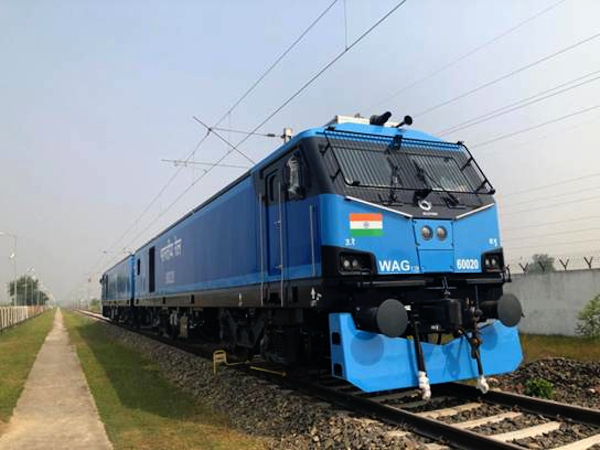
India has emerged as one of the world’s leading countries in railway electrification, with nearly 99.6 per cent of the Indian Railways’ broad-gauge network now operating under electric traction. The achievement places India second only to Switzerland, which has electrified its entire railway network, and represents one of the largest and fastest railway infrastructure transformations undertaken anywhere in the world.
The electrification programme has been pursued in mission mode, with work on the remaining sections already under implementation. Indian Railways electrified 48,072 route kilometres between 2014 and 2026, compared with 21,801 route kilometres completed during the six decades preceding 2014. All newly sanctioned railway lines and multi-tracking projects are also being constructed with electrification from the outset.
According to the June 2025 report of the International Union of Railways, Switzerland leads major railway systems with 100 per cent electrification, followed by India at 99.6 per cent. China has electrified around 82 per cent of its railway network, Spain 67 per cent, Japan 64 per cent, France 60 per cent and the United Kingdom 39 per cent.
India’s approach differs from that of several countries that primarily electrify heavily used passenger and freight corridors. Indian Railways has instead pursued the electrification of almost its entire broad-gauge network, creating one of the most extensively electrified large railway systems in the world.
The transition to electric traction has also brought substantial environmental and economic benefits. Rail transport produces significantly lower carbon emissions than road transport. According to NITI Aayog’s report, “Fast Tracking Freight in India,” transporting one tonne of goods over one kilometre by road produces around 101 grams of carbon dioxide, while rail transport generates approximately 11.5 grams. This makes rail transportation nearly 89 per cent less carbon-intensive than road-based freight movement.
Electrification has reduced Indian Railways’ dependence on diesel and imported fossil fuels. Diesel consumption for railway traction declined from 293 crore litres in 2015–16 to approximately 108 crore litres in 2024–25, representing a reduction of around 185 crore litres. The decline has helped conserve foreign exchange that would otherwise have been spent on fuel imports while also lowering carbon emissions from railway operations.
Electric traction provides operational advantages through improved haulage capacity, higher speeds and greater energy efficiency. Electric locomotives can move heavier passenger and freight trains while supporting faster acceleration, reduced journey times and improved railway network utilisation.
The near-total electrification of the broad-gauge network also enables Indian Railways to integrate renewable electricity into its traction power requirements. Solar, wind and hybrid renewable systems can supply power directly or indirectly to an electrified railway network, helping create a cleaner and more sustainable transportation system.
Indian Railways is progressively increasing the share of renewable energy used in its operations through strategic power procurement and the development of solar and wind capacity. As of June 2026, around 1,161 megawatts of solar power capacity had been commissioned on railway land and rooftops. An additional 103 megawatts of wind power capacity had also been commissioned, taking the combined operational solar and wind capacity to approximately 1,264 megawatts.
The Railways plans to meet a growing portion of its electric traction requirements through solar, wind and hybrid energy systems combining renewable generation with energy storage. The strategy supports Indian Railways’ wider objective of reducing its carbon footprint and moving towards low-carbon operations.
Completing the electrification of an active railway network has involved considerable technical and operational challenges. Electrification work must often be conducted on railway lines that continue to carry regular passenger and freight services. Projects may also encounter difficulties related to land, clearances, infrastructure constraints, power supply arrangements and coordination among multiple agencies.
Indian Railways has introduced several measures to accelerate implementation. These include the use of the Project Monitoring Group portal to resolve commissioning constraints, stronger project monitoring mechanisms, assured funding and enhanced financial powers for field units responsible for executing electrification works.
Fifteen railway zones have already achieved complete electrification. These include Central Railway, East Coast Railway, East Central Railway, Eastern Railway, Konkan Railway, Kolkata Metro, North Central Railway, North Eastern Railway, Northern Railway, South Central Railway, South Coast Railway, South East Central Railway, South Eastern Railway, West Central Railway and Western Railway.
North Western Railway has reached 99.8 per cent electrification, while Northeast Frontier Railway and Southern Railway have each achieved 98.7 per cent. South Western Railway has electrified 96.1 per cent of its network.
Several states and Union Territories have also achieved complete railway electrification. Andhra Pradesh, Arunachal Pradesh, Bihar, Chandigarh, Chhattisgarh, Delhi, Gujarat, Haryana, Himachal Pradesh, Jammu and Kashmir, Jharkhand, Kerala, Madhya Pradesh, Maharashtra, Meghalaya, Mizoram, Nagaland, Odisha, Puducherry, Punjab, Telangana, Tripura, Uttar Pradesh, Uttarakhand and West Bengal have recorded 100 per cent electrification of their broad-gauge railway networks.
Rajasthan has achieved 99.8 per cent electrification, followed by Tamil Nadu at 98.3 per cent, Assam at 97.9 per cent, Karnataka at 96.8 per cent and Goa at 91.4 per cent.
The electrification programme forms a central part of India’s strategy to modernise railway infrastructure, reduce dependence on imported fuel, improve operational efficiency and promote cleaner mobility. Combined with expanding renewable energy capacity, the transition is transforming Indian Railways into a more energy-efficient and environmentally sustainable national transportation system.
The information was provided by Union Minister for Railways, Information and Broadcasting, and Electronics and Information Technology Ashwini Vaishnaw in a written reply to a question in the Lok Sabha on July 22, 2026.
Source: PIB
The electrification programme has been pursued in mission mode, with work on the remaining sections already under implementation. Indian Railways electrified 48,072 route kilometres between 2014 and 2026, compared with 21,801 route kilometres completed during the six decades preceding 2014. All newly sanctioned railway lines and multi-tracking projects are also being constructed with electrification from the outset.
You may also like
-
India’s First Port-Based e-Methanol Plant at Kandla to Supply Green Fuel to Global Shipping
-
India’s Recent Oil and Gas Discoveries: New Finds, Offshore Frontiers and How Much Crude India Produces at Home
-
India’s Hidden Gold Mountain: How Households Came to Own an Estimated 31,000 Tonnes of Gold
-
India–Afghanistan Air Cargo Corridor Returns to Focus as Both Sides Push for Stronger Trade Connectivity
-
India’s Defence Shipyards Build Common Indigenous Supply Chain for Specialised Naval Cables
