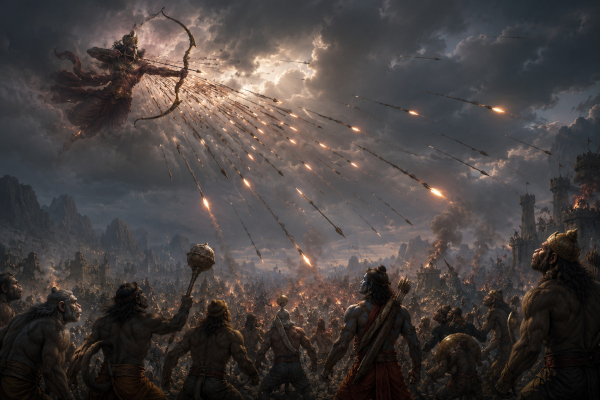
Indrajit’s method of battle in the Ramayana stands among the most advanced military images in the epic. He enters the battlefield as a warrior who understands altitude, concealment, timing and psychological shock. He fights from the sky, hides himself through maya, rains arrows from above and forces Rama’s army to face an enemy beyond ordinary reach. In epic language, this is celestial warfare. In defence language, it is the use of the aerial domain for surprise attack, stand-off engagement and battlefield disruption.
The power of Indrajit comes from the combination of height and invisibility. A warrior standing on the ground can be seen, measured, challenged and surrounded. A warrior operating from the sky changes the geometry of combat. He expands the attack angle, escapes the normal line of sight and strikes the formation from a direction the soldiers cannot physically occupy. This gives him the advantage of elevation. The Vanara army sees the effect of his attack before it can fully identify the attacker. That is the core of aerial dominance: the ability to create damage from a position where the defender struggles to respond.
Indrajit’s invisibility adds another layer to this tactic. He does more than attack from above. He attacks from an unseen position. His arrows arrive like sudden fire from the atmosphere. The battlefield becomes uncertain. Soldiers hear the sound, feel the impact and see comrades falling, while the source remains hidden. This creates tactical confusion and emotional pressure. An army can endure a visible opponent through courage and formation discipline. An invisible aerial enemy attacks the mind first and the body next. Fear grows because every direction appears dangerous.
Modern warfare carries the same principle through stealth aircraft, drones, loitering munitions, cruise missiles, electronic warfare and stand-off weapons. A stealth aircraft reduces detection and penetrates defended airspace. A drone can hover, observe and strike from angles ground troops rarely expect. A cruise missile flies along planned routes and attacks a target with precision. A loitering munition waits in the sky like a hunting weapon before diving on a radar, vehicle or command post. These systems follow the same strategic idea seen in Indrajit’s warfare: the attacker gains superiority by controlling visibility, height and timing.
The arrows of Indrajit resemble precision attack from above. In the epic, the arrow is a divine weapon guided by skill, mantra and battlefield intent. In modern doctrine, this role is filled by missiles, glide bombs, guided rockets and UAV-launched munitions. The weapon descends from the sky with force and accuracy. It can target troop concentrations, vehicles, air-defence nodes, bridges, ammunition points and command posts. The ground force experiences the strike as a sudden vertical threat. The attacker uses the sky as a corridor of destruction.
Indrajit’s warfare also shows the value of stand-off attack. He remains away from direct close combat while delivering damage. This is a major feature of advanced warfare. A pilot firing a beyond-visual-range missile, a ship launching a land-attack missile, a drone operator guiding a munition and an artillery unit using precision rockets all share the same logic. The attacker creates combat effect while preserving distance. Distance protects the attacking platform, stretches the defender’s reaction time and gives commanders more control over escalation.
The psychological effect of Indrajit’s attack is as important as the physical damage. The Vanara army faces a warrior who seems to command the sky itself. His presence turns the open battlefield into a zone of uncertainty. The soldiers cannot relax, gather, advance or regroup with confidence. Every movement feels exposed. This is the same effect modern air power creates when soldiers know that drones, aircraft or missiles are watching from above. A unit under constant aerial threat changes its behaviour. It disperses, hides, slows down, reduces communication and loses momentum. The sky becomes a pressure chamber.
Indrajit’s invisibility can also be read as control of signature. In modern warfare, every platform has a signature. Aircraft have radar signatures. Vehicles have thermal signatures. Troops have electronic signatures through radios and phones. Drones have acoustic and electromagnetic signatures. A smart military force reduces these signatures through stealth shaping, camouflage, electronic silence, decoys, terrain masking and emission control. Indrajit’s maya represents this principle in epic form. He manipulates perception, hides his position and forces the defender to fight against effects rather than visible sources.
This tactic reveals a deeper rule of warfare: detection comes before destruction. A force can defeat an aerial attacker only after finding him, tracking him and building a firing solution. Visibility becomes a weapon. In the Ramayana, the army’s challenge is to understand where Indrajit is, how he strikes and when he becomes vulnerable. In modern war, the same challenge is solved through radars, satellites, airborne early warning aircraft, electro-optical sensors, infrared trackers, acoustic sensors, cyber intelligence and human intelligence. The side that sees first gains the chance to strike first.
A powerful modern Indian parallel appears in Operation Sindoor, where the S-400 Sudarshan Chakra showed how the defender can turn the sky itself into a controlled battlefield. Indrajit’s strength came from height, surprise and the ability to strike from beyond ordinary reach. The S-400 represents the counter to that same principle in modern warfare. It combines long-range radar, tracking, command networks and interceptor missiles to detect aerial platforms far away and destroy them before they can safely direct the battle from above. Reports after Operation Sindoor stated that India’s air-defence network used the S-400 to bring down a large Pakistani airborne platform at extreme range, with several accounts identifying it as an AEW&C or AWACS-type aircraft. Such an aircraft functions as the enemy’s flying eye, watching the battlefield, guiding fighters, tracking targets and extending command over the air war. Removing it from the sky is equal to blinding the aerial commander. In Ramayana terms, this is the moment when the unseen attacker loses the advantage of height and concealment. In modern defence terms, it is the victory of detection, reach and integrated air defence over aerial surprise.
Indrajit’s sky-based attack also resembles modern suppression of ground formations. He does not simply kill individual fighters. He freezes the larger movement of the army. By striking from above, he disrupts command, movement, morale and concentration. In modern operations, aerial strikes are used to break an enemy’s rhythm. Air power hits roads, supply depots, armour columns, bridges, radar stations and headquarters. The aim is to make the enemy slow, confused and vulnerable. Indrajit’s arrows serve this same operational purpose. They break the confidence of a moving force and force it into reaction.
The use of surprise is central to his method. Indrajit chooses the moment of attack and reveals only the result. Surprise is one of the oldest principles of warfare, and the sky multiplies its power. An aerial strike can cross distance quickly, appear suddenly and hit before ground troops complete their defensive posture. Modern militaries invest heavily in early warning systems because surprise from the air can decide the first phase of a battle. The side caught unprepared loses aircraft on the ground, radars, command centres, ammunition and troop concentrations. Indrajit’s method shows this truth through epic imagery.
His attacks also carry the quality of multi-domain warfare. Though he is an individual warrior, his style touches several layers of battle at once. He uses the aerial domain for movement, the information domain for concealment, the psychological domain for fear and the kinetic domain for destruction. Modern warfare works in the same combined manner. A drone strike may begin with satellite surveillance, pass through electronic tracking, rely on encrypted control links, strike with a precision munition and then spread psychological pressure through battlefield awareness. Indrajit’s warfare is an ancient narrative form of this layered approach.
The Ramayana also teaches that aerial invisibility has a counter. Indrajit’s strength grows when he controls the terms of engagement. His weakness appears when his pattern, location and ritual preparation become known. Vibhishana’s intelligence becomes crucial because he understands the inner working of Lanka’s war machine. This shows the military value of insider intelligence. A hidden aerial threat can be defeated through knowledge of its launch base, preparation cycle, command link and vulnerability window. Modern forces apply this through intelligence-led targeting, special operations, electronic surveillance and pre-emptive strikes against launch sites.
Countering such a threat requires layered defence. Ground troops need dispersion, camouflage and hardened positions. Commanders need redundant communication. Air-defence units need sensors and interceptors. Electronic warfare units need jamming and spoofing capability. Fighter aircraft need patrol zones. Mobile columns need short-range air defence. Logistics hubs need deception and concealment. Aerial warfare punishes exposed formations. A disciplined army survives by making itself harder to find, harder to hit and faster to reorganise.
Indrajit’s tactic also highlights the rise of the unmanned battlefield. Drones today perform many functions once associated with supernatural sight. They observe from above, track movement, correct artillery fire, identify weak points and conduct direct strikes. Small drones can hover over trenches. Medium drones can carry guided munitions. Long-endurance drones can monitor borders and oceans. Loitering munitions can wait over the battlefield until the target appears. The ancient image of a warrior attacking unseen from the sky now appears through machines, sensors and artificial intelligence.
For India’s defence thinking, this lesson has strong relevance. The country faces mountainous borders, desert fronts, riverine terrain, dense cities, coastal zones and the vast Indian Ocean. Every theatre demands air awareness. In the Himalayas, altitude decides observation and missile reach. In deserts, open terrain exposes armour and logistics to drones and aircraft. In coastal zones, helicopters, maritime patrol aircraft and anti-ship missiles shape naval combat. Across the border belt, drones can carry weapons, drugs, sensors and surveillance payloads. A military that masters the sky gains reach over every terrain below it.
The response to Indrajit’s style lies in integrated air defence and offensive counter-air capability. Integrated air defence connects radars, missiles, guns, aircraft, command centres and electronic warfare into one shield. Offensive counter-air strikes the enemy’s ability to use the sky by targeting airbases, launchers, control stations, drones, storage sites and command nodes. The defender must protect his own forces while reducing the enemy’s aerial freedom. This dual approach turns the sky from an enemy weapon into a contested domain.
There is also a leadership lesson in this episode. Soldiers under invisible aerial attack need calm command. Panic spreads quickly when the enemy remains unseen. A commander must restore order, identify the threat, preserve communication and prevent the force from breaking formation. Rama’s army survives such trials because leadership keeps the larger mission alive. Modern commanders face the same burden under drone swarms, missile attacks and electronic disruption. The first duty is to keep the force coherent. The second duty is to locate the attacker. The third duty is to regain initiative.
Indrajit’s aerial warfare imagery shows that technological advantage alone can shape the opening phase of battle, while intelligence and discipline decide the final outcome. His sky-based attacks create shock, confusion and damage. His concealment delays the defender’s response. His altitude gives him reach. His timing gives him momentum. Yet the larger war turns when his methods are studied, his vulnerabilities are understood and his freedom of action is reduced. This is the cycle of every advanced weapon system in history. A new method creates dominance. Countermeasures evolve. The battlefield adapts.
The Ramayana presents this through a vivid scene of arrows falling from an invisible warrior in the sky. Modern warfare presents it through stealth aircraft, drones, precision missiles, electronic warfare and sensor networks. The principle remains the same. Whoever controls height, visibility and timing can dominate the battlefield. Whoever builds awareness, resilience and layered defence can survive the first shock and answer with force. Indrajit’s aerial warfare is therefore more than a mythic spectacle. It is a powerful study of air power, stealth, surprise and the eternal contest between concealment and detection.
You may also like
-
Indian Army Special Forces Depart for Indonesia for Exercise Garuda Shakti 2026
-
India to Train 600 Nigerian Army Soldiers in Specialised Jungle and Mountain Warfare
-
Shaka in the Mahabharata: Central Asia’s Steppe Peoples, Nakula’s Campaign and the Alliance with Duryodhana
-
India Moves Towards Five-Year Assured Orders for Defence Startups Under New Procurement Reforms
-
Zen Technologies Introduces Indigenous Hyper-Strike Falcon AI-Guided Counter-Drone Interceptor
