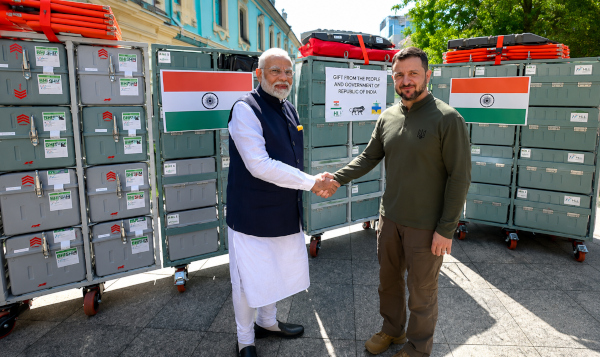
India’s BHISHM Cube is one of the most important defence-medical innovations to emerge from the country’s disaster response and military support ecosystem. It is not a weapon system, but it belongs to the same strategic universe as mobility, logistics, casualty evacuation and combat survival. In any war, disaster or mass-casualty event, the side that saves its wounded quickly preserves fighting strength, morale and operational tempo. BHISHM gives India a compact, mobile and rapidly deployable medical system that can reach the site of crisis before conventional hospital infrastructure can be moved.
BHISHM stands for Bharat Health Initiative for Sahyog, Hita and Maitri. It is part of Project Aarogya Maitri, India’s wider effort to provide essential medical assistance to countries affected by disasters, humanitarian crises and emergencies. The system is designed around one simple battlefield truth: the golden hour decides survival. A wounded soldier, a disaster victim or a civilian caught in a mass-casualty incident needs stabilisation, triage, oxygen, trauma care, emergency medicine and surgical support as close to the incident site as possible. BHISHM compresses these capabilities into modular medical cubes that can be moved by air, land, sea, boat, drone or manual carriage.
The design is modular. A full BHISHM system consists of 72 portable mini cubes. Thirty-six mini cubes form one mother cube, and two mother cubes form a complete BHISHM Cube. Each mini cube contains specific medical supplies, instruments or support items. This structure allows the system to be split, carried, tracked, assembled and used according to the emergency. Instead of waiting for a large hospital truck or container to arrive, responders can move smaller modules through difficult terrain, flood zones, mountains, conflict areas or narrow urban corridors.
The cube is built for immediate trauma care. It can support up to 200 casualties, including patients needing minor surgical procedures. Its medical equipment includes emergency medicines, trauma supplies, surgical instruments, portable diagnostic devices, ultrasound, defibrillators, infusion pumps, ventilator support, anaesthesia stations, blood and fluid warming systems, triage modules and field-care equipment. This makes it useful in war wounds, burns, fractures, bleeding injuries, crush injuries, shock, respiratory distress and disaster-linked trauma.
The most powerful feature of BHISHM is its speed. In a mass-casualty event, the unit can be set up within minutes, with official material describing deployment within 12 minutes. That matters in military medicine. In high-altitude warfare, border clashes, missile strikes, drone attacks, landslides, earthquakes or cyclones, delay kills. A medical system that reaches the affected area quickly can stabilise patients before evacuation to a larger hospital. It becomes a bridge between first aid and definitive care.
BHISHM also reflects the new age of digital field medicine. The equipment inside the cube is RFID-tagged, allowing responders to track supplies, locate items, monitor usage and check expiry status. The supporting software can guide users through the contents and operation of the cube. Digital support in 180 languages makes it useful for multinational humanitarian missions, foreign deployments and emergency operations where local responders may not share one common language. AI and data analytics add another layer by supporting coordination, monitoring and efficient management of medical services in the field.
For defence forces, the system has direct operational value. India’s northern and northeastern borders include mountains, snowbound regions, remote valleys and areas where road movement can be slow or disrupted. A portable trauma-care cube that can be para-dropped or airlifted gives the armed forces a flexible medical reserve. It can support forward troops, border posts, high-altitude training areas, disaster-response columns and humanitarian missions. It also fits India’s growing emphasis on jointness, where the Army, Air Force and medical teams work as one integrated response force.
The most striking demonstration came when the Indian Air Force and Indian Army carried out a precise para-drop of the Aarogya Maitri Health Cube at an altitude close to 15,000 feet. The IAF used the C-130J Super Hercules tactical transport aircraft, while the Army’s Para Brigade supported the precision drop. This showed that BHISHM is not merely a display item for exhibitions. It can be moved into remote and mountainous areas where normal medical infrastructure may take longer to arrive.
The system also strengthens India’s Humanitarian Assistance and Disaster Relief profile. BHISHM Cubes have been used or dispatched for domestic and international emergency requirements. They were deployed for medical readiness during the Ayodhya Pran Pratishtha event, and official parliamentary material records dispatches to countries such as Sri Lanka, Myanmar and Ukraine. India has also gifted BHISHM Aarogya Maitri Health Cubes to Kyrgyzstan for humanitarian assistance, disaster relief and search-and-rescue support during natural calamities. This places BHISHM inside India’s health diplomacy architecture, alongside Vaccine Maitri, development partnerships and Global South outreach.
The medical philosophy behind BHISHM is also important. Traditional disaster response often depends on fixed hospitals, ambulance chains and large mobile medical units. These remain essential, but they need time, roads, coordination and infrastructure. BHISHM adds a smaller, faster layer. It can enter first, stabilise patients, organise triage, support basic surgery and keep casualties alive until evacuation. In military language, it acts as a forward medical node. In disaster language, it acts as an immediate life-saving bridge.
For India, BHISHM carries three strategic meanings. First, it improves national disaster preparedness by giving AIIMS, institutes of national importance and emergency agencies a ready medical response package. Second, it improves military medical mobility by giving the armed forces a portable trauma-care system suited to mountains, islands, borders and conflict zones. Third, it strengthens India’s humanitarian diplomacy by allowing the country to send not only medicines, but a structured emergency hospital capability to friendly nations in distress.
The name BHISHM is appropriate. In the Mahabharata, Bhishma represents endurance, duty, discipline and sacrifice on the battlefield. India’s BHISHM Cube carries that symbolism into modern emergency medicine. It is built to stand where the crisis is hardest, to support the wounded in the first critical minutes, and to give commanders, doctors and rescuers a compact medical system when time, terrain and chaos are against them.
BHISHM is therefore more than a portable hospital. It is a medical logistics system, a battlefield survival tool, a disaster-response platform and a diplomatic instrument. It shows that modern defence preparedness is not only about missiles, radars, aircraft and drones. It is also about saving lives after impact, restoring confidence during crisis and ensuring that India can respond quickly wherever human survival depends on speed.
You may also like
-
Indian Army Special Forces Depart for Indonesia for Exercise Garuda Shakti 2026
-
India to Train 600 Nigerian Army Soldiers in Specialised Jungle and Mountain Warfare
-
India Moves Towards Five-Year Assured Orders for Defence Startups Under New Procurement Reforms
-
Zen Technologies Introduces Indigenous Hyper-Strike Falcon AI-Guided Counter-Drone Interceptor
-
L&T and Germany’s SCHOTTEL Expand Partnership for Controllable Pitch Propeller Systems in Indian Shipbuilding
