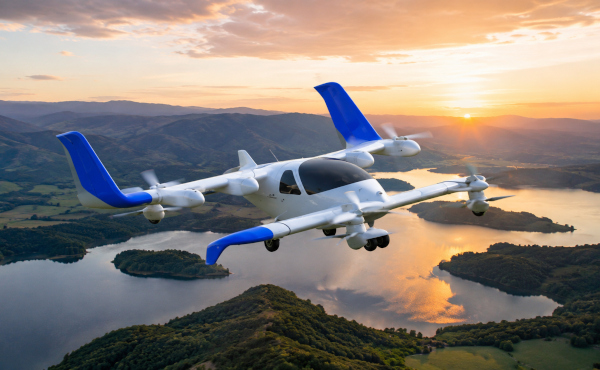
India’s advanced aviation ambitions have received a major global boost after Chennai-based The ePlane Company was featured on NVIDIA’s international AI stage. The recognition places the Indian electric aircraft startup at the centre of a fast-growing global shift where artificial intelligence, aerospace engineering, digital twins and autonomous systems are coming together to shape the next generation of flight.
The ePlane Company is developing the e200x, an electric vertical take-off and landing aircraft designed for urban air mobility. The idea is simple and ambitious: create a compact electric air taxi that can help reduce city congestion by moving short-distance travel from crowded roads to the sky. For a country where major cities lose enormous time in traffic every day, such aircraft could become part of a future mobility network connecting business districts, airports, transport hubs and urban clusters.
The latest attention came after NVIDIA CEO Jensen Huang highlighted ePlane during his COMPUTEX Taipei keynote. This is significant because NVIDIA is expanding its artificial intelligence vision beyond software and data centres into what it calls Physical AI. This field deals with intelligent machines that operate in the real world, including robots, autonomous vehicles, industrial systems and aircraft. For ePlane to appear in this global technology conversation shows that India’s aerospace startup ecosystem is beginning to enter advanced international platforms.
At the heart of ePlane’s work with NVIDIA is the use of digital twin technology. A digital twin is a highly detailed virtual model of a real machine. In ePlane’s case, the company is creating a digital version of its e200x aircraft using NVIDIA Omniverse. This virtual aircraft allows engineers to test flight behaviour, aerodynamics, sensors, autonomy systems, emergency situations and mission profiles before the real aircraft enters demanding physical trials.
This approach is important for aviation because aircraft certification is one of the most complex processes in engineering. Every system must be tested for safety, reliability and repeatability. By using simulation, engineers can expose the aircraft to thousands of flight conditions and rare failure scenarios in a controlled virtual environment. This allows the design team to identify risks early, improve software behaviour, refine sensor fusion and reduce uncertainty before real-world testing.
The company is also integrating NVIDIA hardware into its onboard avionics architecture. This makes the partnership deeper than a display of software capability. It brings AI computing into the aircraft’s core operational system. Onboard computing will be essential for processing data from sensors, cameras and radars, supporting real-time decision-making and enabling future autonomy features.
This is where the project becomes important for India’s larger technology story. For decades, high-end aerospace development was concentrated among a small group of global giants. ePlane’s work shows that Indian startups are now entering areas that require advanced simulation, embedded computing, certification discipline, precision manufacturing and deep engineering talent.
The startup’s progress also reflects the strength of India’s research ecosystem. The ePlane Company emerged from the IIT Madras ecosystem, one of India’s strongest centres for engineering and deep-tech entrepreneurship. Its journey connects academic research, aviation design, electric mobility, AI computing and manufacturing under one mission. This is the type of deep-tech model India needs as it moves from software services toward product-led innovation.
The e200x is more than an electric aircraft. It represents a new industrial category where clean energy, urban transport, aerospace materials, high-performance computing and artificial intelligence meet. If successful, such platforms can create new supply chains in batteries, motors, flight control systems, composites, avionics, charging infrastructure and maintenance services.
The use of NVIDIA Omniverse also opens the door to predictive maintenance. A digital twin can mirror the condition of real aircraft components and help predict wear, stress and possible failures before they become operational problems. For aviation, this can improve safety, reduce downtime and create a more intelligent maintenance ecosystem.
India’s urban air mobility market is still in an early stage. Regulations, infrastructure, public acceptance, safety certification, battery performance and operating economics will decide how quickly electric air taxis become practical. Still, ePlane’s presence on NVIDIA’s global stage shows that Indian companies are preparing for this future at the technology-development level.
The global aerospace industry is moving toward aircraft that are electric, software-defined and increasingly intelligent. ePlane’s work with NVIDIA places India inside this transition. The project brings together indigenous engineering and global computing platforms, giving Indian aviation a chance to build capabilities in a field that could shape future transport systems.
For India, the message is clear. The future of aviation will belong to countries that can combine aircraft design with artificial intelligence, simulation, certification and manufacturing. The ePlane Company’s rise shows that Indian startups are ready to compete in this new frontier. From Chennai to COMPUTEX Taipei, the journey of ePlane signals a larger shift: India is beginning to build for the sky with the tools of the AI age.
You may also like
-
Indian Semiconductor Companies Propose New Manufacturing and Chip Design Investments in Madhya Pradesh
-
CSIR-CRRI Partners with Industry to Develop Advanced Indigenous Airport Runway and Pavement Materials
-
Paras Semiconductors Secures 43 Acres in Madhya Pradesh for Proposed ₹6,200 Crore Advanced Chip Packaging Facility
-
Petronet LNG Plans ₹1,200 Crore Joint Venture for Ten Compressed Biogas Plants Across India
-
India Seeks South Korean Shipbuilding Partnerships as Sarbananda Sonowal Begins Four-Day Visit to Busan
