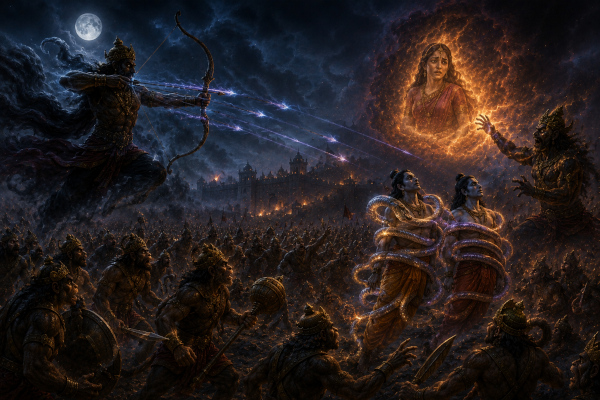
Illusion and deception warfare reach their sharpest form in the Ramayana through Indrajit, the most dangerous commander in Ravana’s army. He fights through maya-yuddha, a style of war built on concealment, surprise, psychological pressure and battlefield confusion. He uses invisibility, magical cover, serpent-like weapons and false imagery to shake Rama’s forces. His strength lies in his ability to attack the body of the army and the mind of the army at the same time.
Indrajit is a warrior of intelligence, timing and deception. He enters battle with the skill of a master tactician who understands that fear can wound before a weapon lands. His attacks create uncertainty among the Vanaras because the source of danger remains hidden. Arrows arrive from unseen directions. Weapons strike before the enemy can locate him. The battlefield becomes a place of doubt, where courage must fight through confusion before it can reach the opponent.
His invisible warfare shows the ancient form of stealth. A visible enemy can be studied, surrounded and challenged. An unseen enemy creates pressure across every direction. The Vanaras face movement without form, injury without a clear attacker and danger without a fixed location. This weakens rhythm and forces the army to react. Indrajit uses concealment as a weapon because an enemy that struggles to identify the threat loses time, focus and confidence.
The binding of Rama and Lakshmana with serpent-like weapons shows another layer of deception warfare. The attack creates a powerful visual shock. The two central figures of the campaign appear trapped, wounded and helpless before the watching army. For the Vanaras, the sight carries emotional force. Their leaders are the source of hope, direction and strength. When they see Rama and Lakshmana bound, the entire army feels the pressure of sudden despair.
A modern parallel to Indrajit’s maya-yuddha appears in reports about India’s use of dummy pilotless aircraft during Operation Sindoor. These decoy platforms were reportedly designed to mimic the radar signature and movement pattern of real fighter aircraft, drawing Pakistani radar attention and forcing air-defence systems to react. While the enemy tracked the false aerial picture, India’s real strike package and precision weapons moved with purpose against selected targets. This reflects the same military logic seen in Indrajit’s illusion warfare. The battlefield is shaped first through perception. The defender sees a threat, commits attention, exposes sensors and begins to respond to a manufactured image. In the Ramayana, Indrajit uses concealment and illusion to disturb the Vanara army’s judgement. In modern air warfare, decoys, electronic signatures and dummy aircraft create a similar fog inside the enemy’s radar screen. The weapon strikes the target, but deception prepares the path.
This is psychological targeting at the highest level. Indrajit understands that the morale of an army is tied to its leaders. He strikes Rama and Lakshmana in a way that appears dramatic before the troops. The purpose is to make the Vanaras believe that the campaign has lost its centre. A weapon on the battlefield becomes a message to the soldiers watching it. The message says that their strongest protectors can be overcome.
Modern warfare follows the same principle through shock, deception and information control. Armies use camouflage, decoys, electronic warfare, false signatures, cyber influence, radar deception, drone swarms and psychological messaging to shape enemy perception. The objective is to make the enemy see the wrong thing, fear the wrong threat, move in the wrong direction and decide under pressure. Indrajit’s maya-yuddha expresses this same logic in epic form.
Electronic warfare offers a clear modern parallel. A force can jam communications, confuse sensors, distort navigation, create false radar images and disrupt command networks. The target is the enemy’s awareness. When awareness is disturbed, decision-making slows. A commander with unclear information begins to act defensively. A unit that loses communication feels isolated. Indrajit’s invisibility creates the ancient version of this effect. He interferes with perception itself.
The illusory image of Sita takes deception into the realm of psychological warfare. Indrajit creates a false scene meant to break the emotional strength of Rama’s army. Sita is the moral centre of the campaign. Her rescue gives meaning to the entire war. By presenting an illusion of her death, Indrajit tries to strike at the purpose behind the army’s struggle. He aims at morale, grief and spiritual resolve.
This is a refined use of narrative warfare. Battles are fought through weapons, and they are also fought through stories carried inside the soldiers. Rama’s army fights with the story of justice, rescue and dharma. Indrajit attacks that story by creating a false image of failure. The illusion attempts to make the Vanaras feel that their sacrifices have lost meaning. A false event becomes a weapon aimed at collective will.
Modern information warfare works through a similar structure. False videos, manipulated images, fabricated claims, staged scenes and coordinated rumours can target public morale, military confidence and political unity. The purpose is to create emotional shock and force hasty reactions. A powerful deception does more than mislead the eye. It unsettles the heart, disturbs judgement and weakens trust. Indrajit’s false Sita episode shows this with remarkable clarity.
Rama’s side survives Indrajit’s deception because it possesses counter-intelligence and trusted counsel. Vibhishana becomes vital in this phase. He understands Rakshasa methods, recognises the logic of illusion and helps separate truth from manufactured fear. His knowledge gives Rama’s side the ability to interpret the enemy’s deception. In modern terms, this is threat analysis, intelligence validation and psychological resilience working together.
Every deception campaign depends on the enemy’s willingness to believe the false picture. The defence against deception begins with calm leadership. A disciplined army checks information before panic spreads. It trusts verified channels. It reads the enemy’s pattern. It understands that sudden shocking images may be designed to disturb judgement. Rama’s command structure gradually develops this strength as the war progresses.
Indrajit’s greatest danger lies in his ability to combine weapons with atmosphere. He fights from concealment, uses supernatural force, chooses emotional targets and manipulates perception. This makes him more than a warrior. He becomes a battlefield system built around uncertainty. His presence forces Rama’s side to fight on multiple levels: physical combat, morale defence, intelligence interpretation and command steadiness.
The campaign against Indrajit also shows the importance of finding the source of deception. A deceptive enemy remains powerful while hidden. Once his method is understood, his advantage begins to shrink. Vibhishana reveals the significance of Indrajit’s rituals and battle rhythm. Lakshmana moves against him with purpose. The hidden commander is drawn into decisive combat. Maya-yuddha loses strength when clarity enters the battlefield.
This reflects a major principle in modern war. Deception must be countered by intelligence, surveillance, pattern recognition and rapid decision-making. Drones, satellites, cyber monitoring, signal intelligence and human sources help commanders identify false movements and real threats. The side that sees through deception gains the initiative. The side that mistakes illusion for reality loses control of tempo.
Indrajit’s fall carries deep military meaning. Lanka loses its master of invisible attack, psychological shock and deceptive warfare. Ravana’s army loses the commander who could create fear beyond his physical presence. The Vanaras gain confidence because the most mysterious threat on the battlefield has been identified and defeated. The removal of Indrajit clears the fog around the campaign and brings the war closer to its final stage.
The Ramayana therefore presents deception as a major instrument of war. Indrajit uses illusion to hide himself, immobilise leaders, manipulate grief and disturb the army’s sense of reality. His warfare teaches that the mind of the enemy is a battlefield. Sight, belief, morale and trust become targets. An army that sees clearly can survive deception. An army that panics before illusion gives the enemy a victory before the main clash.
The modern battlefield has changed in tools, yet this principle remains alive. Stealth platforms, electronic warfare, cyber influence, decoy systems, false media and sensor deception all belong to the same family of tactics. Their purpose is to shape what the enemy sees and how the enemy feels. Indrajit stands as the Ramayana’s great master of this art.
In the Lanka campaign, Rama’s side defeats maya-yuddha through courage, intelligence, leadership and truth. The lesson is direct. A war is fought with weapons, formations and commanders, and it is also fought through perception. Deception can delay victory, shake morale and create chaos. Clear command, trusted intelligence and disciplined minds can break the spell. Indrajit’s illusion warfare shows that the deepest battles are often fought inside the enemy’s understanding before they are settled on the field.
You may also like
-
Indian Army Special Forces Depart for Indonesia for Exercise Garuda Shakti 2026
-
India to Train 600 Nigerian Army Soldiers in Specialised Jungle and Mountain Warfare
-
Shaka in the Mahabharata: Central Asia’s Steppe Peoples, Nakula’s Campaign and the Alliance with Duryodhana
-
India Moves Towards Five-Year Assured Orders for Defence Startups Under New Procurement Reforms
-
Zen Technologies Introduces Indigenous Hyper-Strike Falcon AI-Guided Counter-Drone Interceptor
