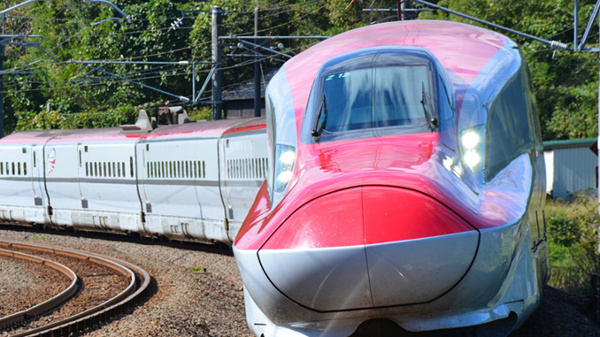
India’s first bullet train corridor has reached another important engineering milestone with the introduction of tunnel hood technology on the Mumbai–Ahmedabad High-Speed Rail project. This is the first time such a system is being used for railway tunnels in the country, marking a major step in India’s shift toward advanced high-speed rail infrastructure.
The Mumbai–Ahmedabad Bullet Train route passes through difficult terrain across Maharashtra and Gujarat. The corridor includes eight mountain tunnels, with seven located in Maharashtra and one in Gujarat. Tunnel hoods are being installed at the entry and exit points of these mountain tunnels to support smooth movement of trains operating at very high speeds.
Tunnel hood technology is a specialised engineering solution used in high-speed rail systems across the world. When a bullet train enters a tunnel at speeds above 300 kmph, it pushes a large volume of air ahead of it. This sudden movement compresses the air inside the tunnel and creates pressure waves. As these waves travel through the tunnel and emerge at the other end, they can produce a loud booming sound known as tunnel boom.
The tunnel hood works as a transition zone between open air and the enclosed tunnel space. It allows air pressure to adjust gradually as the train enters and exits the tunnel. This reduces sudden pressure changes, controls noise and improves the aerodynamic performance of the tunnel section.
A key feature of these tunnel hoods is the use of pressure-relief vents or windows. These openings allow part of the compressed air to escape into the atmosphere in a controlled manner. This weakens the pressure wave, reduces tunnel boom and helps maintain smoother airflow inside the tunnel.
The benefit of this technology will be felt by both passengers and communities living near the corridor. For passengers, it will make tunnel travel smoother and more comfortable. For nearby settlements, it will help reduce noise disturbance caused by high-speed train movement. For the project authorities, it supports safe, efficient and stable train operations at world-class speeds.
The introduction of tunnel hoods also shows the level of technical detail involved in the bullet train project. High-speed rail requires much more than fast trainsets and modern stations. It needs advanced track systems, strong viaducts, precision-built tunnels, aerodynamic planning, noise control, power systems and safety mechanisms working together as one integrated network.
The Mumbai–Ahmedabad corridor is designed to connect key economic centres in western India. Starting from Bandra Kurla Complex in Mumbai, the line will pass through important locations including Thane, Virar, Boisar, Vapi, Bilimora, Surat, Bharuch, Vadodara, Anand and Ahmedabad before terminating at Sabarmati. Once operational, it is expected to sharply reduce travel time between Mumbai and Ahmedabad and strengthen connectivity between industrial towns, ports, business centres and urban clusters.
The project is also introducing several firsts for Indian rail infrastructure. The corridor includes India’s first undersea rail tunnel beneath Thane Creek, modern ballastless track based on Japanese Shinkansen technology, advanced overhead electrification systems, noise barriers along viaducts and specialised construction techniques suited for high-speed operations.
Tunnel hood technology now adds another layer to this modernisation. It reflects India’s move from conventional rail design to high-speed rail engineering, where passenger comfort, environmental performance, safety and precision become central parts of infrastructure planning.
For India, the Mumbai–Ahmedabad Bullet Train project is more than a transport corridor. It is becoming a training ground for advanced railway construction, tunnelling, systems integration and future high-speed mobility. The use of tunnel hoods shows that the project is adopting global standards while building domestic experience in complex railway engineering.
As the corridor moves forward, each such technology will help India build confidence for future high-speed rail routes. The tunnel hood system may appear like a small structure at the mouth of a tunnel, but its role is significant. It manages air, pressure, sound and comfort at the exact point where high-speed movement meets confined underground space.
With this step, India’s bullet train project has added another visible sign of modern railway transformation. The country is preparing for trains that move faster, quieter and smoother, supported by infrastructure designed for the next generation of mobility.
You may also like
-
Indian Semiconductor Companies Propose New Manufacturing and Chip Design Investments in Madhya Pradesh
-
Paras Semiconductors Secures 43 Acres in Madhya Pradesh for Proposed ₹6,200 Crore Advanced Chip Packaging Facility
-
Petronet LNG Plans ₹1,200 Crore Joint Venture for Ten Compressed Biogas Plants Across India
-
PM Modi to Inaugurate RBI’s Tier IV Data Centre and Cybersecurity Training Institute in Bhubaneswar
-
Rosatom Completes Supply of Nuclear Safety Control Systems for Kudankulam Units 3 and 4
