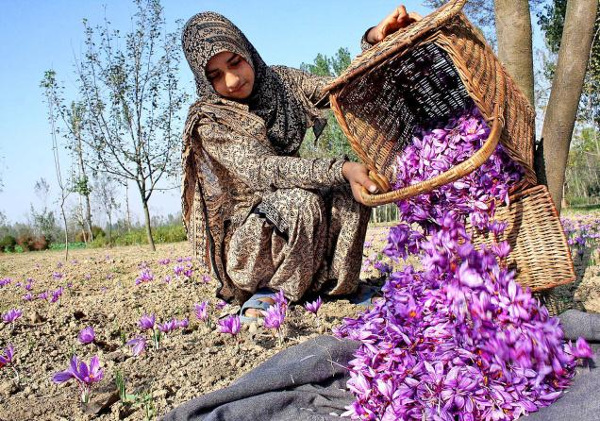
New Delhi, Oct 22 (IANS) The Modi government is working on a mission mode to double the production of saffron in the Kashmir Valley, which is likely to change the fate of thousands of farmers engaged in the cultivation of this expensive spice, said agriculture scientists adding that one hectare of saffron cultivation can earn a farmer up to Rs 24-Rs 27 lakhs.
Agriculture scientist Altaf Eijaj Andrabi told IANS, “saffron is cultivated only in Jammu and Kashmir, but it has a demand all over the world. India exports saffron to England, America and some Middle East countries. It sells at Rs 5 lakh per kilogram in the international market. In India it sells at about Rs 3 lakh per kg.”
Andrabi said that right now saffron is produced 2-4.5 kg per hectare. But it can be doubled to 8-9 kg per hectare.
Saffron is also known as the golden spice and according to Andrabi, the quality of Kashmir”s saffron is the best in the world and in terms of production, it is second only to Iran.
Andrabi said that the way the Central government is focusing on the production of saffron along with the processing and training to farmers, the day is not far when saffron production will jump to double from 17 to 34 tonne, which will make it the largest producer of the coveted spice in the world leaving Iran behind.
Andrabi said that about 32,000 farmers are directly associated with saffron production in Kashmir.
Vikramaditya Pandey, a scientist at the Indian Council of Agricultural Research, PUSA, said the “national saffron mission was launched to bring about a saffron revolution in which the Indian Institute of Horticultural Research is playing a big role. The institute has adopted an integrated system to encourage and promote cultivation of saffron among farmers using drip irrigation.”
He said this new system will not only increase production, but will also require less fertiliser and water.
Saffron, which is cultivated mainly in four districts of Jammu and Kashmir — Pulwama, Budgam, Srinagar and Kishtwar — is in great demand for its medicinal, cosmetic and aromatic properties. The blossoms appear during late autumn from mid October to early November.
–IANS
Source : IANS
Image Courtesy: KashmirLife
You may also like
-
Indian Semiconductor Companies Propose New Manufacturing and Chip Design Investments in Madhya Pradesh
-
CSIR-CRRI Partners with Industry to Develop Advanced Indigenous Airport Runway and Pavement Materials
-
Paras Semiconductors Secures 43 Acres in Madhya Pradesh for Proposed ₹6,200 Crore Advanced Chip Packaging Facility
-
Petronet LNG Plans ₹1,200 Crore Joint Venture for Ten Compressed Biogas Plants Across India
-
India Seeks South Korean Shipbuilding Partnerships as Sarbananda Sonowal Begins Four-Day Visit to Busan
