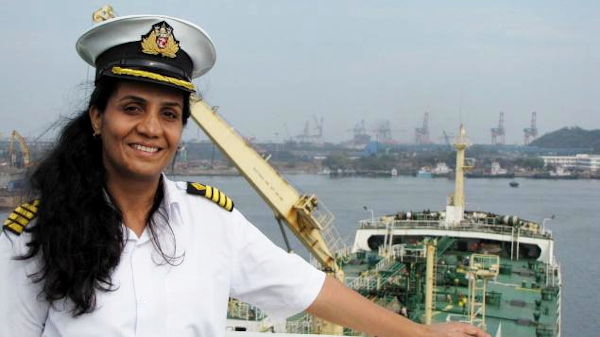
Women’s participation in India’s maritime sector has increased by 340 percent since 2020, marking a major shift in the country’s traditionally male-dominated shipping, ports and maritime workforce. Union Minister for Ports, Shipping and Waterways Sarbananda Sonowal said the sharp rise reflects the government’s effort to build a more inclusive, skilled and future-ready maritime ecosystem.
Speaking at the 10th Indian Ocean Dialogue in New Delhi, Sonowal said initiatives such as “Sagar Mein Samman” are helping create greater dignity, inclusion and leadership opportunities for women across maritime professions. The minister said this transformation is not just about workforce numbers, but about shaping a more resilient and inclusive maritime future for India and the wider Indian Ocean Region.
The development comes at a time when India is positioning the maritime sector as a major driver of economic growth, logistics efficiency, blue economy expansion and regional cooperation. Ports, shipping, coastal infrastructure, inland waterways, maritime training and logistics are becoming central to India’s long-term growth strategy, and the rising participation of women adds a strong social empowerment dimension to that economic transformation.
Sonowal said the “human element” remains central to India’s maritime strategy, alongside connectivity, sustainability and security. His remarks placed women’s participation within a broader maritime vision in which workforce diversity is seen as essential for building modern ports, safer shipping systems, stronger logistics networks and more resilient coastal economies.
The 10th Indian Ocean Dialogue brought together ministers, policymakers, academics, industry representatives and experts from the Indian Ocean Region. Discussions focused on maritime security, blue economy cooperation, climate change, disaster risk management, sustainability, regional connectivity and women’s empowerment. The event was also attended by dignitaries including Mauritius Foreign Minister Dhananjay Ramful and Yemen’s Minister of State Waleed Mohammed Al-Qadimi.
The Indian Ocean remains one of the world’s most important maritime spaces, carrying major energy flows, trade routes and supply chains. Sonowal said India’s maritime initiatives are aligned with the SAGAR framework, or Security and Growth for All in the Region, and MAHASAGAR, or Mutual and Holistic Advancement for Security and Growth across Regions. These frameworks aim to deepen regional cooperation, promote equitable growth and strengthen collective maritime security in the Indian Ocean Region.
India is currently chairing the Indian Ocean Rim Association for the 2025–27 term, and this year’s dialogue was held under the theme “Indian Ocean Region in a Transforming World.” The Indian Ocean Dialogue, launched in Kochi in 2014, functions as IORA’s flagship Track 1.5 platform for discussions on economic cooperation, sustainable development and regional maritime priorities.
The 340 percent rise in women’s participation therefore represents more than a gender-inclusion statistic. It signals a structural change in India’s maritime workforce at a time when the country is expanding port capacity, strengthening coastal infrastructure, modernising logistics and projecting itself as a responsible maritime power. As India’s blue economy ambitions grow, the inclusion of more women in maritime professions could become a major pillar of both social empowerment and sectoral competitiveness.
References:
https://www.ibef.org/news/women-s-participation-in-maritime-sector-up-340-since-2020
https://www.pib.gov.in/PressReleasePage.aspx?PRID=2258853
You may also like
-
India’s E-Commerce Platforms Record ₹24,000 Crore Festive Sales in Two Days as Meesho Reports 75% Surge in Orders
-
India’s Economic Warfare Challenge: Strategic Autonomy, Energy Security and the Rise of a Global Power
-
India-US Trade Deal Stalemate: Why Washington’s Tariff Pressure Has Failed to Secure an Agreement
-
US Double Standards in Foreign Policy: 16 Recent Cases Involving India, Russia, China and Global Trade
-
India’s Arctic Energy Ambitions: Russian Oil, LNG and a New Sea Route to Indian Ports
