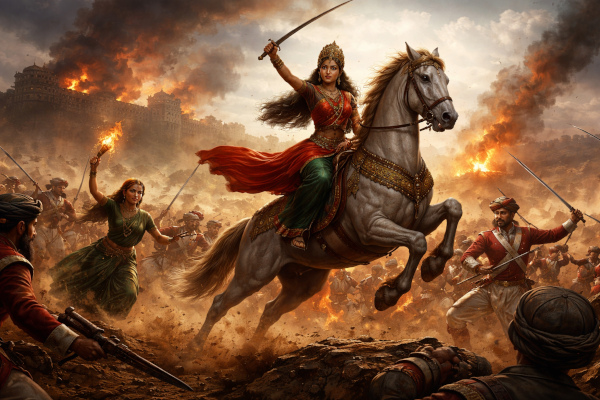
The story of Rani Velu Nachiyar does not begin with rebellion—it begins with preparation. Born on 3 January 1730 in Ramanathapuram, she entered the world as the only heir of King Chellamuthu Vijayaragunatha Sethupathy and Queen Sakandhimuthal, rulers of the Ramnad kingdom. In a court that lacked a male successor, the child who might have been raised in silk and ceremony was instead forged in discipline. She was raised as a prince in spirit and expectation, trained in governance, diplomacy, and warcraft from an early age.
Her childhood unfolded not in passive observation but in deliberate preparation. She mastered Silambam, the fluid and deadly staff-fighting art of Tamil warriors, learned the throwing weapon Valari, trained in Kalaripayattu, and developed precision in archery and swordsmanship. She rode horses across the dry plains of Ramnad with the confidence of a commander. Languages became her second arsenal—Tamil, Urdu, English, and even French—equipping her to navigate both allies and adversaries in a rapidly changing political landscape.
At the age of sixteen, she was married to Muthu Vaduganatha Periyavudaya Thevar, the ruler of Sivaganga. The union tied two powerful lineages—the Sethupathi dynasty and the Sivaganga throne—creating a political axis in southern Tamil Nadu. The marriage brought stability, and a daughter, Vellacci Nachiyar, was born into this royal household.
Then came the rupture that would redefine her life. In 1772, British forces, acting alongside the Nawab of Arcot, attacked Sivaganga. The battle at Kalaiyar Kovil ended in catastrophe. Her husband fell in combat, and the kingdom was seized. The palace that once echoed with royal authority fell into silence, and Velu Nachiyar was forced into exile.
Exile became her crucible. For nearly eight years, she lived away from her kingdom, moving through the territories of loyal chieftains and eventually seeking refuge under Hyder Ali of Mysore. During this period, she transformed grief into strategy. She studied enemy movements, gathered intelligence, forged alliances, and began assembling a resistance force. Hyder Ali, recognizing both her resolve and strategic mind, extended military support—arms, soldiers, and logistical backing—turning a displaced queen into a commander preparing for war.
Her return was not impulsive—it was calculated. By 1780, Velu Nachiyar launched a coordinated campaign against the British. What followed was not merely a battle, but a layered operation combining guerrilla tactics, alliance warfare, and psychological disruption. One of the most striking elements of her campaign was the formation of a women’s regiment, a rare phenomenon in 18th-century warfare. At its heart stood Kuyili, her trusted commander, whose act of self-sacrifice—immolating herself to destroy a British ammunition depot—became one of the earliest recorded instances of a suicide strike in military history.
The explosion did more than destroy supplies—it shattered British momentum. Velu Nachiyar seized the moment, pushing forward with coordinated attacks that overwhelmed colonial positions. Sivaganga was reclaimed. It was a rare reversal in an era when the East India Company expanded relentlessly across the subcontinent.
Her rule, which followed from circa 1780 to 1790, carried the imprint of both resilience and pragmatism. She reorganized administration with the support of the Marudu Brothers, appointing them to key military and governance roles. Stability returned to Sivaganga under her leadership. She governed with an awareness shaped by war—balancing defence preparedness with internal consolidation.
Unlike many rulers who clung to power, Velu Nachiyar prepared succession deliberately. Around 1790, she transferred authority to her daughter Vellacci, ensuring continuity of governance. The warrior who had reclaimed a kingdom stepped back, leaving behind a structure strong enough to endure.
Her final years unfolded away from the battlefield she had once commanded. On 25 December 1796, she passed away in Sivaganga, the land she had lost, fought for, and reclaimed.
Her life stands at a unique intersection in Indian history. She fought the British decades before the 1857 uprising, long before figures like Rani Lakshmibai entered the national imagination. Historians have often described her as a precursor to later resistance movements—a sovereign who recognized the nature of colonial expansion early and responded with organized force.
Velu Nachiyar’s legacy is carved in more than memory. She built one of the earliest structured resistances against colonial rule, pioneered the use of unconventional warfare tactics, raised a dedicated women’s combat unit, and demonstrated the strategic use of alliances in asymmetrical conflict. In the harsh theatre of 18th-century South India, where kingdoms fell and empires advanced, she stood as a ruler who refused erasure.
Her story moves like fire through history—quiet at first, then unstoppable—until it burns its name into time.
Reference:
https://en.wikipedia.org/wiki/Velu_Nachiyar
https://sivaganga.nic.in/tourism/eminent-personalities/
https://www.pib.gov.in/PressReleaseIframePage.aspx?PRID=1664286
https://www.tamilnadutourism.tn.gov.in/blog/velu-nachiyar-the-warrior-queen-of-sivagangai
https://www.thehindu.com/features/friday-review/history-and-culture/velu-nachiyar-the-queen-who-fought-the-british/article7330135.ece
https://www.india.com/news/india/rani-velu-nachiyar-first-queen-to-fight-british-east-india-company-4789891/
https://www.mintageworld.com/media/detail/8373-remembering-rani-velu-nachchiyar/
https://www.gktoday.in/topic/rani-velu-nachiyar/
https://www.indiatoday.in/education-today/gk-current-affairs/story/rani-velu-nachiyar-the-first-queen-to-fight-against-the-british-1754483-2021-01-03
You may also like
-
Sindhu: The Indus Kingdom of Jayadratha in the Mahabharata
-
Kuninda or Kulinda: The Himalayan Realm of the Mahabharata in Uttarakhand and Himachal Pradesh
-
Durga versus Mahishasura: Weapons, Battlefield Tactics and the Triumph of Shakti
-
Kuluta: The Kullu Valley Kingdom of the Mahabharata
-
Israel to Honour Indian Pilot Smit Machchhar with Highest Civilian Bravery Award for Saving Flydubai Flight
