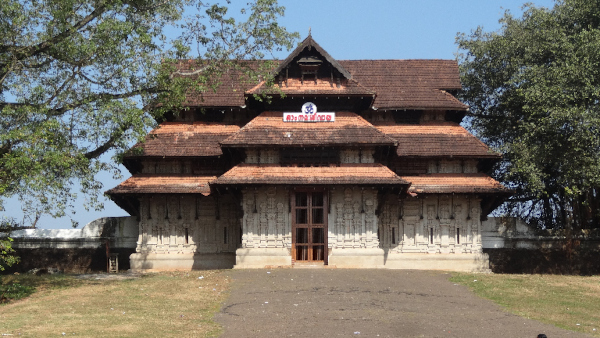
Vadakkumnathan Temple in Thrissur is one of Kerala’s most powerful symbols of Shiva worship, temple architecture, sacred memory and living cultural heritage. Standing at the centre of Thrissur city, surrounded by the green sweep of Thekkinkadu Maidan, the temple is more than a place of worship. It is the spiritual heart of Thrissur, the architectural soul of old Kerala, and the silent axis around which one of India’s greatest temple festivals, Thrissur Pooram, unfolds every year.
The very atmosphere of Vadakkumnathan Temple carries a rare stillness. Outside the temple wall, Thrissur moves with markets, roads, traffic, institutions and civic life. Inside, the world changes. The sound of the city softens. The old trees, the tiled roofs, the massive walls, the deep courtyards, the copper-clad structures and the ancient shrines create a feeling of entry into another age. This is the unique power of Vadakkumnathan: it remains a living temple while preserving the mood of a sacred antiquity.
The temple is dedicated to Lord Shiva, worshipped here as Vadakkumnathan. The name is often understood as “Lord of the North,” and the shrine has also been associated with the sacred imagination of Dakshina Kailasa, the Kailasa of the South. In Kerala’s spiritual geography, this temple occupies a place of exceptional reverence. It is connected with legends of Parashurama, the creator-sage of Kerala in traditional memory, and is counted among the great Shiva temples of the region.
The historical origin of Vadakkumnathan Temple belongs to the deep and layered past. The temple’s official tradition itself states that no historian has been able to fix the exact time of its coming into existence. That uncertainty adds to its aura. The temple is surrounded by legend, early sacred memory, architectural evolution and centuries of worship. According to temple tradition, the original prathishta was performed by Lord Parashurama. Whether approached as history, legend or sacred memory, the story places Vadakkumnathan within the foundational imagination of Kerala itself.
The location of the temple is central to its identity. It stands on an elevated ground in the middle of Thrissur, commanding the landscape around it. Thekkinkadu Maidan encircles the temple like a sacred green belt. This maidan is not merely open land. It is a cultural stage, a civic breathing space, a festival ground and a visible reminder of how Kerala’s old temple towns were organised around sacred centres. Thrissur’s public life and spiritual life meet at this maidan.
The temple complex is a classic example of Kerala temple architecture. It is not built to impress through towering verticality alone. Its strength lies in proportion, timber craft, copper roofing, laterite and stone work, sloping roofs, walled enclosures, sanctum geometry and deeply disciplined spatial planning. The temple follows the traditional Kerala style where architecture works with climate, ritual, material and sacred movement. The form is powerful, yet graceful. The monumentality comes through balance and craftsmanship.
The four gopurams placed along the cardinal directions give the temple a strong axial presence. The gateways mark the sacred boundary between the outer town and the inner world of worship. The temple’s walls, courtyards, chuttambalam, nalambalam, sreekovil and koothambalam together form a complete sacred environment. Each part has a role. Each space guides movement. Each roofline, wooden bracket, carved beam and stone base reflects generations of traditional knowledge.
The main deity is Lord Shiva. The sanctum is associated with one of the most distinctive forms of worship in Kerala. Vadakkumnathan is traditionally worshipped as a Shiva linga covered over time by layers of ghee from repeated ritual offerings. Devotees see in this tradition a symbolic image of snow-clad Kailasa, the abode of Shiva. This gives the shrine a unique visual and spiritual identity. The Lord is present as stillness, mountain, fire, austerity and grace.
Goddess Parvati is also worshipped in the sanctum space, facing the opposite direction, expressing the unity of Shiva and Shakti. The temple therefore carries the presence of both ascetic energy and divine motherhood. Along with Shiva and Parvati, the temple complex houses shrines and sacred points connected with Ganesha, Sankaranarayana, Sri Rama, Krishna, Rishabha, Simhodhara, Dharma Sastha, Vettakkaran, Naga Devatas and Adi Shankara. This makes Vadakkumnathan a multi-layered sacred complex rather than a single-shrine temple.
The presence of Sankaranarayana is especially meaningful. Sankaranarayana represents the combined form of Shiva and Vishnu, expressing the spiritual unity of two great devotional streams. Kerala has long preserved such forms of worship where sectarian boundaries soften within temple culture. The shrine of Sri Rama adds another dimension, bringing the Ramayana tradition into the temple’s sacred field. The presence of Ganesha, Krishna, Sastha, Naga worship and Adi Shankara deepens the temple’s connection to the wider spiritual heritage of Kerala.
Vadakkumnathan Temple is also famous for its koothambalam, the traditional temple theatre. A koothambalam is not an ordinary performance hall. It is a sacred architectural space created for ritual performance traditions such as Koothu, Nangyar Koothu and Koodiyattam. These art forms combine Sanskrit drama, temple ritual, gesture, music, storytelling and philosophical expression. The presence of a koothambalam inside the temple shows the old Kerala understanding that art itself can become worship.
The wooden craft of the temple is among its great treasures. The shrines and the koothambalam display carved wooden details that preserve stories, symbols and decorative intelligence. Kerala’s temple carpentry is one of the finest expressions of India’s vernacular sacred architecture. Timber is used with precision, sensitivity and beauty. Beams, brackets, rafters, roof frames and ornamental elements work together as structure and art. Vadakkumnathan stands as a living museum of this craft.
The mural tradition of the temple is another remarkable feature. The walls contain paintings depicting episodes from Hindu sacred narratives, including Puranic themes and epic memory. Two works often associated with the temple’s artistic identity are the rare images of Nrithanatha and Vasuki Sayana. Such murals are not merely decorative. They are theological art. They make sacred stories visible. They bring cosmic scenes, divine forms and mythic moments into the devotional experience of the pilgrim.
The daily rhythm of the temple begins before sunrise. The early opening, ritual offerings, neyyattam, usha pooja, ucha pooja, deeparadhana, athazha pooja and thripuka create a disciplined spiritual cycle. The temple breathes through ritual time. The day moves from dawn purification to midday worship and evening lamp-light. Devotees experience Shiva through sound, fragrance, light, offering and silence. This ritual rhythm has preserved the temple as a living sacred institution across generations.
Maha Shivaratri is the main festival of Vadakkumnathan Temple. On this night, the temple becomes a field of devotion, music, lamps and wakeful worship. Thousands of oil lamps create a luminous atmosphere around the shrine. Cultural and musical programmes add to the sacred mood. The worship of Shiva on Shivaratri carries the themes of austerity, cosmic stillness, destruction of ignorance and awakening of inner consciousness. At Vadakkumnathan, this festival has a special dignity because the Lord remains within the sanctum, radiating stillness while the temple glows around him.
Aanayoottu is another major festival associated with the temple. It is the ceremonial feeding of elephants, held on the first day of the Malayalam month of Karkkidakam. Elephants have a deep place in Kerala temple culture, and devotees see them with reverence as connected to Lord Ganesha. During Aanayoottu, elephants are worshipped and fed in the temple premises. The festival expresses abundance, gratitude and the sacred bond between humans, animals and temple tradition.
The greatest public cultural association of Vadakkumnathan Temple is Thrissur Pooram. This world-famous festival takes place at Thekkinkadu Maidan, with the temple as its sacred centre. Thrissur Pooram was organised by Shakthan Thampuran, the Maharaja of Cochin, who brought together ten temples around Vadakkumnathan and shaped the festival into a grand public celebration. The participating temples arrive with their deities, processions, elephants, music and ceremonial splendour to pay reverence to Lord Vadakkumnathan, the presiding deity of Thrissur.
During Thrissur Pooram, the temple becomes the silent centre of a vast cultural storm. Chenda melam, Panchavadyam, caparisoned elephants, nettipattam, alavattom, venchamaram, colourful umbrellas, fireworks and massive public gatherings transform the maidan into a theatre of Kerala’s cultural energy. The famous Ilanjithara Melam takes place within the temple premises, creating one of the most intense musical experiences in Indian festival culture. The rhythm rises like thunder, and the crowd becomes part of the sound.
The Kudamattom ceremony, where parasols are exchanged above elephants in a dramatic visual sequence, has become one of the defining images of Kerala. Yet at the heart of all this splendour, Vadakkumnathan remains composed. The temple’s own tradition describes Lord Vadakkumnathan as the silent felicitator of Pooram. This is a profound image: the city celebrates, the drums roar, elephants move, lamps shine, umbrellas bloom, fireworks light the sky, and Shiva remains still at the centre.
Vadakkumnathan Temple also represents the shared civic culture of Thrissur. Pooram is widely celebrated as a festival where communities participate beyond narrow boundaries. Artisans, temple workers, musicians, elephant handlers, traders, devotees, visitors and local residents all become part of the event. This gives the temple a role that goes beyond ritual. It becomes the cultural heart of a city.
The conservation history of Vadakkumnathan is as important as its antiquity. Over centuries, Kerala’s monsoon climate, wooden structures, tiled roofs and organic materials required careful preservation. The major restoration of the temple became one of India’s most respected heritage conservation efforts. The project involved archaeologists, craftsmen, conservation architects, temple authorities, traditional experts, devotees and supporting institutions. The restoration followed traditional methods, respected ritual protocols and used materials compatible with the original structures.
The conservation work restored murals, wooden sculptures, roof systems, copper details and architectural elements while preserving the living nature of the temple. This was not a museum-style restoration of a dead monument. It was the renewal of a functioning sacred space. Ritual continuity remained central. The temple’s spiritual life guided the conservation process. This is why the project became globally admired.
In 2015, the conservation of Sree Vadakkunnathan Temple received the UNESCO Asia-Pacific Award of Excellence for Cultural Heritage Conservation. This recognition placed the temple among Asia’s finest examples of living heritage restoration. UNESCO praised the project for using indigenous knowledge of vernacular building techniques, ritual protocols and modern conservation practice. The award recognised the temple as a significant archetype of Kerala temple architecture and a living centre of worship.
The restoration also revived traditional craftsmanship. Around three hundred artisans are recorded as having worked over a decade on the conservation effort. Such work is vital because temple architecture is not preserved by drawings alone. It survives through hands. Carpenters, mural specialists, lime workers, copper workers, stone craftsmen and ritual experts carry knowledge that books cannot fully replace. Vadakkumnathan’s restoration showed that heritage survives when community, craft and devotion work together.
Today, Vadakkumnathan Temple stands as a model for preserving sacred architecture in modern cities. It is surrounded by urban growth, yet it continues to hold its ancient dignity. It sits within Thrissur as a green, sacred and cultural anchor. The temple teaches that heritage is not a burden from the past. It is a living resource for identity, community, spirituality and beauty.
For devotees, Vadakkumnathan is the abode of Shiva. For architects, it is a masterpiece of Kerala temple design. For historians, it is a layered archive of legend, town formation and sacred geography. For artists, it is a treasury of murals, woodwork and ritual theatre. For Thrissur, it is the heart. For Kerala, it is one of the great guardians of cultural memory.
The greatness of Vadakkumnathan Temple lies in this combination of silence and grandeur. It can hold the stillness of Shiva and the thunder of Pooram. It can preserve ancient ritual and welcome modern conservation. It can remain deeply local and globally respected. It can be a shrine, a monument, a festival centre, an art archive and a civic symbol at once.
Vadakkumnathan is not merely a temple in Thrissur. It is Thrissur’s sacred axis. It is the place where Shiva’s stillness meets Kerala’s cultural splendour. It is a monument of wood, stone, copper, mural, rhythm, devotion and memory. At the centre of a living city, it continues to remind Kerala that the deepest heritage is the one that still breathes.
Source:
Image Courtesy: keralatourism.org
You may also like
-
Tamralipta — The Maritime Gateway of the Lower Ganga
-
Suhma — The River-and-Forest Country of Southwestern Bengal
-
Gauda — The Western Bengal Country of the Bhagirathi and the Rise of Karnasuvarna
-
Pundra — The Northern Bengal Kingdom of the Karatoya and the Ancient City of Pundranagara
-
Vanga — The River Kingdom of the Bengal Delta and the Eastern Sea
