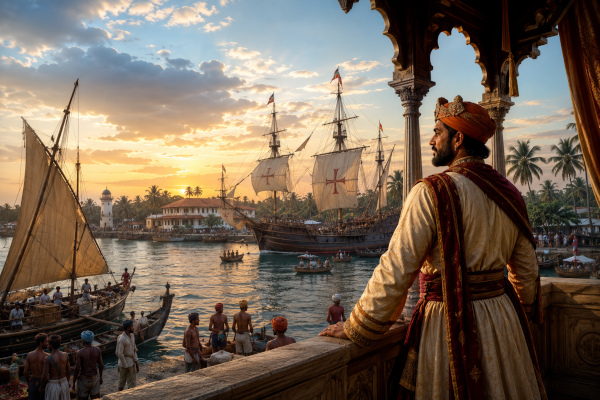
Unni Rama Koil I belongs to that decisive but shadowed phase of Kerala history when the Kingdom of Kochi was beginning to step out from the pressure of older regional powers and into the dangerous brightness of global maritime politics. He was one of the early recorded rulers of Kochi, remembered mainly because his reign coincided with the arrival of the Portuguese naval commander Pedro Álvares Cabral at Kochi in 1500. That single event placed Kochi at the centre of a transformation that would change Kerala’s coast, Indian Ocean trade and the political destiny of the kingdom.
The history of Kochi before this period is tied to the Perumpadappu Swaroopam, the royal house whose older roots lay in central Kerala. In 1405, the ruling line shifted its capital from Mahodayapuram to Kochi, giving the kingdom a new coastal identity. This movement was more than a change of residence. It placed the ruler closer to the sea, closer to foreign merchants and closer to the commercial lifeblood of the Malabar coast. Pepper, spices, timber, coconut products, textiles and ocean-borne trade gave Kochi a new strategic value.
By the time Unni Rama Koil I appears in the historical record, the Malabar coast was already a crowded theatre of power. The Zamorin of Kozhikode held great influence over maritime trade, while Kochi sought space to protect its autonomy and build its own commercial importance. The coastal world was connected to Arab traders, local merchant guilds, temple networks, royal houses and port communities. Every harbour was a market, every market was a political instrument, and every alliance could decide the survival of a small kingdom.
Unni Rama Koil I’s importance comes from the timing of his rule. The Portuguese arrival at Kochi in 1500 gave the kingdom an unexpected opportunity. Cabral had reached the Malabar coast in the larger Portuguese effort to build a direct sea route between Europe and India. After tensions at Kozhikode, the Portuguese found Kochi more receptive. For Kochi, the newcomers represented ships, cannon, overseas trade and a possible counterweight against the dominance of Kozhikode.
This was the great strategic calculation of Unni Rama Koil I’s age. A smaller coastal kingdom could use maritime diplomacy to balance a stronger regional rival. Kochi’s geography gave it a port; its political situation gave it a reason to seek allies; the Portuguese brought naval power at the exact moment when sea control was becoming a decisive factor. The meeting between Kochi and Portugal was therefore not a simple act of hospitality. It was a political choice made in a hard world of rivalry, trade and survival.
Under Unni Rama Koil I, the Portuguese were granted trade facilities at Kochi. This created the foundation for a relationship that would grow rapidly in the following years. Warehouses, trading privileges and commercial contact brought the Portuguese into the economic life of Kochi. The port began to gain attention as an alternative to Kozhikode. This shift gave Kochi greater visibility in the Indian Ocean network and helped it attract new forms of diplomacy, commerce and military support.
The ruler’s position required careful balancing. Welcoming the Portuguese opened valuable opportunities, but it also introduced a new kind of power into Kerala politics. The Portuguese came as traders, but their ships carried cannon, their commanders carried royal orders, and their merchants sought monopoly control over spice routes. Unni Rama Koil I stood at the first stage of this relationship, before its full consequences became clear. His reign marks the moment when Kochi opened a door that brought both advantage and future pressure.
Kochi’s decision to engage with the Portuguese had an immediate strategic logic. The kingdom faced pressure from the Zamorin of Kozhikode and needed naval assistance, commercial expansion and diplomatic leverage. The Portuguese needed a friendly port after their difficulties in Kozhikode. Both sides saw value in the other. This made Kochi one of the earliest Indian centres of sustained Portuguese activity and helped transform the kingdom from a regional coastal power into a major player in the first phase of European contact with India.
Unni Rama Koil I must be understood through this larger maritime setting. He was not a conqueror remembered for grand campaigns, nor an administrator remembered for large monuments. His historical importance comes from the bridge he represents. He stood between the older world of Kerala’s regional rivalries and the new world of European naval expansion. His reign shows how a local ruler could use global change for immediate political advantage.
The Kochi of his time was a living port kingdom. Its waterways connected inland produce to the Arabian Sea. Its merchants understood the language of ocean trade. Its rulers had to negotiate with local chieftains, temple authorities, merchant communities and foreign captains. In such a setting, diplomacy was as important as the sword. A royal decision at the harbour could reshape the fortunes of the throne.
The arrival of Cabral in 1500 also changed the rhythm of Kochi’s future. The Portuguese would soon become deeply involved in the kingdom’s affairs. By 1505, during the next phase of the royal succession, the first Portuguese Viceroy Francisco de Almeida reached Kochi, and Portuguese influence became more institutional. Forts, crowns, treaties, trade privileges and military interventions entered the story. The seed of all that lay in the earlier contact during Unni Rama Koil I’s reign.
The records around this early period are sometimes uneven, and names in Portuguese, Malayalam and later historical writing do not always align neatly. Some sources identify Unni Rama Koil I with the ruler present during Cabral’s arrival, while other accounts describe the succession through Unni Goda Varma and Unni Rama Koil in greater detail. This is common in early Kerala history, where royal names, house names, titles and Portuguese spellings often overlap. The safest way to view Unni Rama Koil I is as a ruler of the first Portuguese-contact phase of Kochi’s history.
His reign also reminds us that small kingdoms often survive through timing, geography and diplomatic instinct. Kochi did not command the largest army on the coast. It did not hold the same trading supremacy as Kozhikode. Yet it possessed a valuable harbour, a ruling house willing to make bold choices and a political need that matched the ambitions of a new maritime power. That combination gave Kochi a historical opening.
Unni Rama Koil I’s legacy lies in this opening. He belongs to the beginning of Kochi’s rise as a port of international significance. The relationship with the Portuguese helped Kochi gain military support and trade visibility, even as it later brought complications and foreign interference. His reign is therefore best remembered as the threshold moment when Kochi entered the early modern world.
In Kerala’s royal history, many later rulers are better documented. Sakthan Thampuran is remembered for administrative strength. Veera Kerala Varma is remembered in relation to later Portuguese-era developments. The last rulers of Cochin are remembered through princely-state records. Unni Rama Koil I stands earlier, in a mistier landscape, but his place is important because he appears at the first great meeting point between Kochi and European sea power.
He was a king of transition. Behind him stood the Perumpadappu inheritance, Kerala’s temple-centred polity, old trade routes and the regional rivalry with Kozhikode. Before him opened the age of Portuguese forts, oceanic empires, cannon-bearing ships and new diplomatic dangers. His reign shows Kochi at the exact moment when local history became part of world history.
Unni Rama Koil I may not have left behind a large body of inscriptions or dramatic court legends, but the event associated with his reign changed the course of Kochi. Cabral’s arrival in 1500 made the kingdom visible to a new global power. Kochi’s acceptance of Portuguese trade facilities created the foundation for a long and complicated relationship. In that sense, Unni Rama Koil I stands as one of the earliest royal figures in Kerala’s encounter with the modern maritime age.
His story is the story of a coastal throne reading the winds of change. It is the story of a kingdom using diplomacy to survive pressure. It is the story of Kochi recognising that the sea had become the new battlefield of power. Through Unni Rama Koil I, we see the moment when the harbour of Kochi became more than a trading port. It became a gateway through which world history entered Kerala.
You may also like
-
Kapisa: The Ancient Kingdom North of Kabul at the Gateway of the Hindu Kush
-
Lampaka: The Mountain Kingdom of Laghman on the Kabul River Frontier
-
Navaratri and Ayurveda: The Nine Divine Medicinal Plants Associated with Navadurga
-
Bahlika: The Ancient Bactrian Realm of Balkh in the Mahabharata
-
Kamboja: The Horse-Breeding Frontier Kingdom of the Hindu Kush in the Mahabharata
