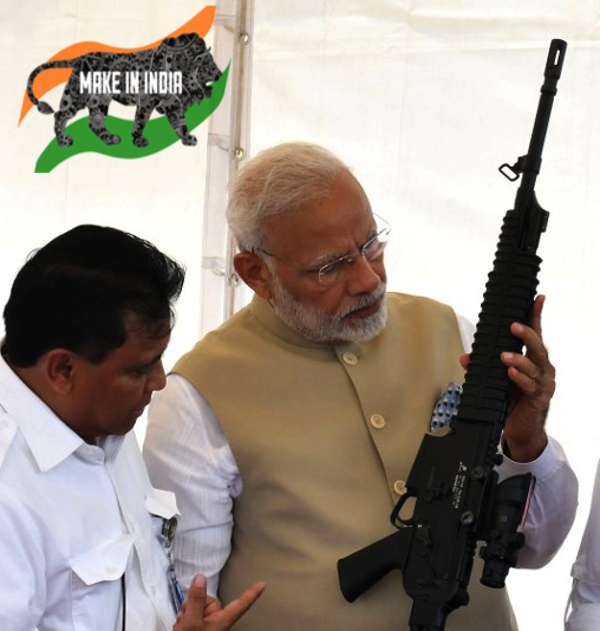
The achievement marks significant progress in one of India’s largest infantry modernisation programmes.
In December 2021, the Ministry of Defence signed a contract with Indo-Russian Rifles Private Limited for 6,01,427 AK-203 assault rifles. The rifles are being produced at Korwa in Uttar Pradesh under an Indo-Russian joint venture involving Indian defence companies Advanced Weapons and Equipment India Limited and Munitions India Limited alongside Russia’s Rosoboronexport and Kalashnikov Concern.
The long-term objective was clear from the beginning: India would progressively absorb the technology and ultimately manufacture the rifle domestically rather than depend on imported kits and components.
47 of 50 Components Now Made in India
IRRPL’s latest publicly available update states that the company has achieved approximately 85% indigenisation, with 47 out of the AK-203’s 50 components now manufactured in India.
IRRPL CEO and Managing Director Maj Gen S.K. Sharma described the milestone as part of a process of “genuine indigenisation”, stressing that localisation involves far more than simply receiving drawings or assembling imported components.
It requires domestic production processes, qualified vendors, materials expertise, testing infrastructure, quality-control systems and skilled manpower capable of reproducing the weapon consistently at military standards.
IRRPL says an ecosystem of nearly 100 Indian MSMEs and industrial partners has contributed to the localisation effort.
The remaining objective is to bring the final components into the Indian supply chain and establish complete domestic manufacturing capability.
100% Transfer of Technology Already Absorbed
The programme has also achieved another important milestone: 100% Transfer of Technology from the Russian partners has been absorbed by IRRPL, according to the company.
Transfer of Technology means India possesses the manufacturing knowledge, processes and technical information required to produce the weapon. Localisation measures how much of the actual rifle, its materials and components are being produced through the Indian industrial ecosystem.
The two therefore do not automatically happen at the same time.
Russia’s Rostec confirmed in 2024 that the AK-203 programme had been structured from the outset around 100% localisation of production in India. It said all necessary production equipment had been supplied to Korwa as localisation progressively increased.
India’s Department of Defence Production had also identified complete indigenisation as a core objective of the project in its earlier official planning documents.
From Imported Kits to an Indian Manufacturing Chain
The evolution of the AK-203 programme illustrates how genuine defence localisation takes place in stages.
Early production relied more heavily on Russian components. As Indian suppliers qualified individual parts and manufacturing processes, the proportion produced domestically increased.
By 2023, the Ministry of Defence confirmed that IRRPL had established the facilities required for indigenous AK-203 production and that manufacturing and testing were underway at Korwa. The government explicitly linked localisation of the rifle with achieving greater self-sufficiency for the Indian Armed Forces.
By July 2024, the Indo-Russian joint venture had produced and delivered 35,000 AK-203 rifles to the Ministry of Defence, according to Rostec.
IRRPL’s current corporate information says deliveries have subsequently crossed 55,000 rifles, while localisation has moved much closer to completion.
The significance is therefore not simply that AK-203 rifles are being assembled in India. The industrial capability required to manufacture the weapon itself is progressively moving into the country.
With Full Localisation Making it Robust
An infantry rifle may appear technologically simpler than a fighter aircraft or missile, but a military cannot afford uncertainty over the supply of its most basic frontline weapon.
The AK-203 will be produced in numbers exceeding 600,000 rifles, meaning the programme must support not merely initial procurement but decades of maintenance, replacement components and potentially future upgrades.
A fully localised production chain gives India much greater control over that lifecycle.
Domestic manufacturers can produce components without waiting for overseas supply, production can be increased when requirements rise, and modifications can be incorporated without the same level of foreign dependence associated with imported weapons.
It also keeps manufacturing expenditure, technical expertise and employment inside the Indian defence ecosystem.
For a weapon expected to become widely distributed across the Army, those advantages are strategically important.
The AK-203 ‘Sher’
The AK-203 is a modern member of Russia’s Kalashnikov AK-200 family and is chambered for the 7.62×39 mm cartridge.
The weapon follows the traditional Kalashnikov emphasis on ruggedness and reliability while incorporating features expected from a modern infantry rifle, including improved ergonomics and provisions for mounting contemporary sights and accessories.
India selected the AK-203 as part of the programme to replace large numbers of older INSAS rifles.
The “Sher” designation has increasingly been associated by IRRPL with the Indian-produced weapon.
Korwa Becomes a Strategic Small-Arms Manufacturing Centre
The Korwa plant in Amethi is emerging as much more than an assembly facility.
IRRPL describes the site as an integrated manufacturing ecosystem incorporating production lines, quality assurance and testing infrastructure. The company says the complete transfer of technology also provides a foundation for future upgrades, research and additional small-arms programmes.
That could ultimately prove as important as the AK-203 contract itself.
India has historically relied on a combination of government factories and imported designs for many categories of modern small arms. Building a domestic facility capable of producing hundreds of thousands of rifles to consistent military standards creates an industrial foundation that can later support new weapons, accessories and improvements.
IRRPL has already indicated ambitions extending beyond the AK-203 into additional small-arms categories.
More Than a Rifle Programme
The deeper importance of the AK-203 programme lies in what is being created around the weapon.
Technology has been transferred. Indian companies are learning manufacturing processes. Components are being localised. MSMEs are joining the supply chain. Testing capability is being established domestically, and Korwa is developing the capacity required for sustained mass production.
With 47 of 50 components already being produced domestically, IRRPL is now close to the final stage of that transition.
Once the company formally confirms 100% localisation, the milestone will represent the culmination of a programme envisaged years earlier: an AK-203 manufactured in India through an Indian supply chain, backed by domestic production and testing infrastructure and produced in sufficient numbers to equip one of the world’s largest armies.
For India’s defence-industrial ecosystem, the “Sher” programme is therefore becoming a test case for how foreign technology can be absorbed, progressively localised and converted into long-term sovereign manufacturing capability.
Official and Primary Sources
Ministry of Defence / PIB, December 20, 2021: Confirms the contract for 6,01,427 AK-203 rifles and production by IRRPL at Korwa, Uttar Pradesh.
Ministry of Defence / PIB, February 13, 2023: Confirms establishment of indigenous AK-203 manufacturing and testing facilities at Korwa and identifies self-sufficiency as the objective of indigenisation.
Department of Defence Production: Records the Indo-Russian joint venture and the programme’s objective of achieving 100% indigenisation.
IRRPL, 2026: Latest publicly available company update confirms approximately 85% indigenisation, with 47 of 50 components manufactured in India and full localisation approaching.
Rostec, July 2024: Confirms technology transfer, the programme’s 100%-localisation objective and delivery of the first 35,000 locally produced AK-203 rifles.
You may also like
-
India Seeks South Korean Shipbuilding Partnerships as Sarbananda Sonowal Begins Four-Day Visit to Busan
-
Koraput Kalajeera Rice of Odisha: The GI-Tagged Aromatic Heritage of India’s Ancient Rice-Growing Region
-
ICAR Scientists Develop Indigenous Protective Gloves for Cotton Farmers, Sign Commercial Manufacturing Agreement
-
India Moves Towards Five-Year Assured Orders for Defence Startups Under New Procurement Reforms
-
BHEL–Coal India Joint Venture Begins Construction of ₹25,016 Crore Indigenous Coal Gasification Project in Odisha
