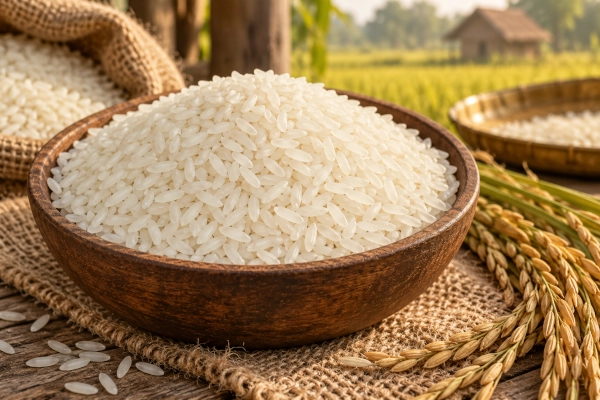
Among West Bengal’s traditional aromatic rices, Tulaipanji holds a distinctive place. It is a non-basmati scented rice associated primarily with Uttar Dinajpur district, with smaller pockets of cultivation in Dakshin Dinajpur. The rice is valued for its delicate aroma, fine grain, soft texture and long-standing place in the food culture of northern Bengal. The Mohiniganj area of Uttar Dinajpur is particularly well known for its cultivation.
Tulaipanji represents a class of indigenous rice landraces that survived not because they produced the highest yields, but because communities continued to value their fragrance, taste and ceremonial importance. ICAR documentation on rice landraces of West Bengal identifies Tulaipanji among the traditional aromatic types collected from Uttar Dinajpur, Dakshin Dinajpur and Malda, and notes that such varieties have often survived in relatively small pockets despite lower productivity.
A Rice Rooted in the Dinajpur Landscape
The traditional home of Tulaipanji lies in the old Dinajpur region, today divided between Uttar Dinajpur and Dakshin Dinajpur districts in West Bengal. The rice is cultivated most extensively in Uttar Dinajpur, where local farming communities have preserved it over generations. IBEF identifies Mohiniganj in North Dinajpur as one of the places especially associated with the variety.
The landscape of the region is dominated by monsoon agriculture, alluvial soils and paddy cultivation. Traditional rice varieties developed here under local ecological conditions, with farmers selecting seed season after season for aroma, grain quality and suitability to household use. Tulaipanji emerged from this agricultural environment as one of the most recognised scented rices of northern Bengal.
Its identity is therefore inseparable from place. The rice is not merely a commercial brand but a landrace whose reputation developed through the interaction of local seed, climate, soil and farming knowledge.
A Non-Basmati Aromatic Rice
Tulaipanji belongs to the large and diverse group of non-basmati aromatic rices found across India. Unlike basmati, which is characterised by long slender grains and pronounced elongation after cooking, Tulaipanji is valued primarily for its aroma, taste and soft eating quality.
ICAR’s documentation on West Bengal rice landraces places Tulaipanji among the smaller-grained aromatic varieties conserved in the region. These traditional rices are important reminders that India’s scented rice heritage extends far beyond basmati and includes numerous local varieties adapted to specific ecological and culinary environments.
The appeal of Tulaipanji lies in the combination of fragrance and flavour rather than visual length alone. For households that continue to use it, the aroma released during cooking remains one of its defining qualities.
An Old Rice with Deep Local Memory
Tulaipanji has a long recorded history. IBEF notes that one of its earliest modern references appears in the Dinjapur district gazetteer associated with Francis Buchanan-Hamilton in 1833. The same source also records older Bengali traditions in which Tulaipanji was used for receiving guests and for preparing sweet dishes such as payas or kheer.
Such references are significant because they place the rice within the social life of the region rather than treating it merely as an agricultural commodity. Aromatic rice was often reserved for hospitality, religious observances and festive cooking, where fragrance and taste carried symbolic as well as culinary value.
This cultural preference helped traditional varieties survive even when high-yielding alternatives became more attractive to farmers from a purely economic perspective.
A Rice Traditionally Reserved for Special Occasions
Tulaipanji has long been associated with hospitality and festive meals. In many parts of Bengal, aromatic rice was used when guests arrived, during religious functions and for preparing sweet milk-based dishes. IBEF specifically notes the traditional use of Tulaipanji in payas or kheer for guests and social occasions.
The rice’s fragrance gives such dishes a distinctive character without requiring heavy seasoning. Its soft texture also allows it to absorb milk, jaggery, sugar and spices effectively, making it well suited to traditional desserts.
At the same time, Tulaipanji is not limited to sweets. It can be served simply as steamed rice and paired with fish, vegetables or lentils, allowing its natural aroma to remain prominent.
Aroma as the Core of Its Identity
The defining characteristic of Tulaipanji is its scent. Traditional aromatic rice varieties contain volatile compounds that become noticeable during cooking, producing fragrances that distinguish them from ordinary paddy varieties.
In Tulaipanji, this aroma is central to both its market value and cultural reputation. Farmers continued to preserve the variety because its sensory qualities justified its cultivation even when competing varieties offered higher yields.
ICAR has highlighted both Tulaipanji and Kalonunia as important scented rices of West Bengal whose aroma and heritage are protected through GI recognition. A 2025 farmer-awareness programme organised through Uttar Banga Krishi Vishwavidyalaya specifically focused on production techniques and commercialisation of these high-value scented varieties.
Traditional Cultivation and Farmer Knowledge
Like many indigenous rice landraces, Tulaipanji has historically depended on farmer-led seed conservation. Seed selected from previous harvests was retained and replanted, allowing local populations of the rice to persist over generations.
Such systems preserved useful genetic diversity, but they also meant that traditional varieties were vulnerable once farmers shifted to modern commercial seed. ICAR documentation notes that several scented landraces of West Bengal, including Tulaipanji, are now cultivated only in limited areas because of their relatively low yield and the spread of newer varieties.
The continued cultivation of Tulaipanji therefore represents more than the production of a premium food. It also preserves a living pool of indigenous rice genetics adapted to the agro-ecological conditions of northern Bengal.
The Challenge of Lower Yield
Traditional aromatic rices often face a structural disadvantage in modern agriculture: they are valued for quality rather than maximum productivity. Tulaipanji is part of this pattern.
ICAR’s work on rice landraces in West Bengal notes that aromatic varieties such as Tulaipanji survive despite lower yield and relatively small grain size because farmers continue to value them for cultural, culinary and religious reasons.
This creates a challenge for conservation. If farmers are not compensated for maintaining a lower-yielding traditional crop, the economic pressure to replace it with more productive varieties can become strong.
GI protection and premium marketing are therefore particularly important for varieties such as Tulaipanji. Their future depends on ensuring that quality commands a sufficient price to make cultivation worthwhile.
The Importance of Conserving Tulaipanji
Traditional rice landraces are important reservoirs of agricultural biodiversity. They may contain traits related to aroma, grain quality, pest tolerance or adaptation to local climatic conditions, all of which can have value for future crop improvement.
Tulaipanji is part of this wider genetic heritage. Its conservation helps maintain the diversity of West Bengal’s rice landscape, which historically supported hundreds of local varieties adapted to different soils, water regimes and culinary uses.
ICAR has documented more than 450 rice landraces in West Bengal and has specifically highlighted the need to collect and identify useful traits among the traditional varieties of Uttar Dinajpur, Dakshin Dinajpur and Malda.
From Local Rice to Premium Regional Product
GI recognition has helped give Tulaipanji greater visibility beyond its traditional growing region. IBEF notes that farmers cultivating the rice can obtain better prices and that online marketing has expanded opportunities for branded sales.
This is important because heritage rice varieties cannot survive on cultural reputation alone. They need viable markets that reward farmers for maintaining them.
If consumers are willing to pay a premium for authentic Tulaipanji, the additional value can support cultivation, encourage seed conservation and reduce the pressure to abandon the variety.
The GI Journey
Tulaipanji Rice was registered as a Geographical Indication through an application filed by the State Agriculture Management & Extension Training Institute (SAMETI) together with Uttar Banga Krishi Viswavidyalaya. The official GI Registry records Application No. 530, filed on 24 August 2015, under Class 30 for agricultural goods.
The application was published in GI Journal No. 97, with an availability date of 22 June 2017, and the registration was granted under Certificate No. 300 dated 24 October 2017. Most importantly, the current GI Registry shows that the registration has been renewed and is now valid until 23 August 2035.
Geographical Indication: Tulaipanji Rice
GI Application Number: 530
Category: Agricultural
Class: 30
State: West Bengal
Registered Proprietors: State Agriculture Management & Extension Training Institute (SAMETI) and Uttar Banga Krishi Viswavidyalaya
Date of Filing: 24 August 2015
GI Journal: No. 97
Journal Availability Date: 22 June 2017
Certificate Number: 300
Certificate Date: 24 October 2017
Current Registration Valid Until: 23 August 2035
The current registry entry is especially useful because some older public databases still display the original validity period ending in 2025. The Intellectual Property India record now confirms the renewed validity through 2035.
What the GI Protection Means
The GI registration formally links the reputation of Tulaipanji Rice with its geographical origin in West Bengal. It provides a legal framework through which authorised producers can distinguish genuine Tulaipanji from rice marketed under the same name without the corresponding regional connection.
This protection is particularly important for premium heritage grains, where commercial success can sometimes lead to imitation or dilution of the original product identity.
The GI framework also supports traceability and collective marketing, allowing producer groups and agricultural institutions to promote Tulaipanji as a geographically distinctive product rather than as anonymous commodity rice.
Commercialisation and Farmer Support
Recent agricultural programmes show that efforts are continuing to improve the commercial prospects of Tulaipanji. In February 2025, ICAR reported on a two-day farmer awareness programme at Balurghat focused on the production techniques and commercialisation of scented rice varieties including Tulaipanji and Kalonunia. The programme emphasised GI awareness, improved cultivation practices and market development.
Such initiatives are important because the future of traditional rice depends on the farmer receiving adequate value. Better branding, producer organisations, improved packaging and direct marketing can allow heritage rice to compete on quality rather than yield alone.
IBEF has similarly observed that cultivation in Dakshin Dinajpur remains scattered and that collective organisation through farmer producer structures could help farmers obtain greater economic benefit.
A Grain of Northern Bengal’s Agricultural Heritage
Tulaipanji Rice is a striking example of how a traditional crop can preserve the memory of a region. Its fragrance, fine grain and association with hospitality have given it a place in the food culture of Dinajpur for generations, while farmer-led seed conservation has allowed the variety to survive despite the spread of higher-yielding alternatives.
Its GI status has added a new dimension to that heritage by formally recognising the connection between the rice and its geographical origin. The challenge now is to ensure that this recognition translates into sustained cultivation, better farmer incomes and greater consumer awareness.
Tulaipanji therefore represents more than a scented rice from West Bengal. It is part of the agricultural identity of northern Bengal—a heritage grain whose aroma carries the landscape, farming traditions and culinary memory of the Dinajpur region.
You may also like
-
Profitable Banks, Growing Savings and Timely EMI Repayments: Signs of a Healthy and Alive Indian Economy
-
Oil India Signs Contract for 272 Sq Km Coal Bed Methane Block in Singrauli, Expanding India’s Domestic Natural Gas Exploration
-
CONCOR Facilitates First Liquid Glucose Export from Kanpur to Vietnam, Strengthening India’s Agri-Export Logistics
-
SAIL Awards ₹854.57 Crore Pellet Plant Contract to SEPC for IISCO Steel Plant Expansion in West Bengal
-
Hooghly Cochin Shipyard Advances Six Hybrid-Electric Catamaran Project for India’s Inland Waterways
