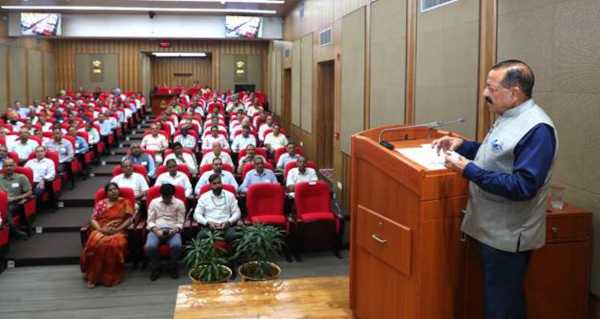
India’s national security landscape is entering a decisive new phase where battlefield strength will increasingly depend on technological superiority, indigenous innovation and the ability to integrate civilian scientific progress with military requirements. Union Minister Dr Jitendra Singh underlined this shift while addressing senior officers and course participants at the National Defence College, stating that the future of warfare will be shaped by Artificial Intelligence, Quantum Technologies, Biotechnology and Space capabilities.
Speaking on the theme “Future Trajectory of Science & Technology and its Impact on National Security”, Dr Singh said modern security can no longer be viewed only through the traditional lens of armies, weapons and borders. The character of conflict is changing rapidly, with technology now influencing surveillance, communications, strategic decision-making, precision engagement, cyber defence and operational resilience. In this emerging environment, scientific innovation has become a core pillar of national preparedness.
The Minister observed that future conflicts will be decided not merely by physical force, but by the speed, accuracy and intelligence with which nations can detect threats, process information and respond. Advanced technologies are already transforming military doctrines across the world. Space-based assets, secure communications, unmanned platforms, AI-assisted command systems, precision weapons and cyber capabilities are becoming central to strategic advantage. For India, staying ahead of this curve is essential to protecting national interests in an increasingly complex global environment.
A major part of India’s strategic transformation, Dr Singh noted, has been the shift from defence import dependence to indigenous capability building. Over the last decade, India’s defence production has grown sharply, rising by nearly 174 percent since 2014 to around ₹1.54 lakh crore. Defence exports have expanded nearly 34-fold to more than ₹23,000 crore, reflecting the country’s growing credibility as a defence manufacturing and technology partner.
This change is being driven not only by public sector institutions, but also by private industry, MSMEs and startups. More than 16,000 MSMEs and hundreds of technology-led startups are now contributing to India’s defence ecosystem. This expanding industrial base shows how national security requirements can generate innovation, manufacturing growth, employment and export opportunities at the same time.
Dr Singh identified Artificial Intelligence as one of the most important technologies for the future battlefield. AI-enabled systems will transform surveillance, threat assessment, training, logistics, mission planning and decision-making. Autonomous platforms, predictive analytics, intelligent sensors and cognitive warfare tools will allow armed forces to respond faster and with greater precision. In high-pressure combat environments, the ability to process information quickly and act decisively can become a decisive operational advantage.
Quantum Technologies were highlighted as another critical domain. Quantum sensing, quantum communication and quantum cryptography are expected to reshape secure military communications, advanced computing and strategic detection systems. India’s National Quantum Mission, launched in 2023, reflects the country’s ambition to remain among the leading nations in this field. Quantum-secure networks and post-quantum cryptography will be vital for protecting military systems, strategic infrastructure and national data from future threats.
Biotechnology and Synthetic Biology are also gaining importance in national security planning. Dr Singh pointed to emerging biosecurity risks, including engineered pathogens and advanced biological threats, as areas that demand continuous scientific preparedness. Biotechnology will play a growing role in strengthening resilience against health emergencies, biological risks and future hybrid security challenges.
Space capabilities form another pillar of the future security architecture. Satellites, surveillance systems, navigation tools, communication networks and space-based monitoring platforms are becoming essential to modern defence operations. As warfare becomes more networked and technology-intensive, space assets will play a decisive role in situational awareness, precision operations and strategic deterrence.
Dr Singh outlined three broad priorities for India’s future security framework: predictive and proactive threat management, strong protection of digital and cyber frontiers, and self-reliance in strategic technologies and supply chains. These priorities reflect the reality that modern national security extends beyond the battlefield. Cyber systems, communications networks, supply chains, laboratories, satellites, ports, energy systems and digital infrastructure are all part of the national security grid.
A key message from the address was the need for deeper collaboration between government institutions, the Armed Forces, academia, research organisations, startups and private industry. Scientific discoveries must move faster from laboratories to deployable defence applications. For India to build lasting strategic strength, civilian innovation and military requirements must evolve together.
This civil-military technology bridge is especially important because many future defence systems will emerge from dual-use technologies. AI, robotics, cyber tools, biotech platforms, quantum communication, advanced materials and space systems all have civilian as well as military applications. Nations that can integrate these sectors effectively will command greater strategic autonomy.
Dr Singh also acknowledged the role of India’s Armed Forces not only in defending the country during conflict, but also in supporting the nation during disasters, emergencies and humanitarian crises. Their service, he said, represents discipline, sacrifice and national commitment.
The address at the National Defence College reinforces a larger strategic message: India’s future security will depend on its ability to combine military experience with scientific ambition. The coming era will reward nations that can innovate quickly, secure their technologies, build resilient supply chains and convert research into battlefield-ready systems.
India’s rise as a defence producer, exporter and technology-driven power signals a major shift in its strategic posture. The next stage will depend on how effectively the country can integrate AI, quantum systems, biotechnology and space capabilities into a unified national security architecture. In that architecture, self-reliance will not only mean producing weapons at home. It will mean mastering the technologies that define the future of warfare.
Source: PIB
You may also like
-
Indian Navy Vice Chief Inspects Japan’s Mogami-Class Stealth Frigate as India-Japan Shipbuilding Cooperation Expands
-
Philippine Marine Wargames Reportedly Show BrahMos Can Penetrate Chinese Destroyer Air Defences
-
Safran Signs 18 Agreements with Indian Aerospace Suppliers, Expanding Make in India Manufacturing Partnerships
-
Indian Army’s Vajra Corps Certifies First Batch of Drone Operators, Strengthens Battlefield Surveillance
-
India to Seek 35% Increase in Defence Modernisation Budget for FY 2027–28
