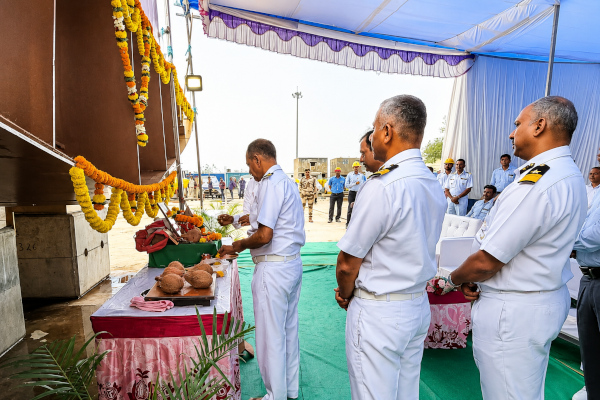
India’s coastal security architecture received another important boost with the keel-laying ceremony of the fourth Next Generation Offshore Patrol Vessel being built by Mazagon Dock Shipbuilders Ltd for the Indian Coast Guard. The ceremony, held in Mumbai on 25 June 2026, marks a key production milestone in a six-vessel programme designed to strengthen India’s maritime surveillance, patrol and law-enforcement capabilities.
The vessel is part of a major indigenous shipbuilding contract signed between the Ministry of Defence and MDL on 20 December 2023. Under the programme, six Next Generation Offshore Patrol Vessels are being constructed for the Indian Coast Guard under the Buy Indian-IDDM category. This makes the project a strong example of India’s growing defence manufacturing depth, where design, development and construction are being carried out within the country.
For the Indian Coast Guard, the NGOPV programme is operationally significant. Offshore Patrol Vessels form the backbone of long-duration maritime presence. They are used for surveillance, search and rescue, maritime law enforcement, pollution response, anti-smuggling operations, protection of offshore assets and humanitarian assistance. In India’s case, these roles are especially important because the country has a vast coastline, island territories, busy sea lanes, exclusive economic zone responsibilities and growing maritime trade infrastructure.
The fourth vessel’s keel-laying shows that the production line is progressing steadily. In shipbuilding, keel laying is one of the most important early construction milestones. It indicates that the vessel has moved from design and material preparation into the structural build phase. From this point, the hull blocks, machinery integration, platform systems, sensors and mission equipment begin to come together in a coordinated construction sequence.
The NGOPVs are expected to bring a major technology upgrade over older patrol platforms. Official details released earlier for the class indicate a range of around 5,000 nautical miles and a maximum speed of 23 knots, giving the vessels the endurance needed for sustained patrols across India’s maritime zones. The vessels are also being equipped with advanced systems such as AI-based predictive maintenance, remote-piloted drones, Integrated Bridge System and Integrated Platform Management System.
These technologies are important because the modern Coast Guard mission has expanded beyond routine patrol. Maritime threats now include illegal fishing, smuggling, narcotics movement, human trafficking, environmental violations, grey-zone activity, suspicious vessel movement and emergencies involving merchant shipping. A next-generation patrol vessel therefore needs endurance, better situational awareness, improved command systems and flexible mission tools.
The inclusion of remote-piloted drones can extend the vessel’s surveillance reach beyond the visual horizon. Drones can help track suspicious boats, monitor pollution incidents, assist in search and rescue, and support boarding operations. AI-based predictive maintenance can improve operational availability by helping crews identify equipment issues before they become mission-critical failures. Integrated platform management can give better control over machinery, power, propulsion and onboard systems.
The NGOPV programme also supports India’s strategic autonomy in maritime security. By building these vessels domestically, India is reducing dependence on foreign yards for key patrol platforms. MDL’s role is especially important because the shipyard has long experience in building complex naval and coast guard platforms. Such projects create a wider domestic industrial effect through steel, marine equipment, electronics, propulsion systems, fabrication, design services, testing, integration and MSME supply chains.
The programme also has a clear fleet-planning logic. Out of the six vessels, four are meant to replace ageing Offshore Patrol Vessels, while two will augment the Coast Guard fleet. This means the project addresses both modernisation and expansion. Replacement ensures that older ships with rising maintenance requirements make way for modern platforms. Fleet augmentation improves the Coast Guard’s ability to maintain stronger maritime presence across multiple zones.
India’s maritime security environment is becoming increasingly complex. The Indian Ocean Region carries some of the world’s busiest energy and commercial routes. India’s western and eastern seaboards require constant monitoring, while island territories such as Andaman and Nicobar and Lakshadweep add strategic depth and surveillance responsibility. In this environment, long-endurance OPVs give the Indian Coast Guard the ability to remain present, responsive and visible across wide maritime spaces.
The fourth NGOPV keel-laying is therefore more than a shipbuilding event. It is part of a larger maritime capability build-up that combines indigenous design, fleet renewal, coastal security and operational readiness. Once inducted, these vessels will help the Indian Coast Guard strengthen its presence at sea, respond faster to emergencies, enforce maritime law more effectively and support India’s broader maritime security posture.
With MDL progressing through the six-vessel programme, the Indian Coast Guard’s next-generation fleet is taking shape. The project reflects the practical meaning of Aatmanirbhar Bharat in defence shipbuilding: Indian yards building Indian-designed platforms for Indian maritime security needs.
Source: PIB
You may also like
-
Russian Navy Delegation Visits Southern Naval Command and Indian Naval Academy
-
PRAHAAR: India’s First National Counter-Terrorism Policy and Strategy
-
Takshak Heavyweight Torpedo: How India’s Indigenous Submarine Weapon Compares With the World’s Leading Torpedoes
-
Embraer Builds Dual Aerospace Strategy in India Through C-390 Military and E175 Regional Aircraft Programmes
-
NextLeap Tests Indigenous Jet Engine for Long-Range Stryker Kamikaze UAV
