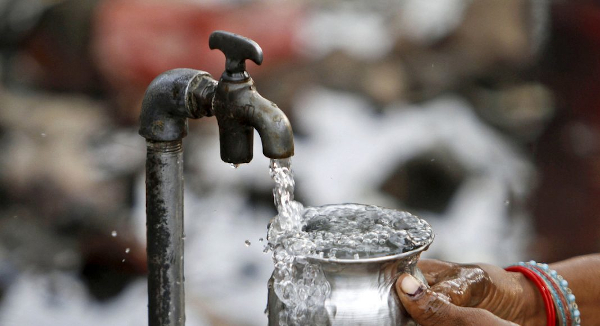
Under the Jal Jeevan Mission, the Union government has delivered tap water to around 5.77 crore rural homes in the last two and a half years making the total to 9 crore rural families in the country, according to the Jal Shakti Ministry. The initiative has transformed 98 districts, 1,129 blocks, 66,067 Gram Panchayats, and 1,36,135 villages into ‘Har Ghar Jals.’ The data shows that every rural home in Goa, Haryana, Telangana, the Andaman and Nicobar Islands, Puducherry, Dadar & Nagar Haveli, and Daman & Diu has access to tap water. Many more states, like Punjab (99%) and Himachal Pradesh (92.4%), Gujarat (92%) and Bihar (90%), are on the edge of becoming ‘Har Ghar Jals’ in 2022.
In the next five years, Rs. 3.6 lakh crore (US$ 49.97 billion) has been set aside to ensure that every rural home has access to quality tap water and the Union Budget 2022-23 allocated Rs. 60,000 crore (US$ 7.99 billion) to the scheme. As part of the 15th Finance Commission’s tied grant for water and sanitation to rural local bodies, the Budget gave Rs. 26.940 crores (US$ 3.6 million) to states in 2021-22.
In 117 aspirational districts, tap water access has expanded from 24 lakh (9.3%) to almost 1.36 crore (40%) homes in the last two years. In 61 districts impacted by Japanese Encephalitis-Acute Encephalitis Syndrome (JE-IES), more than 11.5 million homes (38%) have been provided with tap water. Under the PM’s 100-day campaign to ensure children’s health, 8.46 lakh schools (82%) and 8.67 lakh anganwadi centres (78%) across the country were provided with potable tap water for drinking and cooking mid-day meals, handwashing, and use in toilets in a span of 16 months.
You may also like
-
CG Power Strengthens India’s Semiconductor Manufacturing Ecosystem with ₹7,600 Crore Sanand Investment
-
Kargil Gets Its First Heat-Pump Dehydration and Cold Storage Facility to Boost Ladakh’s Agricultural Economy
-
India Explores 3,000 km Power Corridor to Supply 2,000 MW of Clean Electricity to Singapore
-
ONGC Explores Three Advanced Oilfield Technologies to Improve Mumbai High Well Operations
-
Kabra Extrusiontechnik’s GEON Commissions 20 MWh Battery Storage Project in Rajasthan
