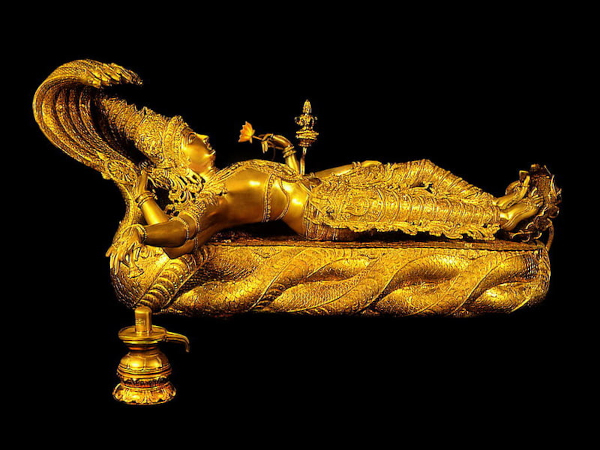
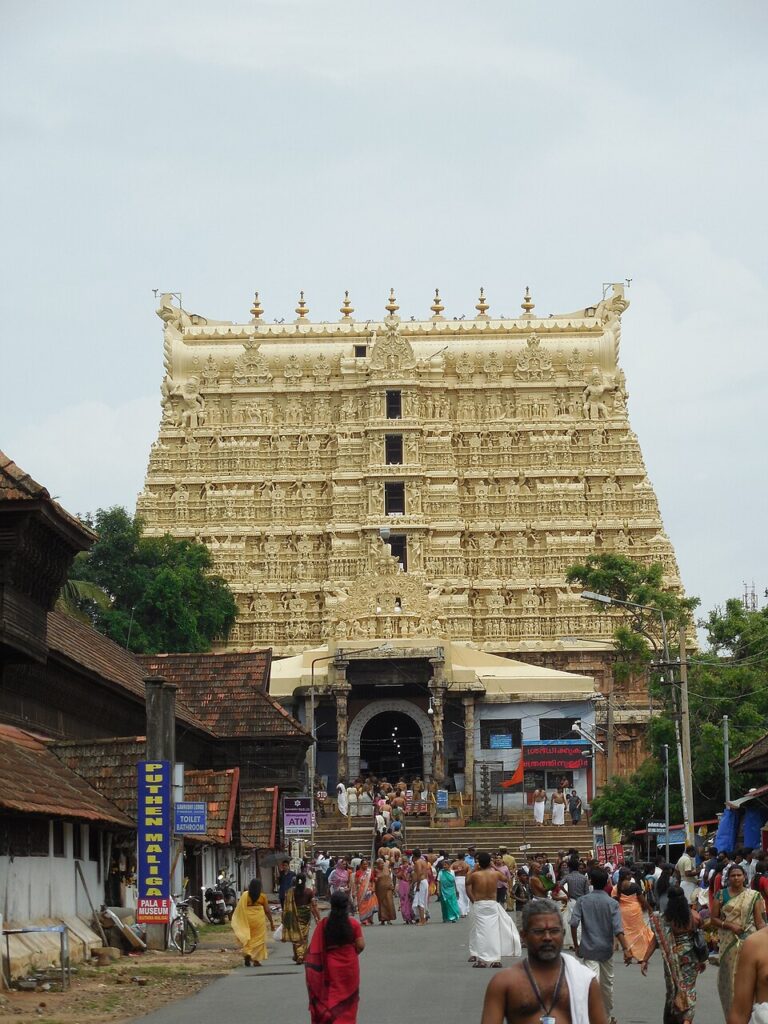
In the old heart of Thiruvananthapuram, inside the East Fort and beside the serene waters of Padma Theertham, stands Sree Padmanabhaswamy Temple, one of the most revered Vishnu temples in India and one of the most symbolically powerful sacred sites in Kerala. Kerala Tourism dates the shrine’s history to at least the 8th century, while Encyclopaedia Britannica notes that hymns of Nammalvar in the 8th or 9th century are among the earliest written attestations to the temple’s existence. The shrine is also one of the 108 Divya Desams of Vaishnavism, giving it a place of exceptional importance in the devotional geography of South India.
The temple is architecturally overwhelming. Its design fuses Kerala and Dravidian traditions, a blend visible in its sloping roofs, towering gopuram, stone corridors, and ritual spaces. The temple’s seven-tier eastern gopuram rises about 100 feet, its gold-plated flagstaff stands about 80 feet high, and the celebrated corridor leading inward is lined with 365¼ sculpted granite pillars. Kerala Tourism also notes that the temple complex is famed for murals, bronze and stone craftsmanship, and ritual halls such as the Ottakkal Mandapam, a platform fashioned from a single massive stone slab. Britannica says the temple complex occupies roughly seven acres enclosed within protective walls.
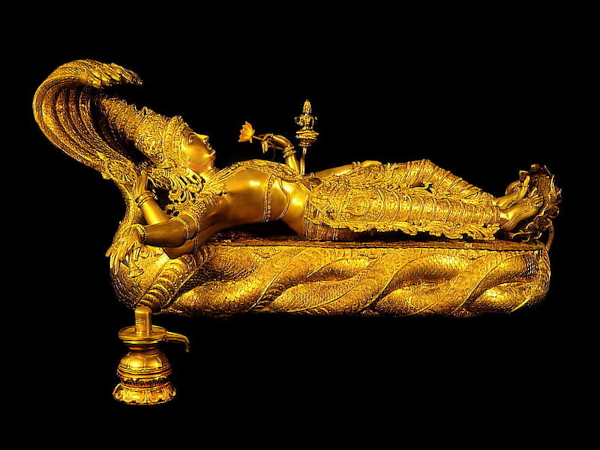
At the center of the shrine lies the extraordinary image of Lord Padmanabha, Vishnu reclining on Anantha, the cosmic serpent. Kerala Tourism states that the main idol is about 18 feet long and is viewed through three separate doors: through one, the head and chest; through another, the hands; through the third, the feet. The deity is especially remarkable for being made with 12,008 salagramams, sacred stones brought from the Gandaki River region in Nepal, according to Kerala Tourism.
The three-door darshan is not merely an architectural peculiarity; in Kerala’s legendary tradition it is the surviving imprint of a divine revelation too vast for ordinary sight. In the old sacred narrative associated with the temple, in Kerala’s later popular legendary memory often linked with Vilvamangalam Swami—was granted the presence of Vishnu first in the form of a radiant child. When the child disappeared after being slighted by Vilvamangalam Swami, the grief-stricken ascetic was told to seek Him in Ananthankadu, the ancient forest-grove of the serpent. There, the Lord revealed Himself in an immeasurable cosmic form, stretching so enormously that the seer could not behold Him in a single glance. At the devotee’s plea, the deity reduced Himself, yet even then He could be worshipped only in sections—face, torso, and feet—giving sacred meaning to the temple’s famous three-door vision. Kerala’s traditional sacred geography further deepens the aura of the shrine: it is revered as one of the Parasurama Kshetras, and temple tradition also places it within the puranic landscape remembered in texts such as the Skanda Purana and Padma Purana.
Its documented historical rise is closely tied to the Travancore kingdom. The Supreme Court’s 2020 judgment in the Padmanabhaswamy case recounts that the modern history of the temple begins in decisive form with Anizham Thirunal Marthanda Varma, who took full control of Travancore and the temple in the 18th century, reconstructed it after earlier damage and fire, and installed a new idol. The judgment specifically notes that the temple had suffered from a major fire in 1686, after which Marthanda Varma played the defining role in restoring the shrine in the form known today. Britannica likewise records that the temple was largely destroyed in that fire and that Marthanda Varma began rebuilding it after ascending the throne in 1729.
The single most dramatic event in the temple’s political-spiritual history came in January 1750, when Marthanda Varma performed the celebrated Thrippadidanam or Trippadi Danam. In this act, he ceremonially dedicated the entire kingdom of Travancore to Lord Padmanabha and assumed the role of “Padmanabhadasa”—servant of the deity. The Supreme Court judgment describe this moment as transformative: from then on, the deity was regarded as the true sovereign, and the ruler governed in trust on behalf of the Lord. This is one reason the temple is unlike an ordinary royal shrine; it became the theological center of statehood itself.
The temple’s cultural archive is nearly as astonishing as its architecture. Kerala Tourism states that the shrine is associated with around 3 million palm-leaf manuscripts, known as the Mathilakam records, dating back to the 14th century CE and preserving administrative and financial details of the temple-town and the Travancore kingdom over centuries. That number is staggering: not just a treasure of ritual memory, but a vast documentary reservoir of political, economic, and social history.
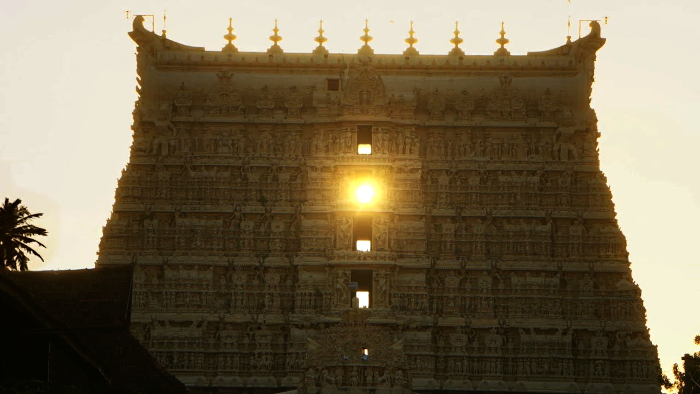
At Sree Padmanabhaswamy Temple, stone does not merely stand still; it appears to wait for the sky. On the days of the equinox, the temple seems to enter into a silent conversation with the Sun itself. Around these moments in March and September, when the Sun is positioned over the Earth’s equator and rises almost due east and sets almost due west, the geometry of the year briefly comes into balance. It is then that the temple’s relationship with the horizon becomes especially arresting. The setting Sun appears to align with the openings of the gopuram in sequence, creating a rare and mesmerizing rhythm of light and architecture.
Of course, the temple is globally famous for another reason: its subterranean vaults. After the Supreme Court-directed inventory process that began in 2011, Padmanabhaswamy Temple drew worldwide attention for the immense wealth stored in several of its chambers. Britannica notes that estimates at the time of the opening of five vaults reached 1 trillion rupees, or 1 lakh crore, though such figures were estimates rather than a formally liquidated valuation. The temple’s wealth became the subject of intense legal and public scrutiny, but in July 2020 the Supreme Court upheld the right of the erstwhile Travancore royal family to continue its role in the management of the temple under the historic legal framework and trust structure.
Yet to reduce Padmanabhaswamy Temple to “the richest temple” would be to miss its deeper grandeur. This is a place where sacred geography shaped the name of a capital city itself. Kerala Tourism notes that Thiruvananthapuram literally means the land of Sree Anantha Padmanabhaswamy, the Lord reclining on Anantha. In other words, the city did not merely grow around the temple; its identity was formed by it.
There is also a rare visual intelligence in the temple’s layout. The long corridor, the tank, the gopuram, the sanctum, the single-stone platform, the reclining deity seen in sequence through three doors—everything seems designed to slow the eye and humble the visitor. This is not the abrupt drama of many later shrines; it is a measured revelation. The temple does not merely show divinity. It stages it.
How to reach
Sree Padmanabhaswamy Temple is located at Fort, East Fort, Thiruvananthapuram – Postal Code : 695023. The nearest railway station is Thiruvananthapuram Central, about 1 km away, and the nearest airport is Thiruvananthapuram International Airport, about 6 km away, according to Kerala Tourism. The official temple site lists its contact point in the Fort area of Thiruvananthapuram as well. From either the station or airport, the temple is typically a short taxi or auto-rickshaw ride to East Fort.
Reference:
https://spst.in/
https://spst.in/History
https://www.keralatourism.org/destination/padmanabha-swamy-temple-thiruvananthapuram/13/
https://www.keralatourism.org/temples/thiruvananthapuram/sree-padmanabhaswamy
https://www.keralatourism.org/mobile/travel/thiruvananthapuram/get_sreepadmanabha.html
https://www.britannica.com/place/Padmanabhaswamy-Temple
https://indiankanoon.org/doc/133687822/
You may also like
-
Durga versus Mahishasura: Weapons, Battlefield Tactics and the Triumph of Shakti
-
Kuluta: The Kullu Valley Kingdom of the Mahabharata
-
Trigarta: The Kangra–Jalandhar Kingdom of the Mahabharata
-
Kasmira: The Kashmir Valley and the Northwestern Himalayan World of the Mahabharata
-
Nepala: The Kathmandu Valley and the Central Himalayan World of the Mahabharata
