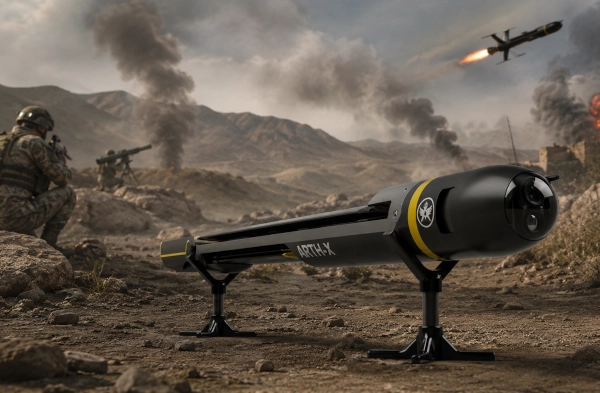
Bengaluru-based defence technology company ArthX has revealed SHARANGA, an indigenous tube-launched tactical loitering munition being developed around the requirements of modern battlefield strike operations. The system combines a compact canister-launched configuration with high-speed terminal attack, GPS-independent navigation, electro-optical targeting and modular payload options, placing it among a growing generation of Indian privately developed precision unmanned weapons.
ArthX officially describes SHARANGA as a tube-launched tactical loitering munition designed and developed in India. The munition is stored and transported inside its launch canister, with its wings deploying shortly after leaving the tube. The airframe incorporates inverted-V stabilators and a rear-mounted pusher propulsion arrangement, allowing the system to remain compact inside the canister before transitioning into its normal flight configuration.
The canisterised architecture is central to SHARANGA’s battlefield concept. ArthX is designing the munition so that a soldier can carry an individual launch canister without requiring extensive assembly before deployment. The company has also shown a larger vehicle-mounted configuration based on the Mahindra Armado, carrying a 12-canister launcher array intended to provide multiple ready-to-launch munitions from a mobile tactical platform.
According to ArthX, SHARANGA is being designed for a terminal dash speed exceeding 400 km/h. The munition would cruise toward the target area before accelerating during the final attack phase, reducing the engagement time available to the target and nearby short-range air-defence systems. The company has not publicly disclosed SHARANGA’s operational range, endurance, launch weight or warhead mass, making the 400+ km/h terminal speed one of the principal performance figures currently available.
A major feature of the programme is its proposed ability to navigate without continuous dependence on satellite positioning. ArthX says SHARANGA combines visual positioning using stored satellite imagery, millimetre-wave radar odometry and inertial navigation. This multi-sensor architecture is intended to maintain navigation when GNSS signals are unavailable, jammed or otherwise unreliable.
This capability reflects one of the most important lessons emerging from contemporary drone and precision-munition warfare. Electronic warfare systems increasingly target satellite-navigation links and command channels, forcing unmanned weapons to rely on multiple navigation sources rather than a single external signal. SHARANGA’s proposed architecture addresses that requirement by combining independent onboard navigation methods with visual and radar-based position estimation.
ArthX has also outlined an electronic communication architecture incorporating frequency-hopping communications, COFDM video transmission and software-defined radio waveforms, together with low-probability-of-intercept and low-probability-of-detection principles. Beyond-line-of-sight connectivity through satellite communications is also included in the company’s disclosed concept.
For terminal detection and identification, SHARANGA is designed around a gimballed EO/IR seeker positioned in the nose. Electro-optical and infrared sensors provide the operator with visual and thermal imagery of the target area, supporting target identification and terminal engagement across different lighting conditions.
ArthX has specifically stated that SHARANGA retains a human operator in the engagement loop. The architecture therefore combines autonomous navigation and onboard sensing with human involvement in the final targeting process rather than presenting the weapon as a completely autonomous strike system.
Another important aspect of SHARANGA is the use of a common airframe for several battlefield missions. ArthX has presented an air-to-ground configuration for precision engagement of armoured vehicles, soft-skinned vehicles, battlefield positions and structures. Other proposed payload configurations include fragmentation effects for personnel and area targets, specialised effects for protected targets and non-kinetic payloads for intelligence, surveillance, electronic warfare and communications relay missions.
The company has also outlined an air-to-air counter-UAS version of SHARANGA intended to engage hostile drones and other loitering munitions. This would extend the basic architecture beyond its conventional strike role and position the system as a potential interceptor against unmanned aerial threats.
Using the same fundamental airframe for strike, counter-UAS and non-kinetic missions offers logistical advantages. Launch infrastructure, vehicle integration and portions of the control architecture can remain common while the payload and mission configuration change according to operational requirements. This modular approach is becoming increasingly visible across modern unmanned weapon development as armed forces seek systems that can perform multiple tasks without introducing a completely separate platform for each role.
ArthX is also paying attention to signature reduction. The company says SHARANGA incorporates airframe shaping intended to reduce radar cross-section, alongside measures aimed at reducing the infrared signature generated by its propulsion arrangement. The compact frontal profile of the munition further reflects an emphasis on reducing its detectability during the approach to a target.
The combination of canisterised launch and vehicle mobility also gives the system a strong shoot-and-relocate character. A multi-canister launcher can disperse several munitions while retaining the mobility required to leave its firing position rapidly, an increasingly important consideration as counter-battery radars, UAV reconnaissance and electronic surveillance shorten the time between detection and retaliatory attack.
SHARANGA arrives at a time when the Indian Army is placing significantly greater emphasis on loitering munitions. On August 14, 2026, the Ministry of Defence signed contracts worth approximately ₹1,577 crore with Tata Advanced Systems Limited and NIBE Limited for Loiter Munition Systems, associated munitions and accessories for the Indian Army. The Ministry specifically described the systems as equipment intended to strengthen the operational capabilities of Army artillery regiments.
Nevertheless, the wider Army investment in loitering munitions demonstrates that this class of weapon has moved firmly into India’s operational modernisation priorities. Loitering munitions occupy the space between conventional UAVs and guided missiles. They can remain airborne while searching for a target, transmit imagery back to an operator and then transition directly into an attack once a suitable target is identified.
Tube-launched systems add another layer of flexibility because the munition can remain protected inside a compact container until required. Infantry units can transport individual systems, while vehicle-mounted arrays provide greater launch density for larger formations. The architecture also permits dispersed deployment without requiring conventional runways or elaborate launching infrastructure.
For the Indian Army, such weapons are particularly relevant to increasingly sensor-rich battlefields where targets can emerge briefly before relocating. Artillery batteries, command posts, radar systems, vehicles and temporary defensive positions often present narrow engagement windows. A loitering weapon already operating over the area can shorten the time between detection, identification and precision attack.
SHARANGA’s emphasis on navigation in GPS-denied environments is equally aligned with evolving battlefield conditions. Modern electronic warfare increasingly makes uninterrupted satellite navigation an unreliable assumption, particularly against technologically sophisticated opponents. Combining inertial, visual and radar-derived navigation provides a potential means of maintaining mission continuity through contested electromagnetic environments.
The programme also illustrates the broadening role of India’s private defence technology sector. ArthX, founded in Bengaluru in 2022, describes itself as a defence and space manufacturing company focused primarily on unmanned systems. The company has separately delivered TARKSH UAVs to the Indian Army for drone-based dry-fire training applications, giving it an existing connection with Army unmanned-system requirements.
SHARANGA represents a considerably more ambitious step into tactical precision weapons. Its disclosed configuration combines tube launch, deployable wings, a high-speed terminal attack profile, GPS-independent navigation, an EO/IR seeker, anti-jam communications and modular mission payloads within a compact unmanned airframe.
At its present stage, SHARANGA remains a company-led indigenous development rather than an officially selected Indian Army weapon. ArthX has not announced completed Army user trials or an acquisition contract, while important specifications including operational range, endurance and payload weight remain undisclosed.
The programme nevertheless reflects the rapid development of India’s indigenous loitering-munition ecosystem. As the Indian Army expands its inventory of precision unmanned weapons, private companies are increasingly developing systems tailored for distributed launch, electronic-warfare resilience and multiple battlefield roles. SHARANGA adds a tube-launched, modular design to that expanding technology base, with ArthX positioning the system around the increasingly demanding tactical strike and counter-UAS requirements of modern land warfare.
You may also like
-
Agnikul Advances Mission-02 with Long-Duration Test of 3D-Printed Agnite Rocket Engine
-
DRDO Successfully Flight-Tests Indigenous High-Altitude Platform at 21 km
-
Air Marshal Ashutosh Dixit Appointed 29th Chief of the Air Staff
-
BEML Takes Indigenous Gaur Protected Vehicle to Australia for Land Forces 2026
-
India-UAE Exercise Mountain Guardian 2026 Begins at Chaubatia in Uttarakhand
