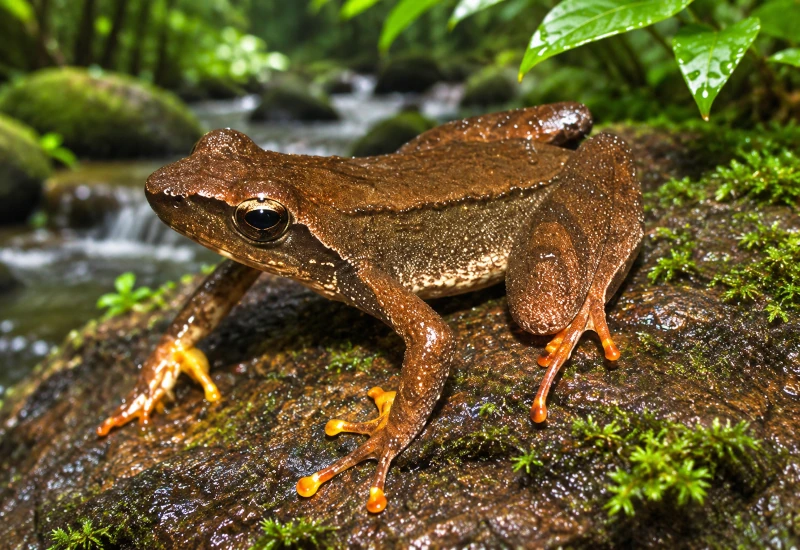
A rare cold stream torrent frog (Micrixalus frigidus) has reportedly been photographed in the Topslip region of the Anamalai Tiger Reserve in Tamil Nadu, drawing renewed attention to the rich amphibian diversity of the Western Ghats. The observation, reported on 28 November 2026, highlights the importance of continued biodiversity monitoring within India’s protected forests. The sighting also demonstrates the valuable contribution of local communities to documenting lesser-known wildlife species.
A Rare Amphibian of the Western Ghats
The cold stream torrent frog belongs to the family Micrixalidae, a distinctive group of amphibians commonly known as dancing frogs. Scientifically described in 2014, Micrixalus frigidus is endemic to the Western Ghats and is associated with freshwater stream habitats in the Anamalai hill landscape. Its restricted geographical distribution makes the protection of suitable freshwater ecosystems particularly important for its long-term survival.
Dancing frogs derive their popular name from the characteristic limb movements exhibited by several members of the family during communication. These behavioural adaptations are particularly interesting in environments where flowing water can interfere with acoustic signals. Their evolutionary specialisation illustrates the remarkable diversity of amphibian life found within the Western Ghats.
Local Communities Contribute to Biodiversity Documentation
The latest photograph was captured by Erumapparai Murugadas, a member of a local tribal community associated with the TREK Tamil Nadu programme. His observation highlights how traditional familiarity with forest landscapes can complement scientific biodiversity surveys. Community participation can be especially valuable in documenting elusive species that may escape detection during conventional field surveys.
Conservationists have encouraged the submission of the photographic evidence to the Forest Department for formal verification. Such documentation could contribute to a better understanding of the species’ local distribution and habitat requirements. Continued collaboration between forest authorities, researchers and indigenous communities could strengthen amphibian conservation across the region.
Anamalai Tiger Reserve and Its Amphibian Diversity
The Anamalai Tiger Reserve encompasses a diverse landscape of tropical forests, mountain grasslands and freshwater ecosystems. Its varied elevations and climatic conditions support numerous endemic amphibians and reptiles, many of which occupy highly specialised ecological niches. A herpetofaunal survey conducted in September 2024 documented 34 amphibian species and 20 reptile species within surveyed portions of the reserve.
The 2024 survey also recorded the cold stream torrent frog, demonstrating its presence in the Anamalai landscape before the latest reported observation. The new photographic record therefore adds to existing knowledge rather than establishing a confirmed rediscovery after two decades. Continued field documentation remains essential for understanding the species’ distribution and conservation requirements.
Protecting Freshwater Ecosystems
Stream-associated amphibians depend on environmental conditions that can be disrupted by pollution, vegetation loss, altered water flow and climatic changes. Maintaining forest cover around freshwater habitats helps regulate water temperature, reduce sedimentation and preserve the ecological conditions required by specialised amphibians. Protecting these ecosystems also benefits numerous aquatic and terrestrial organisms that share the same habitats.
Amphibians are valuable indicators of environmental health because many species are particularly sensitive to changes in moisture, temperature and water quality. Regular population monitoring can help researchers identify emerging ecological pressures and formulate appropriate conservation strategies. Preserving freshwater habitats within the Western Ghats is consequently important for both individual species and the wider ecological integrity of the mountain landscape.
Strengthening India’s Amphibian Conservation Efforts
The latest sighting of the cold stream torrent frog reinforces the importance of systematic wildlife documentation and community participation in conservation. While formal verification of the photographic record remains necessary, the observation offers another opportunity to improve scientific understanding of the Western Ghats’ specialised amphibian species. Continued habitat protection, scientific research and collaboration with local communities can help safeguard India’s distinctive amphibian heritage for future generations.
You may also like
-
Scientists Discover Beddome’s Bronzeback, a New Tree Snake Species in India’s Western Ghats
-
Indian Scientists Discover New Bioluminescent Cardinalfish Species in Bay of Bengal
-
Scientists Discover New Grasshopper Species in Nagaland
-
Three Uncommon Bird Sightings Highlight Tripura’s Sukhsagar Wetland Biodiversity
-
Wild Asian Elephants Reestablish Resident Population in Madhya Pradesh’s Bandhavgarh Forest Landscape
