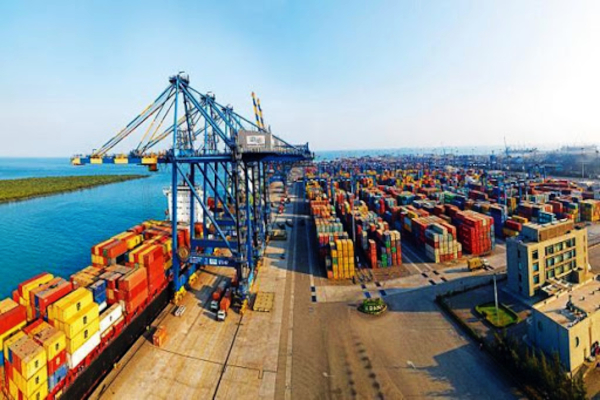
India’s Sagarmala Programme continues to strengthen port infrastructure, coastal connectivity, maritime logistics and port-led economic development through projects implemented across coastal States and Union Territories.
Sagarmala is a Central Sector Scheme administered by the Ministry of Ports, Shipping and Waterways. It provides financial assistance under five principal areas: port modernisation, port connectivity, port-led industrialisation, coastal community development, and coastal shipping and inland water transport.
Under the scheme, 79 projects with a combined cost of ₹5,374.5 crore have been completed. The Ministry’s approved share in these projects amounts to ₹1,799.07 crore, of which ₹1,764.26 crore has been released.
Another 54 projects valued at ₹4,538.2 crore are under implementation. The Ministry’s share in these ongoing projects is ₹2,346.43 crore, with ₹1,306.12 crore released so far.
Maharashtra has completed 21 projects worth ₹1,103.3 crore and has 12 additional projects valued at ₹959 crore under implementation. Tamil Nadu has completed 16 projects worth ₹1,085.6 crore, while eight projects with an estimated cost of ₹250.6 crore are being implemented.
Goa has completed 10 projects valued at ₹840.8 crore, and West Bengal has completed eight projects worth ₹499.6 crore. Andhra Pradesh has completed seven projects with a combined value of ₹1,101.8 crore, while Kerala has completed six projects worth ₹134.5 crore.
Gujarat has five ongoing projects valued at ₹862.5 crore, while Lakshadweep has four projects under implementation with a combined cost of ₹860 crore. Karnataka, Odisha, Kerala, West Bengal and other coastal regions are also implementing projects related to port infrastructure, passenger facilities, fisheries, coastal transport and logistics connectivity.
Budget utilisation under the Sagarmala Scheme has remained consistently high. During 2022–23, ₹412 crore was utilised from an allocation of ₹413 crore. In 2023–24, expenditure reached ₹349 crore against an allocation of ₹368 crore.
The Ministry utilised ₹424 crore from the ₹459 crore allocated during 2024–25. In 2025–26, expenditure stood at ₹449 crore against a budgetary provision of ₹463 crore.
Port-handling capacity has also expanded steadily. The combined capacity of India’s Major Ports increased from 1,617.39 million tonnes in 2022–23 to a provisional 1,728.4 million tonnes in 2025–26.
Capacity at Non-Major Ports rose from 1,050.55 million tonnes in 2022–23 to a provisional 1,090.53 million tonnes in 2025–26. Major Ports are administered by the Union Ministry, while Non-Major Ports fall under the jurisdiction of State governments and Union Territory administrations.
Operational efficiency at ports has also improved. The average vessel turnaround time at Major Ports declined to a provisional 47.25 hours during 2025–26, compared with 58.28 hours in 2024–25. The provisional average turnaround time at Non-Major Ports stood at 40.90 hours during 2025–26.
Multimodal connectivity forms a central component of the Sagarmala vision. The Ministry of Ports, Shipping and Waterways, in consultation with the Ministry of Railways and the Ministry of Road Transport and Highways, has identified 294 rail and road connectivity projects serving ports.
Of these, 84 projects have been completed, comprising 63 railway projects and 21 road projects. Another 66 projects, including 27 railway and 39 road projects, are under implementation.
A further 144 connectivity projects are at the planning stage, consisting of 42 railway projects and 102 road projects. Projects located within port boundaries are generally undertaken by the respective port authorities, while links beyond port limits are developed by the Railways, the road transport ministry or State governments.
India has also expanded terminal infrastructure along its National Waterways. On National Waterway-1, three multimodal terminals and one intermodal terminal have been completed. National Waterway-2 has one multimodal terminal and three inland water transport terminals, while nine such terminals have been developed on National Waterway-3.
Two Roll-on/Roll-off terminals have been completed in Ernakulam, along with another Ro-Ro terminal on National Waterway-4. These facilities are intended to facilitate the movement of passengers, vehicles and cargo through inland waterways while reducing pressure on road and rail networks.
The Ministry has also launched the One Nation One Port Process initiative to standardise and integrate port-related procedures across the country. The programme seeks to create a unified, efficient and transparent maritime operating environment through common processes and improved coordination.
Several measures are being implemented to reduce emissions and promote environmentally sustainable port operations. The HaritSagar Green Port Guidelines provide a framework for the adoption of cleaner technologies, renewable energy and resource-efficient practices.
The Green Tug Transition Programme aims to replace conventional diesel-powered harbour tugs with electric, hybrid and other cleaner alternatives. Ports are also increasing the use of renewable electricity and electrifying cargo-handling equipment, vehicles and railway tracks.
Additional initiatives include the deployment of zero-emission trucks and the installation of onshore power-supply systems. These systems allow ships to use electricity from the shore while berthed, reducing the need to operate their onboard diesel engines and lowering emissions in port areas.
The progress of the Sagarmala Programme reflects India’s broader strategy to increase port capacity, improve logistics efficiency, strengthen road, rail and inland-waterway connectivity and build a greener maritime ecosystem.
The information was provided by Union Minister of Ports, Shipping and Waterways Sarbananda Sonowal in a written reply to the Rajya Sabha on July 21, 2026.
Source: PIB
You may also like
-
Goa Mussarat Mango — The Red-Blushed Monserrate of Goa and the Late-Summer Orchard Heritage of the Konkan Coast
-
India’s First Port-Based e-Methanol Plant at Kandla to Supply Green Fuel to Global Shipping
-
India’s Recent Oil and Gas Discoveries: New Finds, Offshore Frontiers and How Much Crude India Produces at Home
-
India’s Hidden Gold Mountain: How Households Came to Own an Estimated 31,000 Tonnes of Gold
-
India–Afghanistan Air Cargo Corridor Returns to Focus as Both Sides Push for Stronger Trade Connectivity
