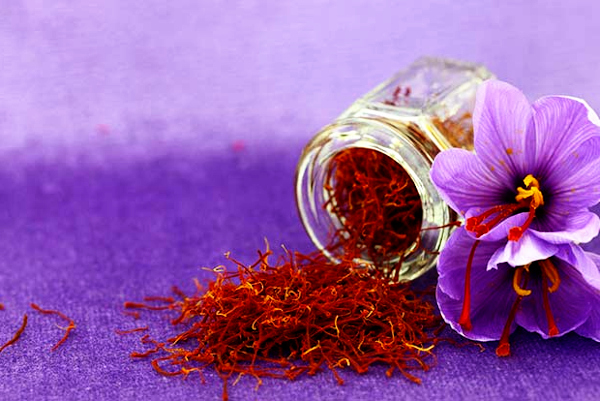
Saffron is usually introduced as the world’s most expensive spice, but Ayurveda sees the delicate crimson threads of Crocus sativus as something far more valuable than a flavouring or colouring agent. Known traditionally as Kumkuma, Keshara or Kesar, saffron has been incorporated into Ayurvedic formulations concerned with complexion, vitality, the nervous system, reproductive health and general nourishment.
The medicinal portion consists of the dried red stigmas of the purple saffron flower. Only a few stigmas are produced by each flower, which explains both the extraordinary labour involved in its cultivation and its high value. In India, saffron is particularly associated with Kashmir, where the crop has acquired an important cultural as well as medicinal identity.
Modern research has begun examining many of the same areas in which saffron acquired its traditional reputation. Its principal bioactive compounds — particularly crocin, crocetin, picrocrocin and safranal — are being investigated for effects involving oxidative stress, inflammation, mood, cognition, sleep and other physiological functions.
Ayurvedic Identity of Saffron
Sanskrit name: Kumkuma
Common names: Kesar, Keshara, Zafran, Saffron
Botanical name: Crocus sativus L.
Family: Iridaceae
Part used: Dried stigma
Ayurvedic pharmacological descriptions of Kumkuma commonly assign it Katu and Tikta Rasa — pungent and bitter tastes — together with Snigdha Guna, or a degree of unctuousness, Ushna Virya or warming potency, and Katu Vipaka or pungent post-digestive effect. It is traditionally described as particularly useful for balancing Vata and Kapha and is strongly associated with Varnya, the promotion of a healthy complexion. Classical descriptions can vary somewhat between later Nighantus and regional traditions, which is common with several ancient medicinal substances.
This Ayurvedic profile helps explain saffron’s wide traditional applications. Its warmth and aromatic quality make it very different from cooling herbs such as sandalwood. Yet it is used in minute quantities, often accompanied by milk, ghee, almonds or other nourishing substances.
Varnya — Saffron and the Ayurvedic Idea of Healthy Complexion
One of saffron’s best-known Ayurvedic associations is with Varnya, a term referring to substances that support healthy colour, clarity and lustre of the skin.
This concept is broader than modern cosmetic “fairness.” Ayurveda connects the appearance of the skin with nutrition, Rakta Dhatu, digestion, circulation and the overall condition of the body. A Varnya substance is therefore understood as supporting the natural quality and radiance of the skin rather than simply bleaching or changing its colour.
Saffron has consequently been included traditionally in facial preparations and herbal pastes, often in combination with sandalwood, milk or rose water. An Ayurvedic publication from the Government’s ESIC Ayush Division also records the traditional external use of saffron with sandalwood and rose water for skin care.
Modern laboratory research provides plausible mechanisms for some of saffron’s protective effects because crocin, crocetin and related compounds demonstrate antioxidant and anti-inflammatory activity. However, clinical evidence for claims such as treating acne, pigmentation or “brightening” the skin remains much less developed than evidence in areas such as mood. Saffron should therefore be viewed as a traditional complexion-supporting herb rather than as a scientifically proven treatment for every skin condition.
Saffron and the Mind
Perhaps the most intriguing convergence between traditional use and modern research concerns the mind and emotional wellbeing.
Saffron has traditionally appeared in preparations intended to support vitality and mental wellbeing. Modern clinical research has investigated it extensively in relation to mood, with depression being one of the better-studied areas of saffron research.
A meta-analysis of randomized clinical trials found that saffron improved depressive symptoms compared with placebo. Earlier studies also found effects comparable with certain antidepressant medicines over short study periods, although the trials were generally small and many originated from a limited number of research centres.
A broader overview of systematic reviews likewise concluded that saffron shows potential across several neuropsychological conditions, while stressing the need for larger and more rigorous trials.
Researchers have proposed several possible explanations. Crocin and safranal appear capable of influencing pathways related to oxidative stress and inflammation, while experimental evidence suggests possible interactions with neurotransmitter systems involved in mood regulation. The precise mechanisms in humans remain under investigation.
This is an important example of how saffron should be discussed responsibly. It has promising clinical evidence for supporting mood, but it should not be presented as a replacement for professional treatment for major depression or other psychiatric disorders.
May Support Better Sleep
Traditional nourishing drinks containing saffron and warm milk have long been associated with relaxation and bedtime routines in Indian households.
Modern studies provide some support for this practice. A systematic review of randomized controlled trials involving several hundred participants concluded that saffron appears capable of improving aspects of sleep duration and sleep quality, although the evidence remains relatively limited.
In one placebo-controlled study of adults experiencing poor sleep, a standardized saffron extract was associated with improvements in insomnia severity, restorative sleep and perceived sleep quality.
These findings are particularly interesting because sleep, mood and stress are closely interconnected. The calming reputation of saffron therefore has both a traditional foundation and emerging clinical support.
Saffron, Memory and Cognitive Health
Saffron has also attracted considerable scientific interest for memory and cognitive function.
A systematic review of randomized controlled trials examining cognition found preliminary evidence that oral saffron may influence cognitive performance, including in people with mild cognitive impairment or Alzheimer’s disease. However, only a small number of clinical trials were available, making it impossible to regard saffron as an established treatment for dementia.
Government Ayurvedic educational material has also noted clinical investigation of saffron in mild-to-moderate Alzheimer’s disease.
Crocin and crocetin are of particular scientific interest because oxidative stress and chronic inflammation contribute to neuronal injury. Experimental studies suggest that saffron constituents may have neuroprotective actions, but translating these mechanisms into prevention or treatment of human neurodegenerative disease requires much larger long-term trials.
For Ayurveda, however, the emerging relationship between saffron and cognitive health is noteworthy because it strengthens the broader traditional association of aromatic medicinal plants with the mind and nervous system.
Antioxidant Protection and Healthy Ageing
One of the most extensively studied biological characteristics of saffron is its antioxidant activity.
Normal metabolism produces reactive molecules commonly called free radicals. The body possesses its own antioxidant defence mechanisms, but excessive oxidative stress can damage lipids, proteins and DNA and is associated with ageing and numerous chronic diseases.
Saffron contains several carotenoid-derived compounds, especially crocin and crocetin, capable of participating in antioxidant pathways. Modern reviews describe antioxidant and anti-inflammatory activity among the most consistent pharmacological properties observed in experimental saffron research.
This does not mean that a few saffron strands can prevent ageing or cure chronic disease. Rather, it helps explain why researchers continue investigating saffron in areas ranging from metabolic health to neurological and cardiovascular function.
From an Ayurvedic perspective, this modern antioxidant language offers one possible biochemical window into saffron’s traditional association with vitality and preservation of healthy tissues.
Supports the Heart and Circulation
Traditional Ayurveda frequently links herbs with Hridya qualities to support the heart, circulation and emotional wellbeing. Saffron has long been used in aromatic nourishing preparations where these functions overlap.
Modern experimental research has identified potential cardioprotective, vascular and lipid-modulating effects of saffron and its constituents. Proposed mechanisms include antioxidant activity, modulation of inflammation and effects on vascular function.
Human evidence is not yet strong enough to recommend saffron as a treatment for cardiovascular disease, high cholesterol or hypertension. Nevertheless, the area represents another interesting correspondence between traditional medicinal reputation and emerging pharmacological investigation.
Anyone taking medication for cardiovascular disease should treat concentrated saffron supplements as medicinal products rather than ordinary culinary spice and discuss their use with a qualified clinician.
Reproductive Vitality and Vajikarana Tradition
Saffron also has a long reputation as a substance associated with vitality, reproductive wellbeing and aphrodisiac preparations.
It commonly appears with milk, ghee, almonds and other nourishing ingredients in traditional formulations intended to support strength and reproductive function.
Modern clinical research has examined these claims. A systematic review and meta-analysis involving both men and women reported statistically significant improvements in measures of sexual dysfunction, although only a small number of studies and participants were available.
Another systematic review investigating erectile function and semen parameters found encouraging evidence regarding erectile function but inconsistent results for sperm parameters. The researchers specifically cautioned that methodological limitations prevented strong conclusions regarding fertility.
This distinction is important. Evidence suggesting that saffron may support aspects of sexual function does not establish it as a treatment for infertility or guarantee improvement in sperm count.
Ayurveda similarly approaches reproductive vitality through the condition of the whole person — digestion, nourishment, sleep, mental state and the health of reproductive tissues — rather than through a single aphrodisiac ingredient.
Saffron and Eye Health
The brilliant colour of saffron arises principally from crocin, and saffron carotenoids have attracted attention in ophthalmological research.
Government Ayurvedic educational material has cited studies reporting improvement in aspects of visual function following saffron administration, particularly in research involving retinal health and age-related macular degeneration.
Experimental work has proposed antioxidant and neuroprotective effects within retinal tissues as possible mechanisms.
The research is intriguing but remains insufficient to regard saffron as a substitute for conventional treatment of macular degeneration, glaucoma, diabetic retinopathy or other eye diseases. Its role at present is better described as an area of promising nutritional and pharmacological research.
May Help the Body Respond to Inflammation
Inflammation is a normal protective response, but persistent low-grade inflammation contributes to many chronic disorders.
Crocin, crocetin and safranal have demonstrated the ability in experimental research to influence inflammatory signalling pathways. Recent reviews describe modulation of pathways such as NF-κB and Nrf2-related cellular responses among possible mechanisms underlying saffron’s biological activity.
Much of this evidence comes from laboratory and animal studies rather than large human trials. It is therefore more accurate to say that saffron contains compounds with anti-inflammatory potential than to describe it as a proven treatment for inflammatory diseases.
Kumkuma and the Ayurvedic Concept of Strength
One reason saffron is traditionally combined with milk is that the two substances perform very different roles.
Saffron is aromatic, penetrating and used in minute quantities. Milk is nourishing and substantial. Almonds, ghee and dates may add further energy and unctuousness.
Together they form the type of preparation Ayurveda often uses when the objective is not simply treating a symptom but supporting Bala — strength and resilience.
An ESIC Ayush publication records a traditional saffron-almond milk preparation for debility and reproductive vitality.
The quantity of saffron in such preparations is tiny. This is important because Ayurveda traditionally treats saffron as a potent substance rather than as something that needs to be consumed by the spoonful.
Traditional Ways of Using Saffron
One of the simplest traditional methods is to soak a few genuine saffron strands in warm milk or water until their colour and aroma diffuse into the liquid.
For nourishing preparations, saffron may be combined with milk, almonds or a small quantity of ghee. It may also occur as a minor ingredient in classical herbal formulations.
For external use, traditional preparations combine saffron with substances such as sandalwood or rose water.
The appropriate preparation depends on the individual, digestive strength, season and intended use. Ayurvedic medicine therefore does not support the modern idea that everyone should consume large quantities of a supposedly beneficial herb every day.
Quality Matters: Genuine Saffron Versus Adulteration
Saffron’s extraordinary price has made adulteration a persistent problem.
True saffron consists of the dried stigmas of Crocus sativus. Historically, cheaper materials such as safflower have been used as substitutes or adulterants. Ayurvedic literature examining substitution specifically notes the problem of Kumkuma being replaced by Kusumbha or safflower, even though their properties are not identical.
Consumers should therefore obtain saffron from reliable sources. Extremely cheap “saffron” should immediately raise questions about authenticity.
Genuine strands normally have a deep crimson-red colour, characteristic aroma and irregular trumpet-like stigma structure. Artificial colouring or substituted plant fibres cannot reproduce the complete chemical profile of authentic saffron.
Saffron Should Be Used in Small Quantities
One of the biggest mistakes with medicinal herbs is assuming that if a little is beneficial, a large quantity must be better.
That principle does not apply to saffron.
The quantities traditionally used as a culinary spice are very small, and clinical research typically uses carefully standardized preparations rather than unrestricted amounts of the raw spice.
Toxicological reviews suggest that saffron is generally well tolerated at therapeutic quantities studied clinically, but high doses can produce adverse effects. Excessive intake has raised particular concerns during pregnancy, with evidence suggesting that very high exposure may stimulate uterine activity or increase pregnancy risk.
Pregnant women should therefore not self-prescribe medicinal doses of saffron simply because traditional recipes sometimes contain a few strands. Culinary exposure and concentrated medicinal dosing are not equivalent.
People receiving regular medication, those with chronic illnesses, and anyone considering concentrated saffron extracts should similarly seek professional advice.
An Ancient Spice With Increasingly Modern Evidence
Saffron occupies an unusual position among Ayurvedic substances.
Its traditional reputation is broad, but unlike many celebrated herbal remedies, several of its proposed actions have now entered randomized human clinical research. The evidence is strongest and most consistent in areas such as mood, while promising but still developing findings exist for sleep, cognition and sexual function. Research into antioxidant, anti-inflammatory, cardiovascular, metabolic and neuroprotective actions provides plausible biological mechanisms but is not yet equivalent to proof of clinical treatment.
This distinction makes saffron particularly interesting.
Ayurveda valued Kumkuma through concepts such as its Rasa, Guna, Virya, Dosha action, Varnya quality and ability to participate in nourishing medicinal preparations. Modern science approaches the same crimson stigma through crocin, crocetin, safranal, oxidative stress, neurotransmission and inflammatory pathways.
The languages are different, but both recognise saffron as an unusually biologically active plant material.
Its value therefore lies neither in treating it as a miracle spice nor in dismissing its traditional reputation as folklore. Kumkuma represents one of the most fascinating meeting points between classical Ayurvedic knowledge and modern botanical research — a medicine measured traditionally in only a few delicate strands, yet associated with the mind, complexion, vitality, sleep and healthy ageing.
You may also like
-
Mankind Pharma to Acquire 70% Stake in Belgian CAR-T Cancer Therapy Developer for €48 Million
-
Agni and Lifestyle: Protecting the Digestive Fire Every Day Through Ayurveda
-
Ayurveda and Anxiety: Lifestyle Principles for a Calmer Mind
-
Ayurveda and Emotional Eating: Understanding How Stress, Emotions and Food Affect Digestion
-
India Records 21% Decline in Tuberculosis Incidence as National TB Elimination Efforts Progress
