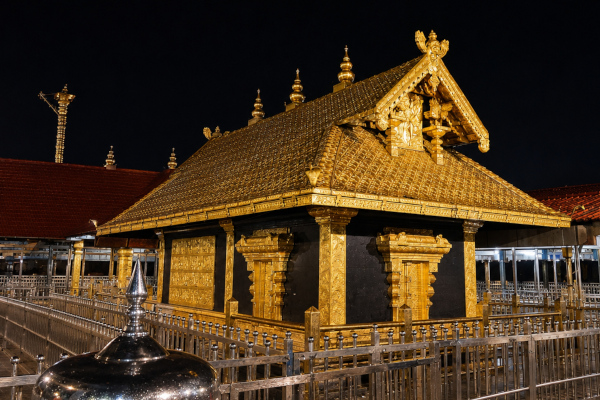
Deep inside the dense forests of the Western Ghats in Kerala’s Pathanamthitta district stands one of India’s most revered pilgrimage centres — the Sabarimala Sree Ayyappa Temple. Perched atop the Sabarimala hill at an elevation of around 1,260 metres above sea level, the temple is dedicated to Lord Ayyappa, the celibate warrior-yogi deity worshipped as “Dharmasastha,” the protector of righteousness and balance. Every year, tens of millions of devotees from across India and abroad undertake the arduous pilgrimage through forests, rivers, and steep hills to seek the blessings of the deity known affectionately as “Swamiye Saranam Ayyappa.”
Sabarimala is not merely a temple; it is a living civilisational tradition deeply intertwined with Kerala’s forest culture, ancient tribal customs, Tantric ritual systems, royal patronage, Shaiva-Vaishnava synthesis, and spiritual austerity. The pilgrimage is regarded as one of the world’s largest annual religious gatherings and is unique for its rigorous discipline, communal equality, and ancient customs that continue largely unchanged even in the modern era.
The Deity: Lord Ayyappa and the Meaning of Dharmasastha
Lord Ayyappa is traditionally believed to be the son born from the divine union of Lord Shiva and Lord Vishnu in the form of Mohini. This unique origin gives Ayyappa a rare theological position in Hinduism as a deity representing harmony between Shaivism and Vaishnavism. In Kerala traditions, Ayyappa is identified with “Sastha” or “Dharmasastha,” a guardian deity associated with justice, discipline, protection of devotees, and spiritual wisdom.
At Sabarimala, the deity is worshipped in a yogic posture known as the “Yogapattasana,” seated with a band tied around the knees, symbolising meditation, restraint, and ascetic power. Unlike many temples associated with royal grandeur or ritual opulence, Sabarimala emphasises austerity, self-control, equality, and spiritual purification.
The famous chant “Tat Tvam Asi” — “That Thou Art” — associated with Sabarimala reflects the Advaitic spiritual philosophy that divinity exists within every being.
The Legend of Manikandan
The most famous legend associated with Sabarimala revolves around the divine child Manikandan, believed to be the earthly incarnation of Lord Ayyappa. According to Kerala traditions, the child was discovered on the banks of the Pampa River by the ruler of the Pandalam royal family. The infant wore a bell (“mani”) around his neck (“kandan”), leading to the name Manikandan.
The childless king adopted him and raised him as a prince. Manikandan soon displayed extraordinary wisdom, martial skill, compassion, and supernatural abilities. However, palace politics eventually led to a conspiracy against him. The queen, manipulated by court advisors, pretended to be gravely ill, and royal physicians declared that only tigress milk could cure her. The impossible task was assigned to Manikandan.
The prince ventured into the forests, where he confronted and destroyed the demoness Mahishi, a powerful asura who had terrorised gods and sages. After defeating Mahishi, Manikandan returned triumphantly riding a tigress, accompanied by a herd of wild tigers carrying the milk. Realising his divine nature, the king and queen begged forgiveness.
Manikandan then revealed his identity as Lord Ayyappa and instructed the king to build a temple at the sacred hill of Sabarimala where an arrow he shot would land. The shrine was subsequently established on the hilltop amidst the forests.
Connection with the Pandalam Royal Family
The Pandalam Royal Family occupies a central place in Sabarimala traditions. The royal family is considered the foster family of Lord Ayyappa and continues to hold ceremonial importance in temple rituals.
One of the most important rituals associated with the family is the annual “Thiruvabharanam” procession. Sacred ornaments believed to belong to Lord Ayyappa are ceremonially carried from the Pandalam Palace to Sabarimala before the Makara Vilakku festival. Thousands gather along the route to witness the procession, which is accompanied by intense devotional fervour.
The relationship between the temple and the Pandalam royal lineage is among the strongest surviving examples of Kerala’s temple-royal ritual traditions.
The Forests, Tribes and Ancient Traditions
Sabarimala’s origins are believed to be deeply connected with ancient forest worship traditions and tribal cultures of the Western Ghats. Scholars and historians often note that the shrine likely evolved through the blending of tribal guardian-deity worship, Buddhist influences, local Sastha traditions, and mainstream Hindu theology over centuries.
Several local communities historically participated in maintaining pilgrimage paths, forest routes, and ritual practices connected to the temple. Even today, the pilgrimage retains strong echoes of ancient forest asceticism — barefoot walking, black or blue clothing, abstinence, simplicity, and carrying offerings through difficult terrain.
The temple’s remote hilltop location amidst dense forests contributes significantly to its mystical aura.
The 41-Day Vratham
One of the most unique aspects of the Sabarimala pilgrimage is the mandatory 41-day “Vratham” or austerity period observed before the journey. Devotees abstain from meat, alcohol, smoking, anger, sexual activity, and material indulgence. They wear black, blue, or saffron clothing and live a disciplined spiritual life focused on prayer and simplicity.
During this period, all devotees address one another as “Swami,” symbolising spiritual equality. Social hierarchy, caste distinctions, wealth, and status are traditionally considered irrelevant during the pilgrimage. This emphasis on equality and discipline has long been regarded as one of Sabarimala’s defining spiritual characteristics.
The Sacred Journey Through Pampa
The pilgrimage traditionally begins at the banks of the sacred Pampa River, often referred to as the “Dakshina Ganga” or Ganges of the South. Pilgrims bathe in the river before beginning the uphill trek through the forests toward Sabarimala.
Historically, devotees undertook long forest routes through Erumeli and other hill paths, chanting “Swamiye Saranam Ayyappa.” Though modern infrastructure has improved accessibility, many pilgrims still undertake traditional trekking routes as acts of devotion and penance.
The Sacred 18 Steps — Pathinettampadi
The golden eighteen sacred steps known as “Pathinettampadi” are among the most spiritually significant features of the temple. Only devotees carrying the sacred “Irumudi Kettu” — a twin-compartment pilgrimage bundle — are traditionally permitted to climb these steps.
Different traditions interpret the 18 steps differently:
- the five senses,
- eight human emotions,
- three gunas,
- knowledge and ignorance,
- or stages toward spiritual liberation.
The steps symbolise the gradual transcendence of worldly limitations before reaching the divine.
Makara Vilakku and Makarajyothi
The annual Makara Vilakku festival held during January is the most important event associated with Sabarimala. Millions of pilgrims gather to witness the ceremonial rituals and the appearance of the sacred “Makarajyothi,” a celestial light associated with the festival traditions.
The festival coincides with the arrival of the Thiruvabharanam procession from Pandalam and marks the climax of the pilgrimage season.
The spiritual atmosphere during Makara Vilakku is considered one of the most intense devotional gatherings in India.
Architecture of the Temple
The temple follows the traditional Kerala style of temple architecture adapted to mountainous terrain. The sanctum sanctorum is relatively modest in size compared to many major South Indian temples, but its spiritual significance is immense.
Copper-plated roofs, wooden structures, stone pathways, oil lamps, and forest surroundings create an atmosphere of sacred austerity. The architecture prioritises ritual functionality and harmony with nature rather than monumental scale.
Several subsidiary shrines dedicated to Malikappurathamma, Vavar Swami, Ganapathy, and Nagaraja also exist within the temple complex.
History and Reconstruction
Historical records suggest that the temple existed for many centuries, though exact dates remain debated. The shrine is believed to have undergone periods of decline, forest reclamation, rediscovery, and reconstruction over time.
In 1950, the temple suffered a devastating fire under controversial circumstances, resulting in major damage to the idol and structures. The temple was later rebuilt and reconsecrated, after which pilgrimage numbers expanded dramatically in the decades following Kerala’s infrastructure development and improved transport networks.
Today, Sabarimala is administered by the Travancore Devaswom Board.
How to Reach Sabarimala
Sabarimala is located in Pathanamthitta district of Kerala and is accessible through multiple routes.
The nearest major base point is Pampa, from where pilgrims traditionally undertake the uphill trek to the temple. Pampa is well connected by road during pilgrimage seasons.
Nearest airports:
- Cochin International Airport — around 160 km
- Trivandrum International Airport — around 170 km
Nearest railway stations:
- Chengannur
- Kottayam
- Thiruvalla
- Pathanamthitta (road connectivity onward)
From Pampa, pilgrims usually trek approximately 5 km uphill through Neelimala and Appachimedu toward the temple complex. Special transport arrangements, virtual queue systems, and seasonal pilgrimage management systems operate during peak pilgrimage months.
The Spiritual Essence of Sabarimala
Sabarimala remains one of India’s most powerful symbols of spiritual discipline, endurance, equality, and devotion. The pilgrimage is not merely about reaching a shrine; it is a transformative spiritual journey rooted in self-restraint, humility, brotherhood, and surrender to dharma.
Amidst mist-covered forests, oil lamps, sacred chants, and the rhythmic cry of “Swamiye Saranam Ayyappa,” Sabarimala continues to preserve an ancient spiritual atmosphere rarely found elsewhere in the modern world. For millions, the journey to the hill shrine is not just a pilgrimage — it is an inner path toward discipline, simplicity, and transcendence.
You may also like
-
BRICS Theatre Festival 2026 Opens in New Delhi, Bringing Together Nine Nations to Strengthen Cultural Cooperation
-
Sauvira: The Indus Realm Linked With Jayadratha in the Mahabharata
-
Sindhu: The Indus Kingdom of Jayadratha in the Mahabharata
-
Kuninda or Kulinda: The Himalayan Realm of the Mahabharata in Uttarakhand and Himachal Pradesh
-
Durga versus Mahishasura: Weapons, Battlefield Tactics and the Triumph of Shakti
