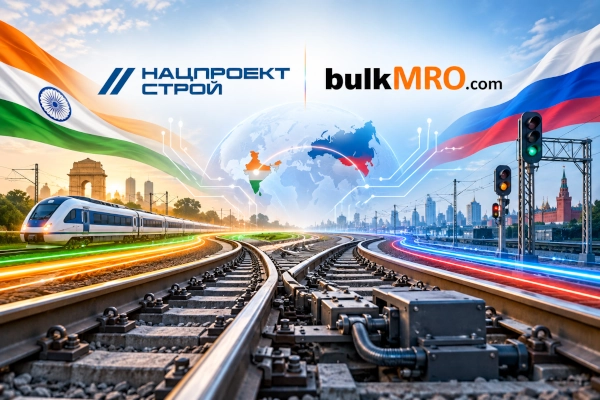
Russian infrastructure and railway technology group Natsproektstroy has taken a significant step towards establishing an industrial presence in India, signing a memorandum of understanding with Indian industrial procurement and supply-chain company Bulk MRO Industrial Supply Pvt. Ltd. to explore localisation of railway automation, signalling and telemechanics equipment.
The agreement brings a new dimension to expanding India–Russia railway cooperation. Rather than limiting the relationship to the supply of finished equipment from Russia, the two companies intend to examine local production of railway-control technologies for the Indian market, potentially creating an Indian manufacturing and supplier ecosystem around specialised Russian railway systems.
The memorandum was signed during INNOPROM.India 2026 in New Delhi by Dmitry Bolotsky, Deputy General Director for Commercial Affairs at Natsproektstroy Group, and Devang Vijay Shah, CEO and Managing Director of Bulk MRO.
Localising Railway Automation in India
Under the memorandum, Natsproektstroy and BulkMRO will work on possibilities for localising production of railway automation and telemechanics equipment in India.
Railway automation covers the systems responsible for controlling and supervising railway operations, including signalling, switching, train detection, route management and traffic control. Telemechanics allows infrastructure and railway equipment distributed across large networks to be remotely monitored and controlled.
For India, localisation could eventually extend beyond assembling imported systems. Domestic manufacture offers the possibility of adapting equipment specifically for Indian operating conditions, building local supplier networks and supporting maintenance and lifecycle requirements within the country.
The initiative is particularly relevant as Indian Railways continues to modernise signalling and traffic-management infrastructure while expanding capacity on some of the world’s busiest railway corridors.
Russian Point Machine Already Adapted for Indian Broad Gauge
Natsproektstroy has already taken an important technical step towards entering the Indian railway market.
At INNOPROM.India, the company displayed a sleeper-integrated electric point machine designed for heavily trafficked railway lines. Point machines are critical railway signalling devices that physically move and lock track switches, allowing trains to be routed safely between different tracks.
The Russian system has been specifically redesigned for India’s 1,676-mm broad-gauge railway network, demonstrating that the company is not simply proposing to transfer equipment developed for Russia’s own railway gauge.
Engineers have also adapted the equipment to operate in temperatures reaching +70°C, addressing the demanding environmental conditions encountered by railway equipment in parts of India.
Natsproektstroy says the system is expected to undergo trial operation on Indian Railways’ Northern Railway network. Successful operational testing would provide an important opportunity to evaluate the technology under actual Indian railway conditions before any wider deployment.
Platform 2.0 Brings Digital Train-Control Technology
Natsproektstroy also presented its Platform 2.0 train-control digitalisation system, another technology with potential relevance to India’s increasingly complex railway network.
Platform 2.0 is intended to integrate and digitalise railway traffic-management processes, giving operators a more unified technological environment for controlling train movements and railway infrastructure.
The platform is also being prepared for deployment on Russia’s first high-speed railway between Moscow and St Petersburg, making India an important prospective international market for technology being developed for Russia’s next generation of railway operations.
As Indian Railways moves towards higher speeds, denser traffic and greater automation, integrated digital traffic-management platforms could become increasingly important for improving network utilisation and operational reliability.
AI-Based RAIL TMS for Network Management
Another system displayed in New Delhi was RAIL TMS, Natsproektstroy’s intelligent railway network-management platform.
The system incorporates neural-network technology to assist railway traffic management. Such platforms can analyse network conditions and support dispatching decisions across complex railway systems where train movements, infrastructure availability and operating constraints must continuously be coordinated.
Digital traffic-management systems are particularly relevant to India because capacity expansion increasingly depends not only on building additional tracks but also on extracting more efficiency from existing infrastructure.
Automation capable of improving traffic sequencing, identifying conflicts and assisting dispatchers could therefore complement India’s major investments in dedicated freight corridors, station redevelopment, line doubling, electrification and higher-speed passenger services.
Computer-Based Axle Counting for Track Occupancy
Natsproektstroy also showcased a computer-based axle-counting system intended to establish whether sections of railway track are occupied or clear.
Axle counters detect trains entering and leaving defined railway sections by counting their axles. Once the number leaving a section matches the number that entered, signalling systems can determine that the track section is clear.
The technology provides an important alternative or complement to conventional track circuits and is particularly useful across complicated railway layouts where reliable detection of train occupancy is essential to signalling safety.
The Russian system presented at INNOPROM.India is designed to operate across complex track configurations, adding another potential component to a broader localisation package covering several layers of railway signalling infrastructure.
Talks With Indian Railways
Natsproektstroy’s engagement in India went beyond its agreement with BulkMRO.
Company representatives held discussions with officials from the Ministry of Railways during INNOPROM.India. According to Natsproektstroy, the discussions examined steps that could expand the use of Russian-developed train-traffic-management technologies on Indian railway lines.
The company also met representatives of Avadh Rail Infra Ltd., an Indian manufacturer and engineering company serving railway infrastructure and rolling-stock requirements.
These engagements suggest that Natsproektstroy is pursuing a broader India strategy encompassing regulatory engagement, operational trials, industrial partnerships and eventual localisation rather than relying solely on exports from Russia.
Piyush Goyal and Russian Industry Minister Visit Natsproektstroy Display
The company’s railway technologies also received attention during a joint visit to its INNOPROM.India pavilion by Union Commerce and Industry Minister Piyush Goyal and Russian Minister of Industry and Trade Anton Alikhanov.
The ministers were shown the Russian signalling technologies being proposed for India, including the sleeper-integrated electric point machine adapted to Indian gauge and climatic conditions.
The interaction placed the company’s commercial initiative within the broader framework of expanding India–Russia industrial cooperation, which increasingly includes advanced manufacturing and technology localisation alongside the two countries’ traditional cooperation in energy and defence.
Railway Signalling Emerging as New India–Russia Cooperation Area
The Natsproektstroy development also follows broader government-to-government discussions on railway technology.
During the 12th Session of the India–Russia Working Group on Modernization and Industrial Cooperation in New Delhi on 7 August 2026, both countries specifically welcomed new areas of cooperation involving railway infrastructure, the Vande Bharat project and signalling equipment.
The working group sits under the India–Russia Intergovernmental Commission on Trade, Economic, Scientific, Technological and Cultural Cooperation and has increasingly focused on industrial partnerships capable of producing tangible manufacturing projects.
Railway signalling therefore appears to be emerging as a distinct new component of the bilateral industrial relationship.
BulkMRO Could Provide the Indian Industrial Interface
BulkMRO’s involvement gives the project an important Indian industrial dimension.
The company operates across industrial procurement, supply-chain management, sourcing and project requirements, positioning it to help connect overseas technology providers with Indian manufacturers, engineering companies and component suppliers.
For specialised railway equipment, such an industrial interface can be particularly important. Local manufacture requires not merely factory space but qualified suppliers, material sourcing, certification, quality-control systems, logistics and long-term maintenance arrangements.
A successful localisation programme could therefore progressively transfer a greater proportion of manufacturing and lifecycle support to India while adapting systems specifically for Indian Railways.
From Imported Equipment to Localised Railway Technology
The most significant aspect of the Natsproektstroy–BulkMRO agreement is its emphasis on localisation rather than straightforward imports.
Russian railway engineering has accumulated extensive experience across long-distance networks, heavy freight operations and extreme climatic conditions. India, meanwhile, possesses one of the world’s largest railway networks alongside an increasingly capable railway manufacturing ecosystem.
Combining specialised Russian signalling technology with Indian manufacturing capacity could create systems tailored from the outset to Indian gauge, climatic conditions and operating requirements.
The adaptation of the sleeper-mounted point machine to 1,676-mm broad gauge and temperatures of up to +70°C demonstrates that this process has already moved beyond a generic export proposal.
A Wider Shift in India–Russia Industrial Relations
The agreement also illustrates the continuing diversification of India–Russia economic ties.
For decades, the relationship was dominated internationally by defence equipment, nuclear energy and hydrocarbons. Current bilateral industrial engagement increasingly includes railway equipment, civil aviation, critical minerals, advanced materials, digital technologies, artificial intelligence, industrial machinery and local manufacturing.
The Natsproektstroy–BulkMRO initiative fits directly into this transition. It connects Russian engineering capability with India’s expanding manufacturing base and one of the country’s largest infrastructure-modernisation programmes.
The immediate next stage will depend on technical trials, commercial negotiations, certification and the precise structure of any localisation programme. Nevertheless, the partnership establishes a pathway through which Russian railway signalling and train-control technologies could eventually be manufactured, adapted and supported within India.
For Indian Railways, such cooperation broadens the pool of advanced technologies available for network modernisation while retaining the possibility of domestic production. For Russia, India offers both the scale of one of the world’s largest rail systems and an industrial base capable of supporting localisation.
The result could develop into another important strand of the India–Russia industrial partnership, with railway signalling joining rolling stock and infrastructure as an area in which the two countries move from conventional buyer-seller relationships towards technology adaptation and manufacturing cooperation in India.
References
- Natsproektstroy Group — Natsproektstroy and Indian BULK MRO Sign Cooperation Memorandum, 10 September 2026.
- Natsproektstroy Group — Natsproektstroy Group at the INNOPROM.India Exhibition, 9 September 2026.
- 1520 Signal — Natsproektstroy and India’s BULK MRO Plan Cooperation in Railway Signaling Manufacturing, September 2026.
- 1520 Signal — INNOPROM.India Industrial Exhibition Concludes in New Delhi, 11 September 2026.
- Press Information Bureau, Government of India — 12th Session of India-Russia Working Group on Modernization & Industrial Cooperation Held in New Delhi, 7 August 2026.
You may also like
-
India and Russia Explore Joint Icebreaker Construction as Maritime Industrial Cooperation Expands
-
Safran Signs 18 Agreements with Indian Aerospace Suppliers, Expanding Make in India Manufacturing Partnerships
-
India to Seek 35% Increase in Defence Modernisation Budget for FY 2027–28
-
DRDO Develops Indigenous STANAG Level 6 Armour, Opens Technology to Indian Industry
-
Embraer to Acquire 51% Stake in Mahindra’s Novavayu Aerospace as India-Brazil Defence Partnership Expands
