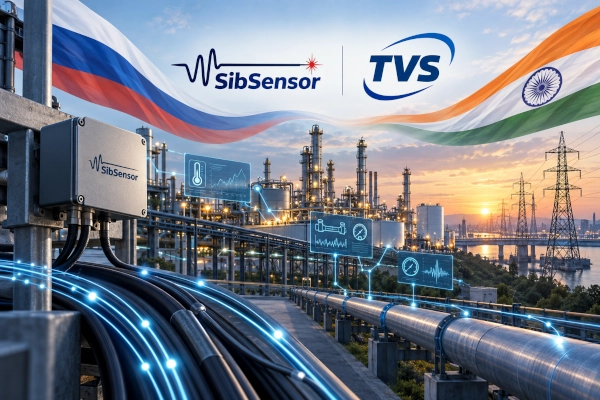
Russian industrial technology company SibSensor has signed a cooperation agreement with India’s TVS Group, creating a new India–Russia industrial link in the field of fibre-optic sensing, infrastructure monitoring and advanced industrial diagnostics.
The agreement was concluded during INNOPROM.India 2026 in New Delhi, where Russian companies engaged with Indian partners across manufacturing, engineering, transport, energy, electronics and industrial technology. SibSensor was among the companies that formalised agreements during the event under a Russian Export Center-led business mission.
The public announcement identifies TVS Group as SibSensor’s Indian partner, although the detailed commercial structure of the agreement has not yet been disclosed. The significance of the development lies in the technological capabilities SibSensor brings into the Indian market and the industrial depth available within the wider TVS ecosystem.
SibSensor Brings Fibre-Optic Industrial Monitoring Technology
SibSensor is based in Novosibirsk and specialises in distributed fibre-optic monitoring systems for industrial and infrastructure applications. The company has operated since 2009 and develops both hardware and software for continuous monitoring across sectors such as oil and gas, electricity, industrial safety and fire detection.
Its technology uses optical fibre as a sensing medium across long distances. Instead of relying only on individual sensors installed at fixed points, distributed fibre-optic systems can monitor changes along extended sections of pipelines, power cables, industrial facilities and other critical assets.
This approach allows operators to identify abnormal temperature changes, developing faults, leaks or other unusual conditions across infrastructure that may extend over many kilometres.
More Than 500 Systems Deployed
SibSensor states that it has deployed more than 500 systems across different industrial applications. Its experience includes more than 200 oil and gas well monitoring systems, over 50 installations for power-cable monitoring and more than 80 fire-detection systems.
The company’s published project portfolio includes industrial monitoring associated with major Russian energy operators and infrastructure projects. These deployments cover environments where continuous surveillance is important because failures can disrupt operations, damage equipment or create environmental and safety risks.
This operational background gives SibSensor a portfolio rooted in large-scale industrial use rather than laboratory development alone.
Distributed Temperature Sensing Forms a Core Technology
One of SibSensor’s principal areas of work is Distributed Temperature Sensing, or DTS.
DTS systems measure temperature continuously along an optical fibre rather than at isolated points. This produces a detailed temperature profile across the full length of the monitored asset.
For power infrastructure, this technology helps identify localised heating along cables. In oil and gas installations, changes in temperature patterns can support leak detection and well monitoring. In industrial facilities, distributed temperature sensing can also strengthen fire detection and thermal surveillance.
SibSensor’s E5 distributed fibre-optic temperature-monitoring system forms part of this product range, alongside specialised systems for energy and industrial applications.
Designed for Demanding Industrial Environments
Fibre-optic sensing is particularly suited to industrial locations affected by electromagnetic interference, difficult physical access and harsh operating conditions.
Optical fibre does not rely on conventional electrical sensing along the entire monitored route, giving it advantages in environments where electrical interference complicates ordinary instrumentation.
The technology also reduces the need to install large numbers of individual sensing devices along pipelines, cables or industrial corridors. A single fibre line can provide continuous monitoring over a large distance while feeding data back to a central analysis system.
These characteristics make distributed fibre-optic systems relevant to large energy networks, refineries, tunnels, power installations, warehouses and industrial plants.
Strong Relevance to India’s Infrastructure Expansion
India’s expanding infrastructure base creates a natural market for this class of technology.
The country is investing heavily in electricity transmission, renewable-energy integration, oil and gas pipelines, refining, petrochemicals, transport infrastructure, data centres and industrial manufacturing. These sectors depend increasingly on continuous asset monitoring and predictive maintenance.
Power transmission is one of the most relevant applications. High-capacity cables operate under varying electrical loads and thermal conditions, and continuous temperature monitoring can help identify stress before it develops into a more serious fault.
Oil and gas infrastructure presents another major area of relevance. Long-distance pipelines, storage facilities, refineries and processing plants require monitoring systems capable of detecting leaks, abnormal temperature patterns and changes in operating conditions over large areas.
TVS Brings an Established Indian Industrial Base
The TVS connection gives the agreement greater weight.
The wider TVS industrial ecosystem has extensive capabilities in manufacturing, electronics, sensors, automotive components and engineering products. This provides SibSensor with access to an Indian partner that already operates across multiple industrial sectors and has established relationships with domestic customers and manufacturers.
Within this ecosystem, TVS Sensing Solutions Private Limited works in areas including sensor assemblies, switches, solenoids, electronic components and industrial digital solutions.
The company also has experience in fibre-optic sensing applications, creating a direct technological overlap with SibSensor’s core business.
The Russian Export Center announcement, however, refers to cooperation with the broader TVS Group of companies and does not publicly identify the exact TVS entity that signed the agreement. That distinction remains important until further details are issued.
Fibre-Optic Sensing Has Major Applications in Power Infrastructure
India’s electricity sector stands out as one of the most important areas for distributed fibre-optic monitoring.
The rapid expansion of transmission networks, renewable-energy corridors and high-capacity power infrastructure places growing emphasis on asset health and system reliability.
Fibre-optic temperature monitoring can continuously track thermal conditions along power cables and identify locations where abnormal heating is developing. This allows operators to focus inspection and maintenance on areas showing measurable stress rather than relying only on fixed maintenance schedules.
Such systems also support broader efforts to digitise grid management and improve predictive maintenance across the power sector.
Oil, Gas and Refining Offer Another Major Application
India operates an extensive and expanding network of crude-oil pipelines, petroleum-product pipelines, natural-gas infrastructure and refining complexes.
These systems extend across long distances and often pass through areas that are difficult to inspect continuously using conventional methods.
Distributed fibre-optic monitoring allows operators to observe temperature changes and other signals along the route of the infrastructure. This supports early detection of abnormal operating conditions and improves situational awareness across critical assets.
SibSensor’s previous work in oil wells, pipelines, refineries and LNG infrastructure gives the company experience directly relevant to these applications.
Fire Detection Across Large Facilities
Distributed fibre-optic sensing also has an important role in industrial fire detection.
Large warehouses, tunnels, cable galleries, industrial corridors and infrastructure facilities can be difficult to monitor using only conventional point detectors.
Fibre-optic systems provide continuous thermal monitoring across long distances and can identify the approximate location of abnormal heating.
This makes them particularly useful in facilities where early detection is critical and where smoke detectors or individual temperature sensors may not provide sufficient coverage.
SibSensor Is Building a Wider India Presence
SibSensor’s engagement at INNOPROM.India was not limited to the TVS agreement.
The company also held discussions with Indian power and infrastructure players, including Sharika Enterprises, around advanced sensing, automation and industrial monitoring.
This wider engagement shows that SibSensor is actively positioning its technology for the Indian market across more than one industrial segment.
The TVS agreement therefore forms part of a broader India-focused commercial effort rather than an isolated meeting.
India–Russia Industrial Ties Are Broadening Beyond Traditional Sectors
The SibSensor–TVS agreement reflects a wider shift in India–Russia economic relations.
For decades, the bilateral relationship was dominated internationally by defence, nuclear energy and hydrocarbons. Recent industrial engagement has broadened into transport systems, digital technology, advanced materials, artificial intelligence, industrial machinery, sensors and manufacturing partnerships.
INNOPROM.India has become one of the platforms through which this diversification is taking place.
SibSensor represents a specialised segment of that shift, combining photonics, industrial sensing, software and infrastructure monitoring in a single technology portfolio.
A New Technology Link Between Russian Engineering and Indian Industry
The agreement connects a Russian company with established experience in distributed fibre-optic monitoring to one of India’s best-known industrial groups.
SibSensor brings experience in energy, pipeline, power-cable and fire-monitoring systems. The TVS ecosystem brings manufacturing depth, sensor expertise and access to major Indian industrial sectors.
The cooperation places fibre-optic industrial monitoring among the newer technology areas entering the India–Russia commercial relationship.
As India continues to expand large-scale infrastructure, technologies that improve asset monitoring, fault detection and predictive maintenance are becoming increasingly important. The SibSensor–TVS agreement places both companies within that growing market and adds another specialised industrial technology link to the broader India–Russia partnership.
References
- Russian Export Center / INNOPROM.India 2026 reporting — confirmation of the SibSensor agreement with TVS Group.
- SibSensor — Official company information and fibre-optic monitoring portfolio.
- TVS Sensing Solutions — Official company profile and sensing technology capabilities.
- INNOPROM.India 2026 — industrial cooperation and business mission reporting.
You may also like
-
India’s Economic Warfare Challenge: Strategic Autonomy, Energy Security and the Rise of a Global Power
-
India-US Trade Deal Stalemate: Why Washington’s Tariff Pressure Has Failed to Secure an Agreement
-
US Double Standards in Foreign Policy: 16 Recent Cases Involving India, Russia, China and Global Trade
-
India’s Arctic Energy Ambitions: Russian Oil, LNG and a New Sea Route to Indian Ports
-
India and Russia Explore Joint Icebreaker Construction as Maritime Industrial Cooperation Expands
